What is B2B Sales? A Complete Guide in 2026
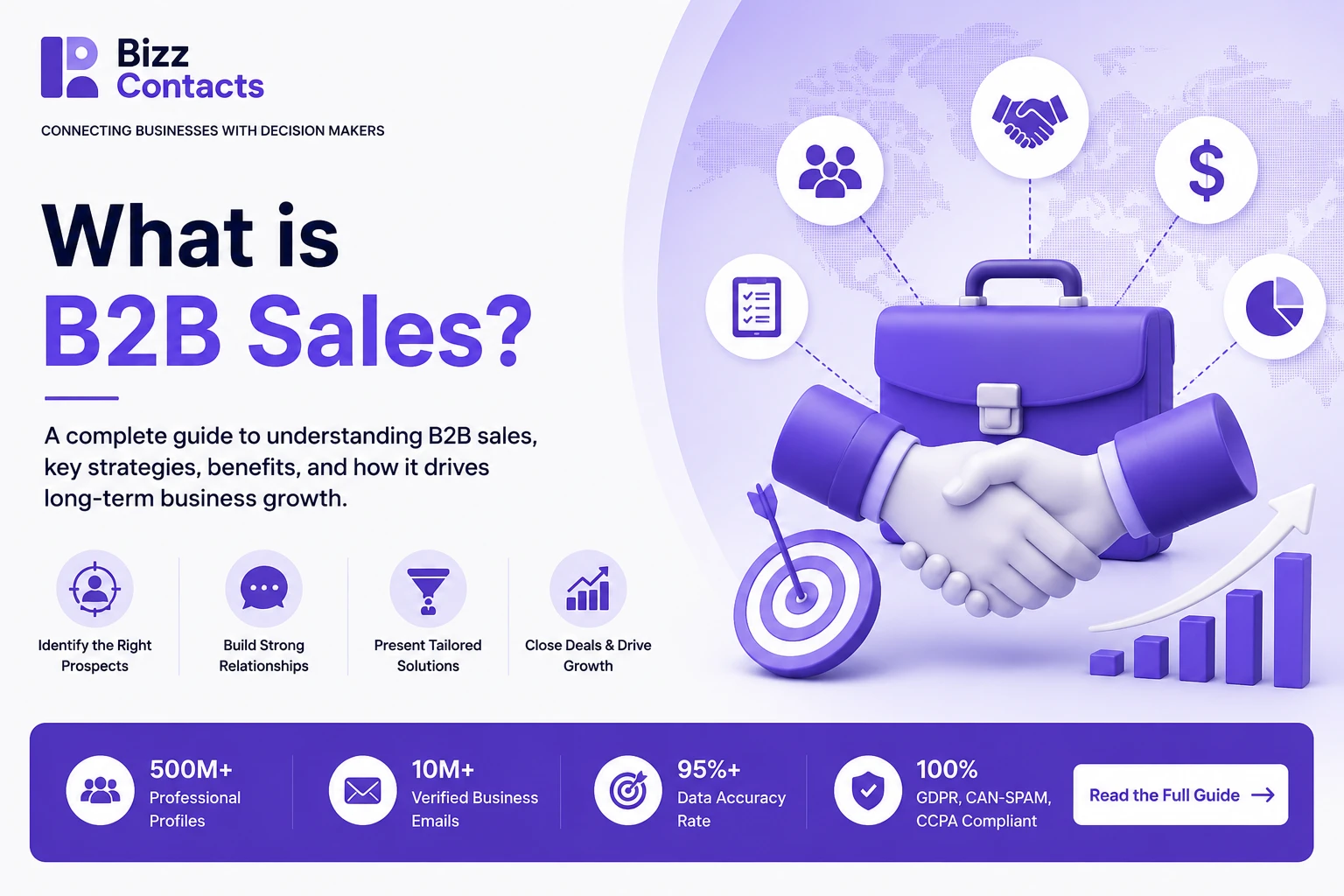
A complete guide to B2B sales in 2026: the definition, how it differs from B2C, the 7-step sales process, the types of B2B sales, the skills that matter, lead generation channels, strategies, challenges, and real examples.

B2B sales is the process of selling products or services from one business to another business. It usually runs on longer sales cycles, involves multiple decision-makers, and leans heavily on ROI, trust, and long-term value rather than a single person's impulse.
When most people think about sales, they picture a brand selling directly to a customer, but that is only part of the picture. A huge share of the global economy runs on B2B sales: companies selling their products or services to other companies. It plays a direct role in how a company grows and functions.
B2B sales is happening around us constantly, even when it is not obvious. The software tools a team runs on and the raw materials supplied to manufacturers are both B2B sales in action. In a fast-moving 2026 market, with new technology, growing competition, and shifting buyer behavior, understanding B2B sales is not optional. It is essential.
This guide covers what B2B sales means, how the B2B sales process works, how it differs from B2C sales, and the strategies businesses are using to improve sales performance in 2026.
What Is B2B Sales?
B2B sales, short for business-to-business sales, is the process of selling a company's products or services to another company. The process is not quick or spontaneous the way a B2C purchase can be, where one individual makes the call. It requires logical clarity and, in most cases, approval from multiple decision-makers before anything closes.
Consider a company selling email marketing software. That product is not sold to an individual sending personal emails. It is sold to businesses that need their messaging reaching a target audience more effectively and efficiently, and the buying decision reflects that.
B2B sales also tends to carry higher stakes, because businesses only invest in something they expect to deliver measurable results. That is exactly why trust, credibility, and clear communication matter so much more in a B2B deal than in a typical consumer purchase.
Why B2B Sales Is Important
B2B sales acts as the backbone of modern business operations. Most companies rely on other businesses for software tools, logistics, or consulting, a mutually beneficial relationship that keeps the broader economy functioning. Companies grow more efficiently because they are not building everything from scratch. They rely on specialized providers for the pieces that are not their core strength.
B2B sales is also more stable than B2C sales in most cases, because it runs on long-term relationships rather than one-time consumer purchases. That stability creates more predictable revenue. It also makes a business more scalable: instead of building every capability internally with limited headcount, it is faster and cheaper to outsource specific needs to companies that specialize in exactly that, freeing the team to focus on what it does best.
B2B sales has a strong collaborative side to it as well. Companies are not just buying a product or service, they are effectively entering a partnership. Those partnerships evolve over time and give both sides long-term growth and better functionality than either would get alone.
B2B Sales vs B2C Sales
B2B and B2C sales share the same basic goal, a completed sale, but they operate very differently. B2C sales happens directly between a company and individual consumers, where the buying decision can happen quickly because something looks good or is trending. Emotion plays a major role.
B2B sales runs on logic and structure instead. Businesses weigh cost, return on investment, long-term benefit, and overall impact far more heavily than how a purchase feels in the moment. A company only buys when it is convinced the purchase is genuinely necessary and beneficial across the board, which is why a decision that takes minutes in B2C can take weeks or months in B2B. The sales cycle reflects that difference too: B2C can close within minutes, while B2B takes longer because the decision sits with multiple stakeholders, not one person. Communication style shifts along with it. B2C leans on emotionally driven storytelling, while B2B communication centers on value, efficiency, and results.
| Area | B2B Sales | B2C Sales |
|---|---|---|
| Buyer | Another business | Individual consumer |
| Sales cycle | Longer and more consultative | Usually shorter and faster |
| Decision basis | ROI, efficiency, and business value | Need, desire, convenience, or emotion |
How the B2B Sales Process Works
The B2B sales process is a sequence of steps companies use to turn possible leads into actual customers. It maps closely to the B2B sales funnel, which views the same journey from the buyer's side. The exact process varies by company, but it typically runs through seven stages.
1. Lead Generation
The initial stage, where companies identify possible customers through marketing efforts, networking, or word-of-mouth referrals. This is the stage our own B2B lead generation guide covers in depth.
2. Lead Qualification
Not every lead is worth pursuing. Companies assess whether a potential customer has the budget, a genuine need, and the decision-making authority to move forward, the core of what B2B prospecting is built around.
3. Initial Contact or Meeting
This stage is about getting in touch with the potential client and building a real understanding of what they need.
4. Product Demonstration or Presentation
The company shows, concretely, how its product or service solves the customer's specific problem.
5. Proposal and Negotiation
A detailed proposal goes out, and both sides work through price, terms, and conditions until they land somewhere that works for both parties.
6. Closing the Deal
Once both sides have settled every term, the agreement is finalized and the deal officially closes.
7. Post-Sale Relationship Management
The stage that gets skipped most often, and the one that matters most over time. A strong post-sale relationship drives repeat business and referrals long after the first contract is signed.
Every stage demands real planning and precise execution. Skipping steps or rushing the process to move faster tends to cost more opportunities than it saves.
Types of B2B Sales
- Product-based B2B sales: physical goods sold from one company to another, such as equipment, parts, or office supplies
- Service-based B2B sales: SEO, digital marketing, legal services, accounting, consulting, and other business services
- SaaS B2B sales: software tools sold to businesses, such as CRM, analytics, email marketing, or HR platforms
- Wholesale and distribution sales: products sold in bulk to resellers or retailers
- Enterprise sales: bigger companies, longer sales cycles, more approvals, and higher-value contracts
Key Skills Needed in B2B Sales
Succeeding in B2B sales takes a specific set of skills, most of which have little to do with talking a lot:
- Communication and active listening
- Deep product knowledge
- Research ability
- Relationship-building
- Negotiation
- Follow-up discipline
Great B2B salespeople do not just talk well. They understand the buyer's business, ask better questions, and connect their solution to real business outcomes instead of generic features.
How to Do B2B Sales Successfully
Doing B2B sales well starts with understanding that it is not just about selling. The first and most important step is figuring out the target audience: which industries actually need your product or service.
From there, the work is research. Before reaching out to potential clients, understand their challenges, their goals, and the market they operate in. Good B2B sales communication starts by understanding the problem, then addresses a solution, not the other way around.
B2B sales is not just selling products, it is building a partnership, and that requires earning trust. B2B purchases involve larger amounts of investment, so the client needs real confidence in the provider, which means the focus has to stay on solving the problem and communicating clearly rather than pushing the sale itself.
Take a company providing SEO services as an example. Instead of simply saying "we provide SEO services," a solution-oriented pitch explains specifically how the service increases website traffic or improves conversion rate. Specificity is what makes the pitch land.
Consistency closes the gap between a good pitch and a long-term partnership. Following up with clients regularly, keeping them informed about what is happening behind the scenes, and staying in touch at the right cadence often makes the difference between closing a deal and losing it. B2B sales comes down to finding the right companies and building real relationships with them, and that takes consistent, ongoing contact, not a single great pitch.
How Businesses Generate Leads in B2B Sales
Lead generation plays a central role in B2B sales. Without leads there is no conversion, and without conversion there is no sales. Businesses lean on a handful of channels to keep the pipeline full.
Content marketing is one of the most effective and organic methods available. Writing blogs, guides, and video content attracts clients and generates leads without paid spend behind every touch.
Social media, LinkedIn especially, is just as powerful. It lets businesses connect and build relationships directly with the decision-makers at potential client companies, and reps who prospect heavily on the platform often lean on tools like the BizzContacts Chrome extension to reveal verified emails and direct dials on any profile without leaving the page.
Email marketing lets businesses send personalized messages that reach potential clients and nurture them through the sales process, but only when the underlying list is accurate. A verified B2B contact database keeps bounce rates low and protects the sender reputation the whole program depends on.
Networking events like webinars and industry conferences are effective platforms for direct interaction with potential clients. Across every channel, the focus should stay on quality over quantity: a small number of well-qualified leads consistently outperforms a large pile of unqualified ones.
B2B Sales Strategies for 2026
In 2026, B2B sales is no longer about sending the same message to a large list of prospects. It is about reaching the right companies with the right message at the right time. Buyers expect relevance, clear value, and proof that a solution solves a real business problem, which means combining personalization, data, technology, and strong relationship-building across the entire sales process.
- Use personalized outreach to make communication more relevant and engaging
- Target high-value accounts instead of focusing only on volume
- Leverage LinkedIn and social selling to connect with decision-makers
- Highlight ROI and business value rather than just product features
- Use AI and automation to save time and improve efficiency
- Align sales and marketing teams to improve lead quality and conversions
- Follow up consistently with useful and timely communication
- Track performance data to refine strategy and improve results
- Create educational content that builds trust and supports buyers
- Focus on long-term relationships to increase retention and repeat business
This approach helps businesses build a stronger pipeline, improve conversions, and create more sustainable growth in a highly competitive B2B market. Most of it depends on accurate underlying data, which is worth understanding on its own: see the guide on what B2B data actually is for how verified data feeds every strategy on this list.
Common Challenges in B2B Sales
B2B sales teams run into the same friction points again and again:
- Long sales cycles
- Difficulty reaching the actual decision-makers
- Intense competition
- Trust barriers with new prospects
- Poor lead quality
- Inconsistent follow-up
Understanding these challenges up front is what lets a business build stronger systems and better sales strategies around them, instead of being surprised by the same problems deal after deal.
How to Improve B2B Sales Performance
B2B sales performance needs continuous work, not a one-time fix. A few levers move the needle more than the rest.
- Analyze performance data continuously to see what is working and what isn't, and make decisions based on that instead of a hunch
- Invest in a well-trained sales team; effective communication from reps improves sales outcomes directly
- Improve the customer experience; an easy, smooth buying process lifts conversion numbers
- Prioritize follow-ups; a single well-timed follow-up can be the difference in whether a deal closes
- Stay ahead of industry trends to keep a competitive edge as the market shifts
Examples of B2B Sales
B2B sales happens across nearly every industry. A few common examples:
- A SaaS company selling software to businesses
- A digital marketing agency offering services to brands
- A manufacturer supplying goods to retailers
- A wholesaler distributing products to stores
- A logistics company providing delivery services to e-commerce businesses
Every one of these examples shows how businesses depend on each other, and how central that dependency is to proper growth and function across the economy.
Conclusion
B2B sales is not just buying and selling products or a transaction between businesses. It is about building trust and a relationship with another business by giving them a product or service that genuinely solves a problem they are facing, and that relationship is built to last, carrying real long-term value.
Heading further into 2026, the B2B sales landscape keeps getting more competitive and more customer-focused. The businesses that understand their clients, their needs, build real trust, and adapt to new industry standards hold a clear advantage over the ones still pushing a generic pitch.
At its core, B2B sales is not about pushing a product or service on a client. It is about understanding them, their needs, and their challenges, and providing a solution that actually helps the business succeed. Ready to put verified data behind your next B2B sales push? Get a free sample from the BizzContacts B2B email list, or go straight to the executive email list to reach the decision-makers your sales team is targeting.
Frequently Asked Questions
Calvin Christopher is the Marketing & Sales Manager at BizzContacts, specializing in B2B marketing, lead generation, sales intelligence, and verified business contact data.