Fortune 500 Companies That Use SAP: The Complete 2026 Guide
A complete 2026 guide to the Fortune 500 companies that use SAP. Includes a 50-row named customer table, industry breakdowns for manufacturing, retail, energy, automotive, healthcare, tech, logistics, and finance, plus a full comparison to Oracle ERP, Microsoft Dynamics, and Workday, and 15 in-depth FAQs.

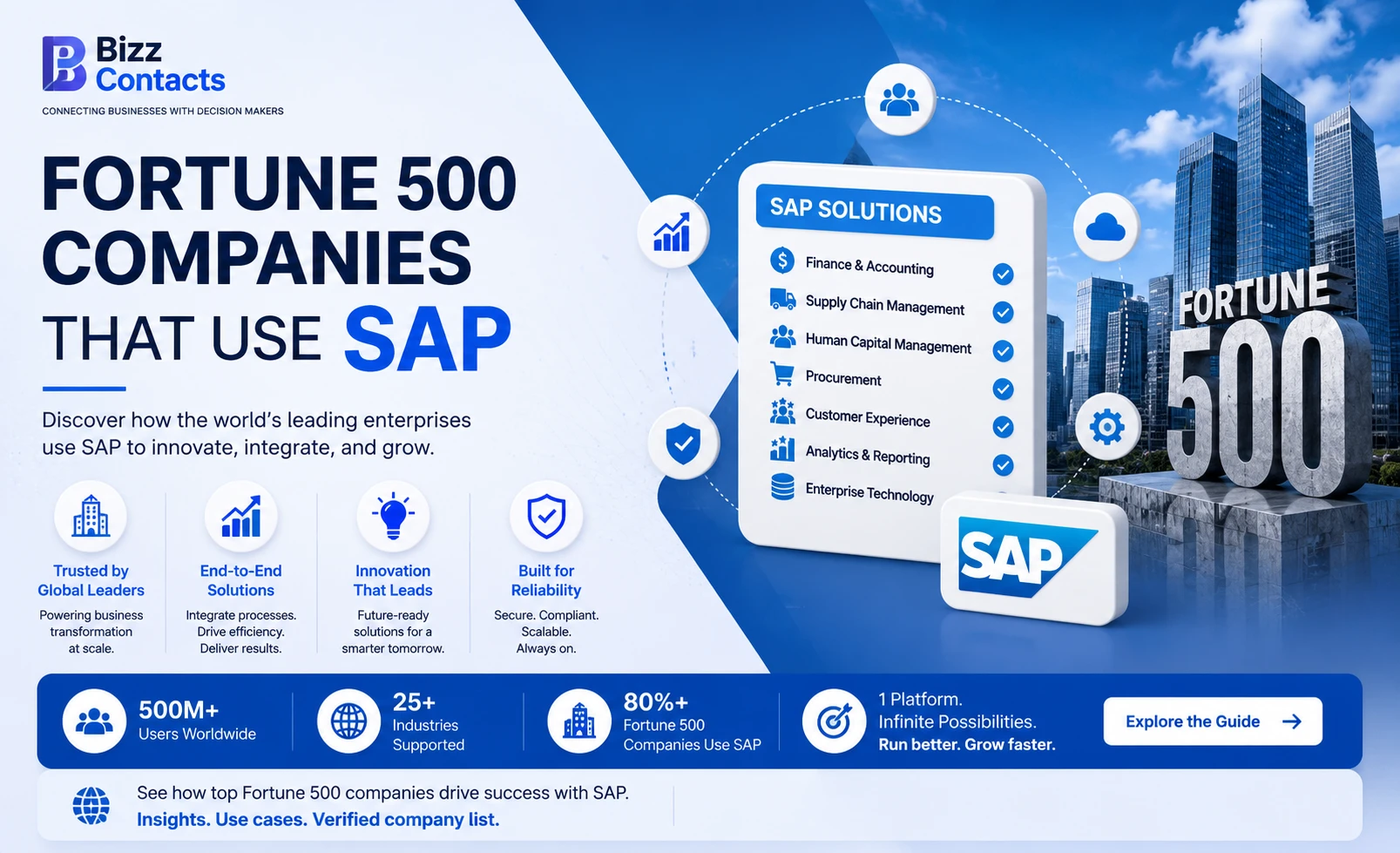
SAP is the single most-used enterprise resource planning (ERP) platform inside the Fortune 500. Look at any list of the largest US and global companies and the majority of them run SAP somewhere in their finance, supply chain, HR, or procurement stack. This guide names the companies, explains why they picked SAP, and shows how sales and marketing teams reach these accounts.
Whether you sell software into the SAP ecosystem, staff enterprise implementations, or run outbound campaigns to Fortune 500 decision-makers, knowing the companies that use SAP, why they use it, and who inside those companies owns the decision is the fastest path to a real pipeline.
Quick answer: roughly 90% of Fortune 500 companies use SAP in some form, with the highest concentration in manufacturing, automotive, energy, chemicals, life sciences, retail, and financial services. Common footprints include SAP S/4HANA (ERP), SAP Ariba (procurement), SAP SuccessFactors (HR), and SAP Concur (travel and expense).
What This Guide Covers
- What SAP is and why the Fortune 500 depends on it
- How many Fortune 500 companies run SAP right now
- A 50-company named customer table with industry, HQ, revenue, and SAP products used
- Deep industry breakdowns: manufacturing, retail, energy, automotive, healthcare, tech, logistics, financial services
- Direct comparisons of SAP against Oracle, Microsoft Dynamics, and Workday
- How to identify companies using SAP (technographic intelligence)
- How B2B marketers, sales teams, and recruiters use SAP customer lists
- How the BizzContacts SAP users email list works
- 15 detailed FAQs targeting Google People Also Ask
What is SAP?
SAP SE is a German software company founded in 1972 and headquartered in Walldorf, Germany. SAP is short for Systems, Applications, and Products in Data Processing. The company sells enterprise software that lets large organizations run every part of their business, from finance and supply chain to procurement, human resources, and customer experience, on a single connected platform.
SAP's flagship product family in 2026 is SAP S/4HANA, the fourth generation of its ERP. Around that core sit SAP Ariba (procurement and supplier management), SAP SuccessFactors (HR and talent management), SAP Concur (travel and expense), SAP Fieldglass (external workforce), SAP Business Technology Platform (data and AI), and SAP Analytics Cloud. Most Fortune 500 SAP customers run at least three of these products together.
Publicly reported figures put SAP's total customer base at over 440,000 organizations across more than 180 countries. Roughly 87% of the Forbes Global 2000 run SAP, and inside the US Fortune 500 specifically the share sits at approximately 90% depending on how ownership overlaps (parent versus subsidiary) are counted. Detailed technographic data on individual SAP customer accounts is available in the BizzContacts SAP customers database.
Key takeaways: What is SAP
- SAP is the world's largest enterprise ERP vendor by revenue and customer count
- SAP S/4HANA replaced SAP ECC as the flagship ERP in 2015 and is now the standard for new implementations
- SAP Ariba, SuccessFactors, and Concur extend the core into procurement, HR, and expense
- Roughly 90% of Fortune 500 companies run at least one SAP product
Why Fortune 500 Companies Choose SAP
Large enterprises pick SAP for six repeat reasons. If you sell to Fortune 500 SAP customers, these are the same reasons your buyer will list back to you.
1. One system of record for a very complex business
A Fortune 500 company might operate in 100 countries, book revenue in 40 currencies, and manage tens of thousands of suppliers. SAP S/4HANA gives them one connected ledger, one master data spine, and one procurement backbone across every entity, which is very hard to replicate with a stack of point tools.
2. Industry-specific process depth
SAP has 30+ years of industry solutions baked in. Discrete manufacturing, chemicals, pharma, oil and gas, utilities, retail, banking, insurance, aerospace, and defense all have SAP configurations tuned to their regulatory and operational reality. That depth is what keeps SAP embedded in industries like automotive and life sciences.
3. Global compliance and localization
SAP maintains country-specific tax, statutory reporting, and payroll rules for over 60 jurisdictions. For a Fortune 500 that operates worldwide, this reduces the cost of every new market entry and every regulation change.
4. A very large partner ecosystem
SAP has more than 25,000 partners and hundreds of thousands of certified consultants. Any Fortune 500 CIO can find qualified SAP talent in every major geography, which makes SAP a safer long-term platform than smaller ERP vendors.
5. Deep integration with SAP Business Technology Platform
SAP BTP acts as the data, integration, and AI layer above every SAP application. That gives customers a native path to embed generative AI, real-time analytics, and custom extensions without leaving the SAP stack.
6. Cloud-first transition path (RISE with SAP, GROW with SAP)
SAP's RISE and GROW programs give Fortune 500 buyers a packaged path from on-premises SAP ECC to cloud-hosted S/4HANA with clear licensing, hosting, and change-management support. That predictability is exactly what enterprise steering committees look for.
Benefits of SAP for Fortune 500 Enterprises
- One connected finance, supply chain, procurement, and HR ledger
- Real-time analytics on the same data that runs the business
- Industry-specific processes preloaded for 25+ verticals
- Global compliance and localization built in
- Very large partner and talent pool
- Native generative AI (Joule) and machine learning inside every module
- Standard interfaces to Salesforce, Microsoft, ServiceNow, Workday, and every major SaaS
- Predictable RISE with SAP path from on-prem to cloud S/4HANA
Industries Where SAP Adoption is Highest
SAP has near-universal share in a handful of Fortune 500 industries and strong-but-not-dominant share in the rest.
In pure-play technology and internet-native categories the share is lower (many hyperscalers built their own internal ERPs), but even there most Fortune 500 tech companies run SAP for at least one function, most commonly procurement (Ariba) or travel and expense (Concur).
How Many Fortune 500 Companies Use SAP?
Public estimates put the share at approximately 90% of the US Fortune 500 running at least one SAP product in 2026. That figure includes any of the SAP family: S/4HANA or ECC for ERP, Ariba for procurement, SuccessFactors for HR, Concur for expense, Fieldglass for external workforce, or Analytics Cloud for BI. The number drops to roughly 65% if you count only companies running SAP as their primary ERP.
The concentration follows revenue. Above $50B in annual revenue, SAP adoption is close to universal. Between $10B and $50B, SAP adoption is high but so is Oracle Fusion Cloud, Microsoft Dynamics, and Workday. Under $10B, ERP choice fragments significantly.
Fortune 500 Companies That Use SAP: The Named List
The list below is drawn from SAP's public customer story archive, published SAP case studies, company 10-K filings that reference SAP, and public press releases about SAP implementations. It is intentionally organized alphabetically inside each industry so you can scan for adjacencies fast. Fifty representative Fortune 500 SAP customers are shown here. The full BizzContacts SAP customers list contains several thousand named accounts with verified decision-maker contacts.
Manufacturing and Industrial Fortune 500 SAP Customers
| Company | Industry | Headquarters | Revenue | SAP Products |
|---|---|---|---|---|
| 3M | Diversified manufacturing | St. Paul, MN | ~$33B | SAP S/4HANA, Ariba |
| Caterpillar | Heavy equipment | Deerfield, IL | ~$67B | SAP ERP, S/4HANA |
| Deere & Company | Agricultural equipment | Moline, IL | ~$61B | SAP S/4HANA |
| Emerson Electric | Industrial automation | St. Louis, MO | ~$17B | SAP ERP |
| General Electric | Industrial conglomerate | Boston, MA | ~$68B | SAP ERP (business unit) |
| Honeywell | Diversified industrial | Charlotte, NC | ~$37B | SAP S/4HANA, Ariba |
| Illinois Tool Works | Industrial products | Glenview, IL | ~$16B | SAP ERP |
| Parker Hannifin | Motion and control | Cleveland, OH | ~$19B | SAP S/4HANA |
Automotive Fortune 500 SAP Customers
| Company | Industry | Headquarters | Revenue | SAP Products |
|---|---|---|---|---|
| Ford Motor Company | Automotive | Dearborn, MI | ~$176B | SAP ERP, Ariba |
| General Motors | Automotive | Detroit, MI | ~$172B | SAP ERP, SuccessFactors |
| Goodyear Tire & Rubber | Tires | Akron, OH | ~$20B | SAP S/4HANA |
| PACCAR | Trucks | Bellevue, WA | ~$34B | SAP ERP |
| Tesla | Electric vehicles | Austin, TX | ~$97B | SAP Concur (verified) |
Oil, Gas, and Energy Fortune 500 SAP Customers
| Company | Industry | Headquarters | Revenue | SAP Products |
|---|---|---|---|---|
| Baker Hughes | Oilfield services | Houston, TX | ~$26B | SAP S/4HANA |
| Chevron | Integrated oil and gas | San Ramon, CA | ~$196B | SAP ERP, Ariba |
| ConocoPhillips | Oil and gas E&P | Houston, TX | ~$59B | SAP S/4HANA |
| ExxonMobil | Integrated oil and gas | Spring, TX | ~$346B | SAP ERP |
| Halliburton | Oilfield services | Houston, TX | ~$23B | SAP S/4HANA |
| Marathon Petroleum | Refining and marketing | Findlay, OH | ~$148B | SAP ERP |
| Occidental Petroleum | Oil and gas E&P | Houston, TX | ~$29B | SAP ERP |
| Phillips 66 | Refining | Houston, TX | ~$149B | SAP S/4HANA |
| Schlumberger (SLB) | Oilfield services | Houston, TX | ~$34B | SAP S/4HANA, Ariba |
| Valero Energy | Refining | San Antonio, TX | ~$145B | SAP ERP |
Healthcare and Life Sciences Fortune 500 SAP Customers
| Company | Industry | Headquarters | Revenue | SAP Products |
|---|---|---|---|---|
| Abbott Laboratories | Medical devices and diagnostics | North Chicago, IL | ~$41B | SAP S/4HANA |
| AbbVie | Biopharma | North Chicago, IL | ~$56B | SAP ERP, Ariba |
| Bristol Myers Squibb | Biopharma | Princeton, NJ | ~$45B | SAP S/4HANA |
| Cardinal Health | Health services and distribution | Dublin, OH | ~$205B | SAP ERP |
| Eli Lilly and Company | Pharma | Indianapolis, IN | ~$34B | SAP S/4HANA, SuccessFactors |
| Johnson & Johnson | Pharma and consumer health | New Brunswick, NJ | ~$85B | SAP ERP, Ariba, SuccessFactors |
| McKesson | Drug distribution | Irving, TX | ~$277B | SAP ERP |
| Merck & Co. | Pharma | Rahway, NJ | ~$60B | SAP S/4HANA |
| Pfizer | Pharma | New York, NY | ~$58B | SAP S/4HANA, Ariba |
Consumer Products and Retail Fortune 500 SAP Customers
| Company | Industry | Headquarters | Revenue | SAP Products |
|---|---|---|---|---|
| Coca-Cola Company | Beverages | Atlanta, GA | ~$46B | SAP S/4HANA, Ariba |
| Colgate-Palmolive | Consumer products | New York, NY | ~$20B | SAP ERP |
| Costco Wholesale | Retail | Issaquah, WA | ~$249B | SAP Ariba, Concur |
| Home Depot | Home improvement retail | Atlanta, GA | ~$152B | SAP Ariba, SuccessFactors |
| Kimberly-Clark | Consumer products | Irving, TX | ~$20B | SAP ERP |
| Kroger | Grocery retail | Cincinnati, OH | ~$150B | SAP ERP |
| PepsiCo | Food and beverage | Purchase, NY | ~$91B | SAP S/4HANA |
| Procter & Gamble | Consumer products | Cincinnati, OH | ~$82B | SAP S/4HANA, Ariba |
| Target Corporation | Retail | Minneapolis, MN | ~$107B | SAP Ariba, SuccessFactors |
| Walmart | Retail | Bentonville, AR | ~$648B | SAP Ariba, Concur |
Technology Fortune 500 SAP Customers
| Company | Industry | Headquarters | Revenue | SAP Products |
|---|---|---|---|---|
| Cisco Systems | Networking | San Jose, CA | ~$54B | SAP ERP, Ariba, SuccessFactors |
| HP Inc. | PCs and printing | Palo Alto, CA | ~$54B | SAP S/4HANA |
| Hewlett Packard Enterprise | Enterprise IT | Spring, TX | ~$29B | SAP ERP |
| IBM | Enterprise IT and services | Armonk, NY | ~$62B | SAP ERP (partner) |
| Intel Corporation | Semiconductors | Santa Clara, CA | ~$54B | SAP S/4HANA, Ariba |
| Microsoft Corporation | Software and cloud | Redmond, WA | ~$245B | SAP Ariba, Concur |
Note on tech companies: hyperscale and internet-native firms often have custom in-house ERPs for their core business but still run SAP inside procurement, travel and expense, or specific business units (for example acquired subsidiaries). The public references above reflect those functional footprints.
Logistics, Transport, and Aerospace Fortune 500 SAP Customers
| Company | Industry | Headquarters | Revenue | SAP Products |
|---|---|---|---|---|
| Boeing | Aerospace | Arlington, VA | ~$77B | SAP S/4HANA, Ariba |
| FedEx | Logistics | Memphis, TN | ~$88B | SAP ERP, Ariba |
| Lockheed Martin | Aerospace and defense | Bethesda, MD | ~$67B | SAP ERP |
| Northrop Grumman | Aerospace and defense | Falls Church, VA | ~$39B | SAP ERP |
| Raytheon Technologies (RTX) | Aerospace and defense | Arlington, VA | ~$68B | SAP S/4HANA |
| Union Pacific | Rail freight | Omaha, NE | ~$24B | SAP ERP |
| UPS | Logistics | Atlanta, GA | ~$91B | SAP ERP |
Financial Services Fortune 500 SAP Customers
Financial services is a different pattern from manufacturing. Most banks and insurers don't run SAP as their transaction system, but they use SAP heavily inside finance consolidation, procurement, and HR. Named Fortune 500 SAP customers include:
| Company | Industry | Headquarters | Revenue | SAP Products |
|---|---|---|---|---|
| Bank of America | Banking | Charlotte, NC | ~$98B | SAP Concur, Ariba |
| JPMorgan Chase | Banking | New York, NY | ~$158B | SAP Ariba, SuccessFactors |
| MetLife | Insurance | New York, NY | ~$68B | SAP S/4HANA (finance) |
| Prudential Financial | Insurance | Newark, NJ | ~$56B | SAP ERP |
| Visa | Payments | San Francisco, CA | ~$33B | SAP S/4HANA |
Every account above appears in SAP's own customer story pages, in public SEC filings that reference SAP contracts, or in named partner references. For a full verified customer list with named CIO, ERP director, VP procurement, and finance leader contacts, use the BizzContacts SAP users email list.
Top Manufacturing Companies Using SAP
Manufacturing was SAP's founding market and remains its largest vertical by license revenue. The top named Fortune 500 manufacturers on SAP include 3M, Caterpillar, Deere & Company, Emerson Electric, Honeywell, Illinois Tool Works, and Parker Hannifin. These companies typically run SAP S/4HANA for finance and supply chain, SAP Ariba for procurement, and SAP SuccessFactors for HR, with SAP Digital Manufacturing Cloud on top for factory execution.
If you sell into manufacturing, targeting SAP-running accounts gives you access to consistent buyer titles: the CIO, VP of Supply Chain, VP of Manufacturing, and Head of Procurement. These roles are the same across every SAP-running manufacturer, which makes messaging and campaign scale much easier.
Top Healthcare Companies Using SAP
In healthcare and life sciences, SAP dominates the pharma and medical-device end of the market. Named Fortune 500 SAP customers include Johnson & Johnson, Pfizer, Merck, AbbVie, Bristol Myers Squibb, Eli Lilly, Abbott Labs, McKesson, and Cardinal Health. These run SAP S/4HANA with the SAP Life Sciences industry accelerator, plus SAP Ariba for supplier compliance and SAP GRC for regulatory controls.
Provider-side healthcare (hospital systems) uses SAP less often than pharma; hospitals typically run Epic, Cerner, or Meditech for clinical operations and a mix of SAP or Oracle for finance and supply chain.
Top Retail Companies Using SAP
SAP has strong Fortune 500 retail share through SAP for Retail (S/4HANA industry cloud) and SAP Ariba. Named retail SAP customers include Walmart, Costco, Home Depot, Kroger, Target, PepsiCo, and Coca-Cola. Retail deployments typically use SAP for finance, merchandising, supplier compliance, and store operations back-office, with adjacent tools handling POS.
Top Energy Companies Using SAP
Oil, gas, utilities, and mining are near-universal SAP markets. Named Fortune 500 energy SAP customers include ExxonMobil, Chevron, ConocoPhillips, Marathon Petroleum, Phillips 66, Valero, Occidental Petroleum, Schlumberger (SLB), Halliburton, and Baker Hughes. SAP for Oil & Gas is the industry-specific configuration, plus SAP Environmental Health & Safety.
Top Automotive Companies Using SAP
The automotive industry adopted SAP earlier than most and has close to universal Fortune 500 adoption. Named US Fortune 500 automotive SAP customers include Ford, General Motors, PACCAR, and Goodyear. Globally, virtually every major OEM (BMW, Volkswagen, Daimler, Toyota, Hyundai) runs SAP as their primary ERP.
Top Technology Companies Using SAP
Even inside the Fortune 500 tech category, SAP has meaningful reach through Ariba, Concur, and SuccessFactors, and through acquired business-unit ERPs. Named Fortune 500 tech SAP customers include Cisco, Intel, HP Inc., HPE, IBM, and Microsoft (for procurement and expense).
Top Logistics Companies Using SAP
Logistics and aerospace SAP customers include FedEx, UPS, Union Pacific, Boeing, Lockheed Martin, Northrop Grumman, and RTX. These companies typically use SAP S/4HANA with SAP Transportation Management and SAP EWM (extended warehouse management).
Top Financial Services Companies Using SAP
Named Fortune 500 financial services SAP customers include JPMorgan Chase, Bank of America, Visa, MetLife, and Prudential Financial. Financial services use SAP most heavily in finance consolidation, procurement (Ariba), and HR (SuccessFactors), with core banking transactions running on separate specialized systems.
SAP vs Oracle ERP
SAP and Oracle are the two dominant Fortune 500 ERP vendors. SAP's core strengths are process depth in manufacturing, chemicals, and CPG, plus a deeper industry accelerator library. Oracle Fusion Cloud ERP's strengths are on the cloud-native design and stronger native financials for services businesses. In practice, most Fortune 500 companies picked one platform decades ago and have stayed on it. SAP leads in Europe, Latin America, and heavy industry; Oracle leads in North American mid-market financials and technology-native companies.
- **SAP strength**: manufacturing, supply chain, industry solutions, global compliance
- **Oracle strength**: cloud-native financials, technology-industry footprint, EPM
- **Overlap**: procurement (Ariba vs Oracle Procurement Cloud), HR (SuccessFactors vs Oracle HCM)
- **Reach**: SAP has ~90% Fortune 500 share (any product), Oracle has ~65-70%
If you target Oracle-running accounts as well, see the Oracle users email list for named customer contacts.
SAP vs Microsoft Dynamics
Microsoft Dynamics 365 competes with SAP mainly in the mid-market and lower enterprise. Inside the true Fortune 500, Dynamics is rarely the primary ERP but is common for CRM (Dynamics 365 Sales), for specific business units, or for companies with a heavy Microsoft platform commitment. SAP typically wins the top of the Fortune 500; Dynamics wins the tail.
- **SAP strength**: complex multi-national ERP, industry depth, global localization
- **Dynamics strength**: Microsoft integration, CRM, mid-market financials, Copilot AI
- **Fortune 500 share**: SAP ~90% overall, Dynamics ~20-25% (mostly non-primary ERP)
For target lists that include both, see Microsoft Dynamics users email list.
SAP vs Workday
Workday is not a direct SAP ERP competitor. Workday leads in cloud-native HCM and is winning HR replacements against SAP SuccessFactors in many Fortune 500 accounts. Workday Financials competes with SAP S/4HANA Finance in services companies. In heavy industry and manufacturing, SAP still dominates finance; in professional services, higher education, and technology, Workday has taken meaningful share.
- **SAP strength**: end-to-end ERP, manufacturing, supply chain, global HR
- **Workday strength**: cloud-native HCM, services financials, user experience
- **Overlap**: HCM (SuccessFactors vs Workday HCM), financials in services verticals
For Workday-specific target lists see Workday users email list.
How to Identify Companies Using SAP
There are four practical ways to identify Fortune 500 companies that use SAP:
- **SAP's public customer story archive** — SAP publishes hundreds of named customer references at sap.com/customer-stories. Every logo there is a verified SAP customer.
- **SEC filings** — 10-K annual reports often reference the company's ERP platform in the technology or operations risk section. Word-search 'SAP' inside the filing.
- **Job postings** — LinkedIn and Indeed job postings for SAP-specific skills (SAP FICO, SAP MM, SAP ABAP, SAP HANA administrator) are strong signals the company runs SAP.
- **Technographic databases** — Vendor-verified install-base databases like the BizzContacts SAP customers list combine all three signals above with hand-verification, and add named decision-maker contacts.
How B2B Marketers Use SAP Customer Data
For ABM (account-based marketing) teams, an SAP customer list is a targeting filter. You build a target account list of Fortune 500 accounts running SAP S/4HANA, then run coordinated campaigns across LinkedIn Ads, direct mail, email, and BDR outreach. The technographic signal ('runs SAP') is highly predictive of readiness to buy SAP-adjacent tools, from SAP integration middleware to third-party analytics and RPA.
The highest-converting ABM plays combine three data points: (1) confirmed SAP install, (2) SAP-adjacent buyer role (CIO, VP IT, ERP Director, SAP Center of Excellence Lead), and (3) an intent signal (recent job posting, S/4HANA migration announcement, executive change).
How Sales Teams Use SAP Company Lists
Outbound sales teams selling into SAP accounts use the customer list two ways. First, as a total-addressable-market (TAM) definition, which anchors quota and territory planning. Second, as an ideal-customer-profile (ICP) filter for their SDR sequences. A well-built SAP customer list with verified emails and phones cuts SDR research time from an average of 12 minutes per account to under 30 seconds.
The buyer titles that matter most for SAP-adjacent sales are CIO, CTO, VP IT, ERP Director, SAP Center of Excellence Lead, VP Supply Chain, VP Procurement, and (for RISE-with-SAP migrations) CFO.
How Recruiters Use SAP Company Lists
Enterprise IT and consulting recruiters use SAP customer lists as candidate-sourcing targets. Companies running SAP employ large populations of SAP consultants (functional and technical), SAP developers (ABAP, BTP, Fiori), SAP Basis administrators, and program managers. A verified SAP customer list is a direct target list for passive-candidate sourcing.
How Software Vendors Target SAP Users
Vendors selling into the SAP ecosystem (SAP consultancies, integration tools, extension SaaS, industry SaaS, analytics tools) live and die by the quality of their SAP customer list. The vendors who win are the ones with the freshest, most-verified list, because SAP-adjacent buyers are besieged by generic outreach; only relevant, technographic-verified pitches get through.
How BizzContacts Helps You Reach SAP Users
BizzContacts maintains one of the largest verified install-base databases in the market for SAP and every other major enterprise platform. Every SAP customer record inside the BizzContacts SAP users email list includes:
- Company name, industry, HQ, revenue, and employee count
- SAP products in use (S/4HANA, Ariba, SuccessFactors, Concur, Fieldglass, BTP)
- Named decision-maker contacts: CIO, CTO, VP IT, ERP Director, SAP CoE Lead
- Verified business email addresses (98%+ deliverability standard)
- Verified direct-dial phone numbers where legally permissible
- LinkedIn profile URLs
- Continuous re-verification cycle so records don't decay
Complementary datasets that pair well with the SAP customer list include the Oracle users email list, the Microsoft Dynamics users email list, the Salesforce users email list, the Workday users email list, and the C-level executives email list for direct CIO and CTO reach. For B2B teams new to install-base data, start with the B2B email list hub.
Related BizzContacts Products
- SAP Users Email List — verified SAP customer database
- Technology Users List — every major enterprise platform, one hub
- Installed Base Database — the full install-base intelligence portfolio
- B2B Email List — the base BizzContacts contact database
- Company Database — 35M+ enriched company profiles
- Chrome Extension — reveal SAP-buyer contacts on LinkedIn
- Industry Email Lists — healthcare, tech, finance, manufacturing
- Decision Maker Lists — CIO, CTO, CFO, CEO across the Fortune 500
Conclusion
Roughly 90% of Fortune 500 companies use SAP, and the highest concentration sits in manufacturing, automotive, energy, life sciences, retail, and CPG. The list above is a representative slice; the full BizzContacts SAP customers database goes far deeper with named decision-maker contacts for every account. If you sell to, market to, recruit from, or consult inside SAP-running enterprises, a verified SAP customer list is the single highest-leverage input you can add to your GTM stack. Start with the BizzContacts SAP users email list and a free 50-record sample.
Frequently Asked Questions
Calvin Christopher is the Marketing & Sales Manager at BizzContacts, specializing in B2B marketing, lead generation, sales intelligence, and verified business contact data.