What Is an Ideal Customer Profile? A Complete B2B Guide to Building an ICP in 2026
An ICP is a working definition of which companies your business is built to serve. This guide covers the four evidence layers behind a credible profile, a five-step build process, a complete ideal customer profile template for B2B, a one-page version for sales reps, and the mistakes that keep the whole exercise from paying off.

Not every closed deal is a good deal. Some accounts cost more to win, more to onboard, and more to keep alive than they ever return. Chase enough of them and the damage shows up everywhere at once: bloated pipeline, slipping forecasts, exhausted reps, and a churn number nobody wants to put in front of the board.
An ideal customer profile is the correction. Strip away the jargon and an ICP is a working definition of which companies your business is actually built to serve. Not who might buy. Who should buy, stay, expand, and refer.
This guide covers what an ideal customer profile is, why it carries more weight in B2B now than it did five years ago, the four layers of evidence that make one credible, a five-step build process, and a complete ideal customer profile template you can fill in with your own numbers. There is also a one-page version built specifically for sales reps working live accounts.
What Is an Ideal Customer Profile (ICP)?
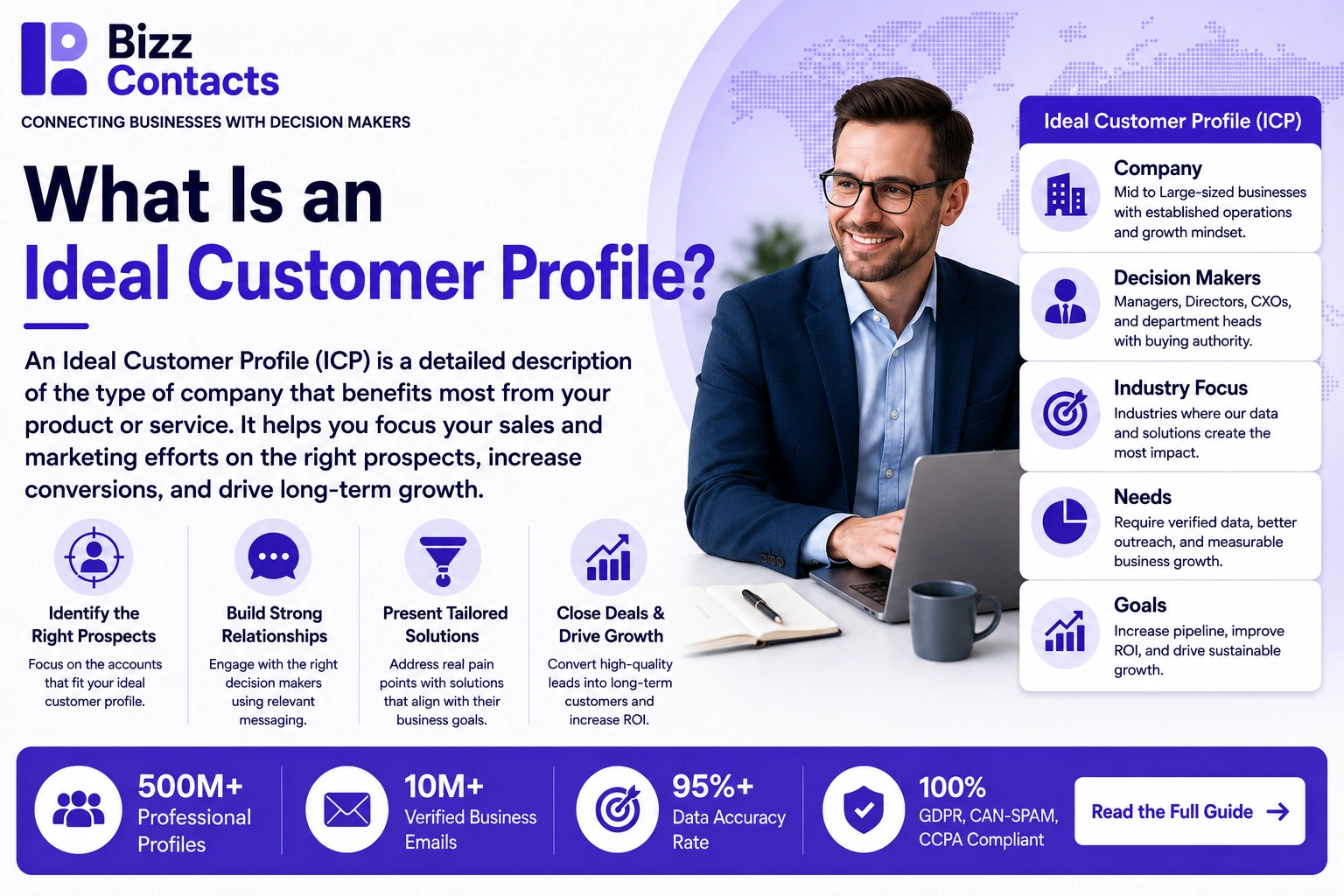
An ideal customer profile is a data-backed description of the type of company that gains the most from your product and returns the most value to your business over time.
The word company is doing heavy lifting in that sentence. In B2B, your ICP describes an organization, not an individual buyer. It is assembled from four kinds of evidence: firmographic attributes, technographic signals, behavioral intent, and situational context. Together they answer one question. What did our best accounts have in common before they ever spoke to us?
ICP vs Buyer Persona: What Is the Difference?
An ideal customer profile defines the account you are selling to. A buyer persona defines the decision-maker inside that account.
Both matter, and they are not interchangeable. The ICP tells your team which door to knock on. The persona tells them what to say once it opens. Revenue teams that collapse the two into a single document end up with targeting criteria that read like job titles, which is how outbound sequences start landing with directors at companies that were never going to buy.
Treat the ICP as the foundation under your entire demand generation engine. Before any campaign launches, inbound or outbound, one question should clear it: does this reach our ICP?
Organizations that define an ICP and hold the line on it tend to see shorter sales cycles, higher win rates, stronger net revenue retention, and better customer lifetime value. None of that is magic. It is the arithmetic of no longer selling to accounts that were never a fit.
Why the Ideal Customer Profile Matters More in 2026
B2B buying has shifted in ways that specifically punish unfocused targeting.
Buying committees have grown. Every purchase gets a second and third round of scrutiny. Budget holders are more cautious than they were in the last cycle. Channels are saturated, and generative tools have made high-volume outreach effectively free, which means volume no longer signals effort to anyone receiving it.
What survives that environment is relevance. Buyers do not want to feel targeted. They want to feel understood, and that is only possible when you know from the first touch which companies belong in front of you.
The cost of skipping the work shows up in four predictable places:
- Reps spend a meaningful share of every week working accounts that were never qualified, and that time almost never converts.
- Poor-fit customers signed for short-term revenue churn faster and consume disproportionate support capacity on the way out.
- Marketing budget flows toward leads that sales quietly declines to work, and neither side raises it until the quarter closes.
- Forecasting loses credibility once the pipeline fills with accounts that do not resemble any past win.
A precise ICP addresses all four at the source, because it gives every revenue function the same definition of a good account.
The Four Components of a Strong B2B Ideal Customer Profile
A credible profile draws from four layers of evidence. Skip one and the profile fails in a predictable way.
1. Firmographic Criteria: The Structural Fit
Firmographics describe the shape of the organization. They are the base layer of any B2B ideal customer profile.
- Industry or vertical, such as healthcare IT, industrial manufacturing, financial services, or B2B SaaS
- Company size, measured by headcount, annual revenue, or both
- Geography, defined at country, region, or metro level
- Business model, including B2B, B2B2C, or marketplace
- Ownership structure, whether public, private equity backed, venture funded, or family owned
Weighting varies by what you sell. A compliance platform lives or dies on regulatory exposure, so industry and ownership carry most of the signal. A self-serve analytics tool may care far more about headcount than about who owns the company.
2. Technographic Signals: The Systems Fit
By 2026, a company's software stack describes it as accurately as its org chart does. Technographic data has become one of the sharpest ICP inputs available to B2B revenue teams.
Four questions worth answering for every target segment:
- Which CRM runs their pipeline? Salesforce usually indicates process maturity and a dedicated operations function.
- Which marketing automation platform sits underneath it? HubSpot, Marketo, and Pardot each imply a different scale and internal complexity.
- Is their ERP legacy or cloud native? That single detail predicts integration effort and procurement timelines, which is why SAP and NetSuite accounts behave so differently in a sales cycle.
- What does their data infrastructure look like, and can your product connect to it without a services project?
Platforms including BuiltWith, G2, and Bombora surface these signals at scale. If your product replaces, extends, or integrates with another system, technographic criteria are not optional in your ICP.
3. Behavioral and Intent Signals: The Timing Fit
Firmographics and technographics tell you who fits. Behavioral signals tell you who is in market right now, which is a different and far more perishable piece of information.
- Research activity across topics tied to your category, captured through intent providers such as Bombora or TechTarget
- Job postings that expose priorities. A newly opened VP of Revenue Operations role means the go-to-market structure is being rebuilt.
- Funding announcements, which typically precede a spending cycle by one or two quarters
- Leadership changes at C-level or VP level, which almost always trigger a vendor review
- Review activity on G2 or Capterra, which usually means a competitor is already under evaluation
4. Situational and Psychographic Context: The Cultural Fit
The fourth layer covers strategic posture and how the organization actually behaves when it buys.
- Is the company in a growth phase or an optimization phase? Growth-stage buyers weigh speed. Mature buyers weigh return.
- What is the operating priority this year: expansion, efficiency, compliance, or transformation?
- Is decision-making centralized under one executive or distributed across a committee? This changes your entire sales motion.
- What is their risk tolerance? Early adopters buy on vision. Late majority buyers need three references from companies that look exactly like them.
How to Define Your ICP: A Five-Step Build Process for B2B Teams
Step 1: Mine Your Best Existing Accounts
Start with evidence rather than opinion. Pull the 20 to 30 accounts scoring highest on lifetime value, retention, speed to first value, and satisfaction. That cohort is your raw material, and everything downstream is pattern recognition against it.
Step 2: Debrief Sales and Customer Success
Your reps and CSMs hold context no dataset captures. Ask three questions. Which accounts close without friction? Which reach value fastest? Which consume support capacity for a year and still fail to renew? The answers surface patterns your CRM fields never recorded.
Step 3: Validate Against Win-Loss Data
Pull twelve months of closed-won and closed-lost deals. Segment them against the criteria you drafted, then compare win rate, average deal size, and cycle length across segments. This step exists to catch the gap between the customer you want and the customer you consistently win.
Step 4: Write Your Negative Filters
A profile that only describes who you want is half a profile. Define the anti-ICP explicitly: industries you will not serve, company sizes your pricing cannot support, geographies where you cannot deliver, and stack combinations that make implementation unworkable. Disqualification criteria save more hours than qualification criteria do.
Step 5: Operationalize and Review
An ICP that lives in a slide deck changes nothing. It has to reach CRM fields, lead scoring rules, SDR territory definitions, and paid media audiences. Train the revenue team on it, build it into process, and revisit it quarterly as your product and market move.
Ideal Customer Profile Template B2B: The Full Framework
Use the template below as your working ideal customer profile template for B2B. It fits both founders running early customer discovery and revenue operations teams formalizing targeting criteria across a mature funnel.
| ICP Attribute | What to Define |
|---|---|
| Industry Verticals | Two to four named industries. Specificity wins: "mid-market B2B SaaS, 50 to 500 employees" beats "technology". |
| Revenue Range | The annual revenue band your pricing and impact fit, for example $10M to $150M ARR. |
| Employee Headcount | The size range where your product solves a real problem, for example 50 to 500 employees. |
| Geography | Countries, regions, or time zones where you can sell, support, and deliver today. |
| Business Model | B2B, B2B2C, marketplace, or a specific delivery model such as SaaS, manufacturing, or professional services. |
| Tech Stack Signals | Three to five platforms your best accounts run, especially those you replace or integrate with. |
| Team Structure | Roles or functions that must exist for your product to land, for example a dedicated RevOps or internal data team. |
| Trigger Events | Events that reliably precede a purchase: a funding round, a new CRO, an audit deadline, a platform migration. |
| Strategic Priorities | The initiatives this company is actively funding this year. |
| Budget Indicators | Evidence of spending capacity and authority, such as recent tooling investments or a defined operations budget. |
| Growth Stage | Early stage, scaling, or established. Each stage buys on different criteria. |
| Decision-Making Model | Single decision-maker or buying committee, and how many approvers sit in the path. |
| Exclusion Criteria (Anti-ICP) | Company types that look like a match on paper but are not, with the disqualifying reason recorded. |
The Best Ideal Customer Profile Template for Sales Reps
The framework above serves strategy. Reps working live accounts need something shorter that fits on a single screen and answers questions mid-call.
The best ideal customer profile template for sales resolves three things instantly:
- Does this account qualify against our criteria?
- What is happening inside it right now that creates an opening?
- What outcome should I lead with?
Four elements deliver that on one page:
- The firmographic floor the account must clear, covering industry, size, and revenue
- The three technographic signals that matter most to your product
- The two or three trigger events worth referencing directly in outreach
- The core problem or opportunity this segment is dealing with this quarter
Load that page into your CRM or attach it to the prospecting sequence, and every rep pursues the same accounts with the same message. A free browser extension that surfaces verified contact detail on the account page keeps the qualification check to a few seconds rather than a research task.
How an ICP Rewires Your GTM Playbook
Account-Based Marketing
ABM without a sharp ICP is spray and pray with a bigger budget. With one, tiering becomes straightforward. Tier 1 accounts match every criterion and earn custom programs. Tier 2 match most and receive scaled personalization. Tier 3 clear the structural criteria and enter programmatic campaigns.
Sales Development and Outbound
A defined ICP removes the research tax from SDR work. Instead of debating whether an account deserves a sequence, the test becomes binary. Match? Sequence it. No match? Disqualify and move on. That single change typically returns several hours per rep per week.
Lead Scoring and Inbound Qualification
ICP criteria belong inside your scoring model as weighted attributes, not in a separate reference document nobody opens. Accounts that match rise to the top of the queue. Accounts that do not are routed to nurture or disqualified at the MQL stage, before they consume selling time. If you are still mapping where that decision sits, the B2B sales funnel guide covers the stage boundaries.
Customer Success and Retention
The ICP keeps working long after the contract is signed. Accounts drifting away from the profile, through acquisition, restructuring, or a change in strategy, are your earliest churn signal. Reading that drift early gives customer success a real window to intervene. The profile also sets honest expectations during onboarding, which is where most retention problems are actually created.
Common ICP Mistakes B2B Teams Keep Making
- Defining it too broadly. "Technology companies with more than 50 employees" is not an ICP. It is a market segment wearing an ICP label.
- Treating it as a one-time project. Markets move, products change, and pricing evolves. A profile written eighteen months ago is describing a company you no longer are.
- Merging it with the buyer persona. The ICP is the account. The persona is the buyer inside it. Two documents, two jobs, no overlap.
- Ignoring churn data. Churned accounts hold the clearest fit signal you will ever get. Work backward through them and ask what was true at signature that should have disqualified them.
- Building it without sales in the room. A profile marketing writes alone gets ignored by the team expected to sell against it.
How to Keep Your ICP Current in a Moving B2B Market
Change is the baseline condition in 2026. AI adoption is reshaping cost structures across entire verticals. Economic conditions are pushing budget authority further up the org chart. New competitors enter categories in months rather than years, and your own roadmap keeps shifting what you can credibly serve.
Attach the ICP review to a rhythm your organization already runs, most naturally the quarterly forecast cycle. Refresh win-loss data. Compare net revenue retention across segments. Talk to your strongest accounts about how their requirements are changing. If a vertical is outperforming, formalize it in the profile. If a segment that used to renew reliably is now leaking, examine whether it still belongs.
Frequently Asked Questions
Conclusion
Clarity is the durable advantage in B2B. The more precisely you can name who you sell to and why they win with you, the better every stage performs, from first marketing touch through renewal conversations years later.
A strong ICP does not narrow your ambition. It concentrates it. Build yours from the template in this guide, ground every field in real data, align the full revenue team behind it, and revisit it on a schedule. Do that and the profile stops being a document and starts being the reason your growth compounds.
Once the profile is written, the next problem is reaching the accounts that match it. A verified B2B email list filtered to your firmographic and technographic criteria turns the document into a working target list, and our data team will scope the real match rate against your profile before you commit to anything.
Calvin Christopher is the Marketing & Sales Manager at BizzContacts, specializing in B2B marketing, lead generation, sales intelligence, and verified business contact data.