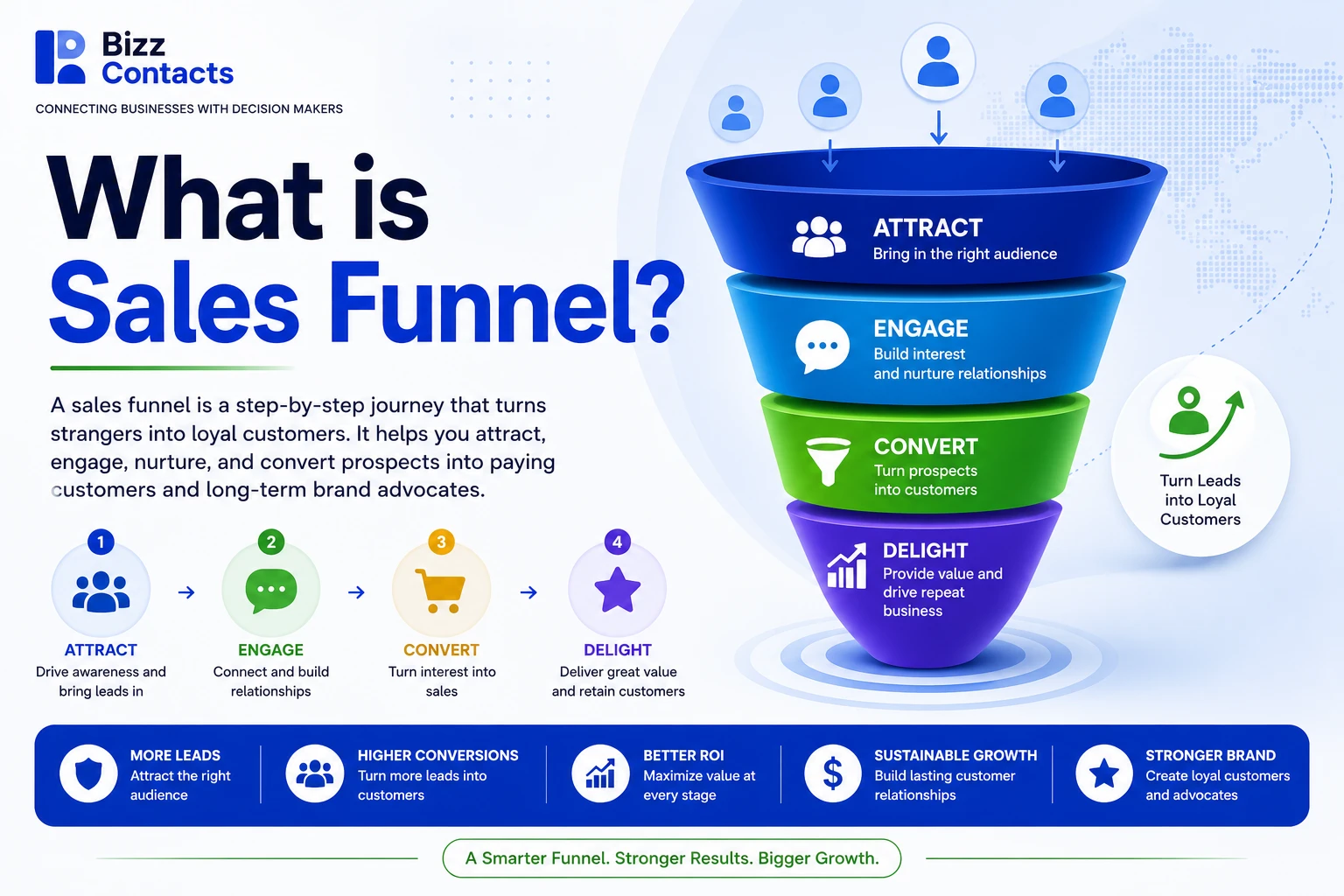
What is a B2B Sales Funnel? Stages, Types, and How to Build One
A complete guide to the B2B sales funnel: what it is, why it matters, the five stages from awareness to action, how to build one, the main funnel types, how AI is reshaping it, and how it differs from a sales pipeline.

A sales funnel is a framework that maps the customer's buying journey. It helps a business understand exactly where a prospect is at any point. Are they just discovering the brand? Are they already interested? Or have they lost interest entirely?
A well-built funnel answers those questions, which lets a business nurture leads in a way that actually lands. The outcome is better responses and higher conversions.
The sales funnel is owned jointly by the marketing and sales teams. Marketing guides prospects in at the entry, and sales directs them out at the exit. At the entry, marketing outlines the brand, the product, and how it solves the prospect's pain points. At the exit, sales works a list of prospects who are almost ready to buy, pinpoints the most persuasive angles, and moves them to a decision.
That is the quick version. There is a lot more to it, and this guide covers the full picture: why the funnel matters, its stages, how to build one, the different types, the role of AI, and how it differs from a sales pipeline.
What Is a B2B Sales Funnel?
A B2B sales funnel is a visual model of the path a business prospect takes from first hearing about a company to becoming a paying customer. It is drawn as a funnel because the number of people shrinks at every stage: a large pool of prospects enters at the top, and a smaller, qualified group converts at the bottom. In B2B, that journey is longer and involves more decision-makers than a consumer purchase, which is exactly why mapping it matters.
The funnel gives both marketing and sales a shared language for where each prospect sits, so the right message reaches the right person at the right moment. It also depends entirely on reaching real recipients in the first place, which is why most B2B teams start with a verified B2B contact database rather than a scraped or outdated list.
Why Is a Sales Funnel Important for B2B Businesses?
B2B is one of the more complex parts of the economy. A single purchase decision moves through multiple steps and multiple stakeholders, so a clear sales funnel is essential for understanding and marketing your product effectively. A strong funnel helps you:
- Understand and visualize the sales process, track how each prospect is progressing, and measure conversion success at every stage
- Guide prospects through a structured journey that captures attention, nurtures interest, and closes the deal
- Tailor your marketing strategy, messaging, and content to the specific needs and challenges of each stage
- Identify inefficiencies or leaks in the process, such as high drop-off between two stages, so you can adjust before revenue slips
- Track and analyze performance using metrics like response rate, conversion rate, stage-by-stage interest, customer lifetime value, and average order value
Ultimately, the sales funnel is the central tool for understanding the buyer's perspective, anticipating their questions, and guiding them smoothly toward a purchase.
What Are the Five Stages of a Sales Funnel?
Most sales funnels move through five stages, starting wide at the top and narrowing toward the sale.
1. Awareness
This is the broad top of the funnel, holding the largest number of leads. At this point, prospects are trying to understand what your business does, so the goal is to keep them engaged inside the funnel.
The most effective approach is multi-channel visibility. Make your business easy to find across search engines, social media, and other channels. For B2B, LinkedIn is one of the best ways to build awareness. Support it with relevant blog posts, clear infographics, and short videos wherever they help. Traditional formats like industry magazines still work too, and because many B2B marketers have written them off, they can be an opening to stand out.
2. Interest
The funnel narrows here, because not every lead will be intrigued by your company. Some drop off or find an alternative, and that is normal for every business. Your focus should be on the leads who did step into the interest stage, using tactics that sustain and deepen their interest.
This is where personalization matters. If you understood your audience properly during the awareness stage, you can now deliver a tailored experience: explain why your solution is the smart choice and how it maps directly to each prospect's needs and challenges.
3. Consideration
The funnel narrows further. You might have captured the attention of most prospects in the interest stage, but only a portion move into active consideration. Concentrate on the prospects who are genuinely weighing your brand for purchase, and nurture them with proof and incentives:
- Show real customer reviews. Put your product reviews on Google, Trustpilot, Quora, and in video testimonials. Buyers trust other buyers, and seeing existing customers vouch for the product lifts conversion.
- Offer live product demos. Walking a prospect through the product shows it from every angle and builds the confidence that pulls them closer to a purchase.
- Use discounts and gift cards. Prospects compare brands for the same product, so a well-timed offer can be the nudge that tips them toward you.
Stay patient here. A B2B prospect may take weeks or months to decide, so keep nurturing throughout the evaluation and stay on top of their mind.
4. Action
This is the bottom of the funnel, where the buyer is ready to purchase and prospects convert into paying customers. Guide them cleanly through the buying process and be available in the moment to answer questions or clear doubts instantly.
If a prospect reaches the action stage and chooses not to buy, do not assume the funnel failed. Keep analyzing behavior and adjusting your strategy so the next cycle converts better.
5. Retention and Loyalty
The funnel does not truly end at the sale. Keeping a customer engaged after purchase raises customer lifetime value and turns one-time buyers into repeat revenue, which is covered in the funnel-building steps below.
How to Build an Impactful Sales Funnel
Building a strong funnel takes an in-depth understanding of the company, its target audience, and the budget. These steps double as best practices for optimizing a funnel you already run.
1. Optimize your website
Your website should clearly communicate what the company does and its unique selling proposition. Add social proof, since reviews and testimonials carry real weight, and use triggering calls to action that capture attention. Sign-up forms help you gather contact details for later marketing and sales. Above all, make the site and landing pages mobile-friendly, because most people now browse on their phones far more than on larger screens.
2. Offer relevant lead magnets
Lead magnets gather information about prospects, build trust, and move new leads into the first stage of the funnel. Common examples include:
- Blogs
- Infographics
- Case studies
- E-books
- White papers
- Discounts
- Free trials or samples
- Demo videos
3. Publish interactive ads on LinkedIn and beyond
Ads that speak to the target audience's requirements and pain points are far more effective. In B2B, LinkedIn is where most businesses are present, so posts and videos that resonate with your audience keep leads flowing into the funnel. Keep the tone slightly formal but engaging, and use polls or quizzes to learn more about your audience for later nurturing.
4. Nurture leads with email marketing
Use the email addresses captured through sign-up forms, along with behavioral signals like landing-page activity and social engagement, to write copy that speaks directly to your audience's pain points. Send at the right time, give prospects clear reasons to choose you over competitors, and keep interest alive with consistent follow-ups. This works best when the underlying list is accurate, which is where B2B lead generation and verified data feed straight into the funnel.
5. Close deals with samples or a sharp sales pitch
Once prospects are inside the funnel and considering your brand, reach out and ask about their requirements. Keep it a two-way conversation: introduce yourself and the reason for the call, and stay on point rather than dragging it out. This is the stage where the sales team earns the conversion.
6. Engage customers after the purchase
Your job does not end at the sale. To grow customer lifetime value, keep engaging after purchase with useful updates and alerts. Start with:
- A thank-you email
- Discounts, where they apply
- A request for a review or feedback
- Relevant resources tied to their past purchase
- Invitations to webinars or events they would find useful
Consistent post-purchase engagement keeps customers close and retains them for the long term.
What Are the Various Types of Sales Funnels?
Depending on a campaign's goals, funnels come in several forms. The most common types include:
- Lead generation funnel
- Product launch funnel
- Squeeze funnel
- Reverse squeeze funnel
- Lead magnet funnel
- Webinar funnel
- Survey funnel
- Limited-time offer funnel
- Tripwire funnel
- Cancellation funnel
Whatever the shape, every funnel shares the same end goal: moving prospects toward a conversion. Choose the type that fits your objective and build around it.
The Impact of AI on the Sales Funnel
AI does not replace human effort in the funnel; it supports and accelerates it. Because each stage needs its own strategy, from building email lists and sending campaigns to curating content and scheduling meetings, AI is most valuable at automating the repetitive work so your team can focus on the high-value activities.
Here is where AI helps most across the funnel:
- Content development. Generative AI drafts and refines persuasive copy for landing pages and ads, but human expertise is still essential for the organic, relatable touch, so treat AI as a starting point rather than the final word.
- Finding gaps and bottlenecks. AI can surface leaks at each stage that a busy team might miss, then suggest ways to fix them.
- Analyzing customer behavior. Predictive AI tracks browsing patterns across platforms at a scale no team could match manually, then recommends the tactics most likely to convert each prospect.
The effect compounds across the funnel. At the top, AI chatbots and real-time behavior analysis capture leads around the clock and flag high-potential prospects. In the middle, automated lead scoring, smarter segmentation, and behavior-based follow-ups keep leads nurtured. At the bottom, predictive analytics and personalized recommendations drive conversions while flagging at-risk customers for proactive retention. Industry reporting suggests AI-assisted funnels can lift conversion rates meaningfully and cut sales-cycle time, though the exact gains vary widely by team and should be validated against your own numbers.
Sales Funnel vs Sales Pipeline
The two terms are often used interchangeably, but they describe different things. A sales funnel is built around the buyer's journey: it tracks how prospects move from awareness to purchase from the customer's point of view. A sales pipeline is built around the seller's process: it tracks the specific deal stages a rep works through to move an opportunity to closed-won.
| Area | Sales Funnel | Sales Pipeline |
|---|---|---|
| Point of view | The buyer's journey | The seller's deal process |
| Measures | Volume and conversion rate at each stage | Deals, their stage, and their value |
| Typical stages | Awareness, interest, consideration, action, retention | Prospecting, qualification, proposal, negotiation, closing |
| Main question | Where are prospects dropping off? | Which deals will close, and when? |
In practice, the two work together: the funnel shows how well you attract and nurture demand, while the pipeline shows how well you convert that demand into revenue.
Case Study: How Grow and Convert Built an Effective Sales Funnel
Grow and Convert is a content marketing agency that helps companies turn their blogs into a source of conversions. Its unique selling proposition centers on search marketing, long-form content, and case studies that keep prospects moving smoothly through the funnel. Here is how the agency mapped its work to each stage.
- Awareness: they produced two kinds of articles, one set aimed at their target audience's needs and pain points, and another addressing common content-marketing problems.
- Interest: they built trust by weaving existing customer case studies into those articles, letting proof do the persuading.
- Consideration: they offered a course teaching traffic-driving content methods to prospects who could not yet afford full-service help, keeping those leads engaged.
- Action: their sales team walked prospects through the service and its value proposition, accountable content marketing that drives conversions, which moved prospects to inquire and buy.
Ready to Close the Deal With a Robust Sales Funnel
An effective B2B sales funnel exists to drive conversions, the goal of nearly every business. A large number of prospects enter the awareness stage, and far fewer reach the action stage. Even with the strongest strategy, some drop-off is guaranteed, which is exactly why the funnel is drawn as a pyramid.
If you want to move more leads from awareness to action, and on to repeat business, a well-built funnel is the key. Master the right strategy for each stage and you will see it show up in your sales numbers. Ready to feed the top of your funnel with real prospects? Get a free sample from the BizzContacts B2B email list, or reach decision-makers directly with the executive email list.
Frequently Asked Questions
Calvin Christopher is the Marketing & Sales Manager at BizzContacts, specializing in B2B marketing, lead generation, sales intelligence, and verified business contact data.