What is B2B Lead Generation? A Complete Guide in 2026
A complete B2B lead generation guide for 2026: the definition, inbound vs outbound, the five-step funnel, top strategies, real examples, the essential tool stack, key metrics to measure, common challenges, and the AI-driven trends shaping the future.

In this digital era, businesses no longer rely completely on cold calls or old methods to spot clients. Instead, organizations now depend on strategic marketing methods that attract potential customers and convert them into loyal clients. One of the most effective methods that enables this is B2B lead generation.
If a company wants to grow consistently in competitive industries, it needs a robust system that identifies potential buyers, captures their interest, and converts them into paying customers. This is exactly where B2B lead generation helps.
What is B2B Lead Generation?
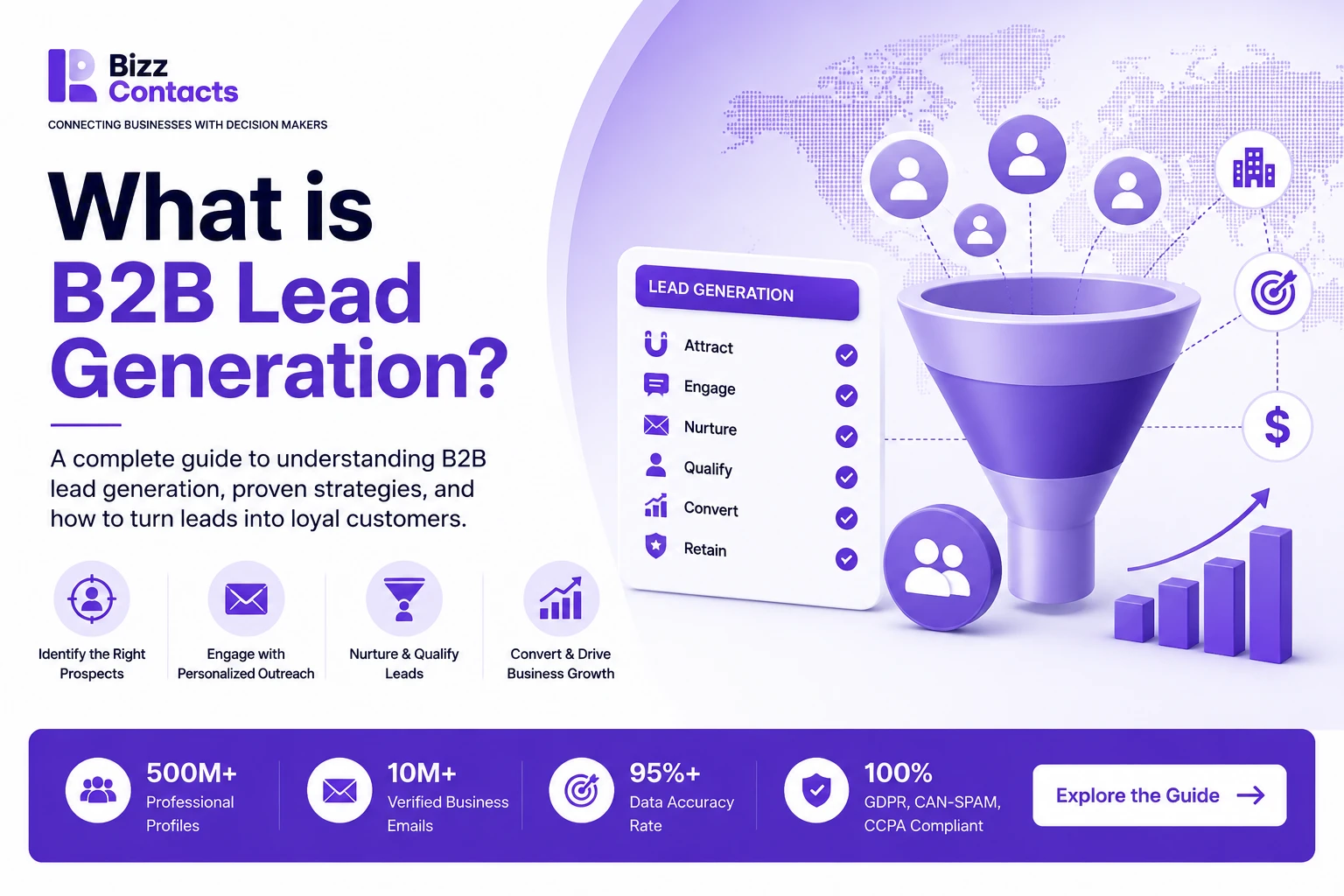
In simple terms, B2B lead generation is the process of identifying potential businesses and customers in the market that might be interested in buying your company's product or service.
Put plainly, it is the method of finding organizations that are likely to buy from your company, capturing their contact details, and then pitching them your offer. It is about spending your outreach energy on the accounts most likely to convert, not on random prospects.
A "lead" in B2B marketing usually includes details such as:
- Company name
- Decision maker (CEO, CFO, CTO, or procurement officer)
- Business email address
- Direct phone number
- Industry
- Company size
The end goal of B2B lead generation is to move potential clients through a well-designed sales funnel and convert them into long-term customers. If your list is built from a verified B2B contact database, the whole funnel runs faster and cleaner.
B2B Lead Generation in Brief
Here is a simple way to understand it:
- B2B means business-to-business
- Lead generation means attracting and capturing potential buyers
- B2B lead generation means finding business prospects who may buy your product or service
The purpose is not just to collect contacts. The real goal is to build a pipeline of qualified leads that your sales team can convert into revenue.
For example:
Imagine a software company that sells accounting software to businesses of different sizes. Instead of waiting for companies to find them by chance, the software company builds leads by:
- Publishing useful accounting blogs
- Running LinkedIn ads targeting senior finance executives
- Offering free demos
- Collecting contact details through forms
All of these activities are part of B2B lead generation.
Why B2B Lead Generation is Important in 2026
The business ecosystem is changing rapidly. Buyers today are more informed and more selective than they used to be, and competition in every digital-first market has intensified.
Here are the main reasons B2B lead generation has become essential:
1. Predictable Revenue Growth
With B2B lead generation, a company continuously discovers new potential customers, which reduces dependency on existing accounts and word-of-mouth referrals. It opens up conversations with fresh buyers, which lifts sales and drives revenue growth.
2. Targeted Customer Acquisition
Modern B2B marketing lets you focus on specific industries, job roles, and company sizes. Your sales team then spends its time on accounts and individuals that can actually convert into long-term customers, not on lookalikes that were never going to close.
3. Data-Driven Marketing
In 2026, businesses depend on analytics, automation, and CRM tools. Lead generation surfaces valuable data about:
- Customer behavior
- Purchase intent
- Industry demand
This helps companies refine their marketing strategies based on what buyers are actually doing, not on assumptions.
Types of B2B Lead Generation
B2B lead generation splits into two main categories.
1. Inbound Lead Generation
Inbound lead generation focuses on attracting customers organically by giving them the information they are already searching for. Instead of pushing a sales message, you publish helpful, informative resources that encourage the buyer to reach out to you.
Common inbound methods include:
- Content marketing
- SEO blogs
- Webinars
- Whitepapers
- Social media marketing
- Podcasts
Example:
A cybersecurity company publishes a blog titled "Top 10 Cybersecurity Protocols Businesses Should Follow in 2026." IT executives searching for cybersecurity practices read the article and download a free security checklist. In exchange for the checklist, the company collects the executive's business email, generating a qualified inbound lead.
2. Outbound Lead Generation
Outbound lead generation is the push method. The sales team directly reaches out to prospects who are not yet aware of your product or service.
Typical outbound methods include:
- Cold emails
- Cold calls
- LinkedIn outreach (fast with the BizzContacts Chrome extension for one-click contact reveal)
- Paid advertising
- Sales prospecting
Example:
A digital marketing agency identifies target e-commerce companies in the digital space and sends them personalized emails offering a free website audit. Every reply is a warm outbound lead.
How to Do B2B Lead Generation
Every company follows some version of a systematic process to build leads. Below is a simplified step-by-step framework you can apply.
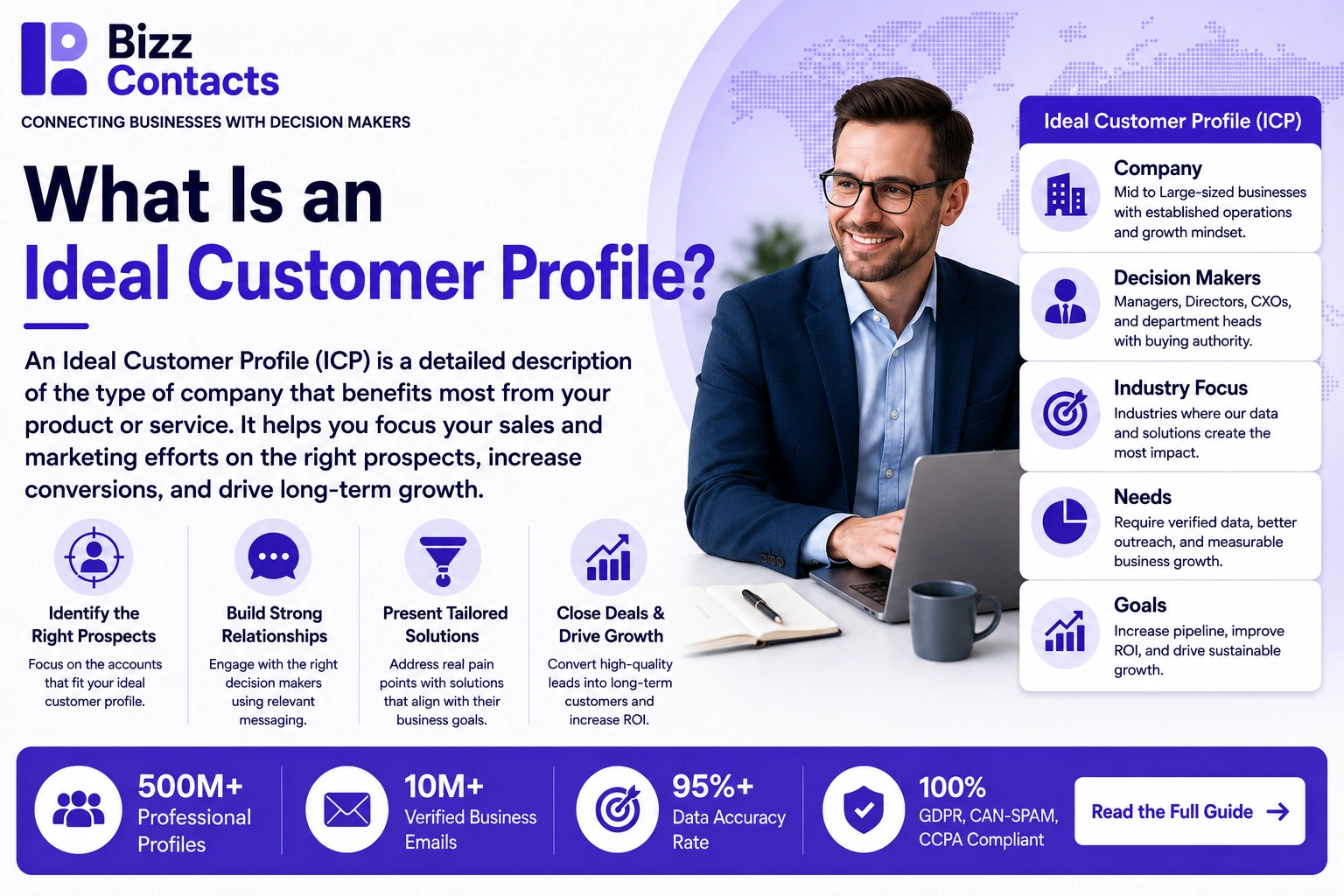
Step 1: Identify Your Ideal Customer Profile
Before you go looking for leads, you need a clear picture of who is most likely to buy your product or service.
Important factors include:
- Industry
- Company size
- Revenue
- Geographic location
- Job titles of decision makers
For example, a SaaS company might target:
- Technology startups
- Companies with 50 to 500 employees
- CTOs or IT managers as the primary decision makers
Step 2: Build a Funnel for Lead Generation
A typical B2B sales funnel has three stages:
- Awareness, where prospects discover your company
- Interest, where they engage with your content
- Decision, where they consider purchasing
Businesses create content or campaigns tailored to each stage. Examples include:
- Blog articles for awareness
- Webinars for interest
- Free trials for the decision stage
Step 3: Capture Contact Information
Once potential buyers show interest, you need to collect their details without adding friction. The common methods are:
- Website forms
- Newsletter subscriptions
- Downloadable resources
- Webinar registrations
- Free trial sign-ups
The goal is to convert anonymous website visitors into named, contactable leads.
Step 4: Qualify the Leads
Not all leads are equal. Some prospects are interested but not ready to buy. Lead qualification makes sure your sales team spends its time on the leads with the highest chance of closing.
Businesses typically categorize leads into:
- Marketing Qualified Leads (MQL): interested but not ready to purchase
- Sales Qualified Leads (SQL): ready to talk to a salesperson
Step 5: Nurture the Leads
Lead nurturing is about building rapport with potential clients and offering value until they are ready to buy.
This can include:
- Educational email campaigns
- Product demos
- Case studies
- Follow-up calls
B2B Lead Generation Strategies in 2026
Modern businesses combine multiple strategies to generate leads in a competitive market.
1. Content Marketing
Content marketing remains one of the most effective lead generation strategies. Companies publish blog posts, industry reports, e-books, and whitepapers. Good content pulls in an audience that is already searching for the solutions you sell.
2. LinkedIn Marketing
LinkedIn has become the primary social platform for B2B marketing because it lets you target buyers by industry, company size, and role. Businesses use it to:
- Connect with decision makers
- Share industry insights
- Run targeted advertisements
- Promote webinars
If your team runs a lot of LinkedIn prospecting, tools like the BizzContacts Chrome extension reveal verified business emails and direct dials directly on LinkedIn profiles, cutting research time to seconds.
3. Search Engine Optimization (SEO)
SEO helps your company appear at the top of Google when a prospect searches for a solution. For example, if someone searches for "best CRM software," companies with optimized content have a strong chance of capturing that lead.
4. Email Marketing
Email remains one of the most cost-effective B2B lead generation strategies. Personalized email meaningfully lifts engagement. Companies use email campaigns to:
- Nurture leads
- Share case studies
- Promote webinars
- Announce product updates
If you are still building your first list, the guide on how to build a B2B email list in 2026 walks through eight practical methods.
5. Paid Advertising
Paid ads help businesses reach their target audiences quickly. Common platforms include:
- Google Ads
- LinkedIn Ads
- Facebook Ads (for certain B2B industries)
B2B Lead Generation Examples
To understand how companies actually generate leads, here are four real-world scenarios showing B2B lead generation in practice.
Example 1: SaaS Company
A SaaS company offering project management software generates leads through several channels:
- SEO blog posts
- Free project management templates
- LinkedIn ads targeting engineering managers
- Free product trials
Visitors who download the templates or sign up for a trial become qualified leads that the sales team can work.
Example 2: Marketing Agency
A digital marketing agency offers free website audits for businesses. Prospects submit their website URL and business email to receive a detailed report. The result is a qualified lead list of businesses that have actively raised their hand for digital marketing services.
Example 3: Consulting Firm
A consulting firm publishes an informative report on the latest industry trends. Businesses fill out a short form with their company details to download the report, which automatically hands the consulting firm a qualified prospect list.
Example 4: IT Services Company
An IT service provider announces a webinar on cybersecurity. Participants register with their professional email and company information, and every registration is a fresh contact for the sales team to follow up with.
B2B Lead Generation vs B2C Lead Generation
Although both involve attracting prospects, B2B and B2C lead generation look very different in practice.
B2B Lead Generation
- Longer sales cycles
- Multiple decision makers per account
- Higher-value deals
- Logic and ROI-driven decisions
- Personalized nurturing
B2C Lead Generation
- Shorter buying cycle
- One main buyer
- Lower transaction value
- Emotion-driven decisions
- Faster conversions
B2B is usually slower and more relationship-focused. That is why trust, relevance, and buyer education matter so much.
B2B Lead Generation Tools
Modern lead generation depends heavily on technology that automates prospecting, outreach, and analytics.
Here are the categories of B2B lead generation tools that dominate in 2026.
1. CRM Tools
Customer Relationship Management systems help companies track every lead, every interaction, and every stage of the sales pipeline.
Popular CRM platforms include:
- Salesforce
- HubSpot
- Zoho CRM
2. Lead Data Platforms
These tools tell you who a potential buyer is, what their company does, and how to reach them. Companies increasingly source pre-verified records from a B2B contact database rather than building lists from scratch.
Examples include:
- BizzContacts
- ZoomInfo
- Apollo.io
- Cognism
For a side-by-side view of the market, see the guide to the top B2B data providers in the USA.
3. Email Outreach Tools
Email automation platforms send personalized campaigns at scale and track replies.
Common tools include:
- Mailchimp
- Lemlist
- Outreach
4. Marketing Automation Tools
Marketing automation platforms nurture leads through email workflows and personalized messaging, which meaningfully improves efficiency.
Examples include:
5. Analytics Tools
Tools like Google Analytics help organizations measure the effectiveness of every campaign by surfacing the metrics that matter.
Important metrics include:
- Conversion rate
- Cost per lead
- Customer acquisition cost
Key Metrics to Measure B2B Lead Generation Success
The lead generation metrics you should track are:
- Lead conversion rate: percentage of visitors who become leads
- Cost per lead: how much it costs to generate each lead
- Cost per acquisition: total cost to win a customer
- MQL to SQL conversion rate: how many marketing-qualified leads become sales-qualified leads
- Email open and reply rates: engagement with outreach campaigns
- Demo booking rate: percentage of leads that book a demo
- Pipeline contribution: how many leads turn into real sales opportunities
Challenges in B2B Lead Generation
Even though lead generation is essential, businesses hit a few common obstacles.
1. Long Sales Cycles
B2B purchases usually involve multiple decision makers, which makes the buying process both complex and slow.
2. Data Accuracy
Lead databases can contain outdated or incorrect information. Working with a verified B2B contact database reduces bounce rates and protects sender reputation.
3. High Competition
Multiple companies pitch their products and services to the same buyers, which saturates the inbox and raises the bar for personalization.
4. Lead Quality Issues
Generating a large number of leads does not guarantee they will convert. Volume without fit is expensive.
To overcome these challenges, companies focus on quality targeting and personalized communication rather than blasting the market.
The Future of B2B Lead Generation
By 2026, several trends are shaping the future of B2B marketing.
1. AI-Powered Prospecting
Artificial intelligence now helps businesses identify buyers with the highest intent and predict their purchasing behavior before a rep ever makes contact.
2. Hyper-Personalization
Buyers expect communication that is tailored to their specific needs, not a copy-and-paste template.
3. Video and Interactive Content
Videos, live demos, and interactive tools are becoming more effective than static content at pulling prospects into a conversation.
4. Data Privacy Regulations
As data becomes more valuable, companies are required to strictly follow data protection laws when collecting customer information.
Businesses that adapt to these trends stay ahead in a highly competitive market. With the right B2B lead generation tools and content marketing, lead generation becomes both simple and repeatable. As technology evolves, companies that combine data-driven strategy with personalized outreach will keep generating high-quality leads and closing them faster.
Effective B2B lead generation is not just about collecting contacts. It is about building relationships that generate trust through valuable content and guiding buyers toward solutions that help their business grow.
Conclusion
B2B lead generation is really about building connections. It is about reaching the right businesses, starting the right conversations, and showing how your product or service can solve a real problem. Getting leads is important, but building trust is what actually moves prospects closer to a decision.
As competition grows in 2026, businesses that focus on relevance, personalization, and consistency will stand out. The companies that understand their buyers and offer real value at every stage will always have a stronger chance of generating quality leads and driving better results.
Ready to source pre-verified B2B contacts and skip the guesswork? Get a free 50-record sample from the BizzContacts B2B email list or explore the executive email list to reach CEOs, CFOs, CTOs, and every other C-suite title in one shot.
Calvin Christopher is the Marketing & Sales Manager at BizzContacts, specializing in B2B marketing, lead generation, sales intelligence, and verified business contact data.