What is B2B Data? A complete guide in 2026!
A 2026 buyer's guide to B2B data: what it is, the five types that matter (firmographic, professional, technographic, intent, geographic), how it is collected and verified, real use cases, compliance frameworks, pros and cons, and ten questions to ask any data vendor before you write a check.

Picture this. Your marketing team has come up with a creative campaign to sell your product. The budget approval has come through. The messaging has been written and re-written to perfection, and the sales team is ready to launch their outreach. Then you realize the one flaw that can topple your entire campaign: you do not know who to connect with.
- Which businesses fit your ICP?
- Who are the decision-makers you need to target?
- Do you have access to their accurate and up-to-date data?
It might seem basic until you realize that 94% of businesses think their prospect data is inaccurate. Shocking, right? Unfortunately, with B2B data decaying at almost 30% every year, it is not exactly surprising.
Without reliable B2B data, things go downhill pretty fast. Sales teams spend hours hunting down prospects, your campaigns reach the wrong audience, and your high-intent ICPs end up signing deals with your competitors. The fix usually starts with a verified B2B email list built around your actual buyer profile rather than scraped from public directories.
This is what makes B2B data so critical. In this blog, we will delineate every aspect of B2B data, starting from the definition all the way to how to address the issues surrounding it. So, without further ado, let us get started.
Part 1: The basics of B2B data
Before we get deeper into the topic, let us begin with the basics.
What is B2B data?
B2B or business-to-business data is the information about other companies and their decision-making employees. It is used by B2B marketing, sales, and revenue teams to find their target audience and launch hyper-personalized campaigns to offer maximum relevance.
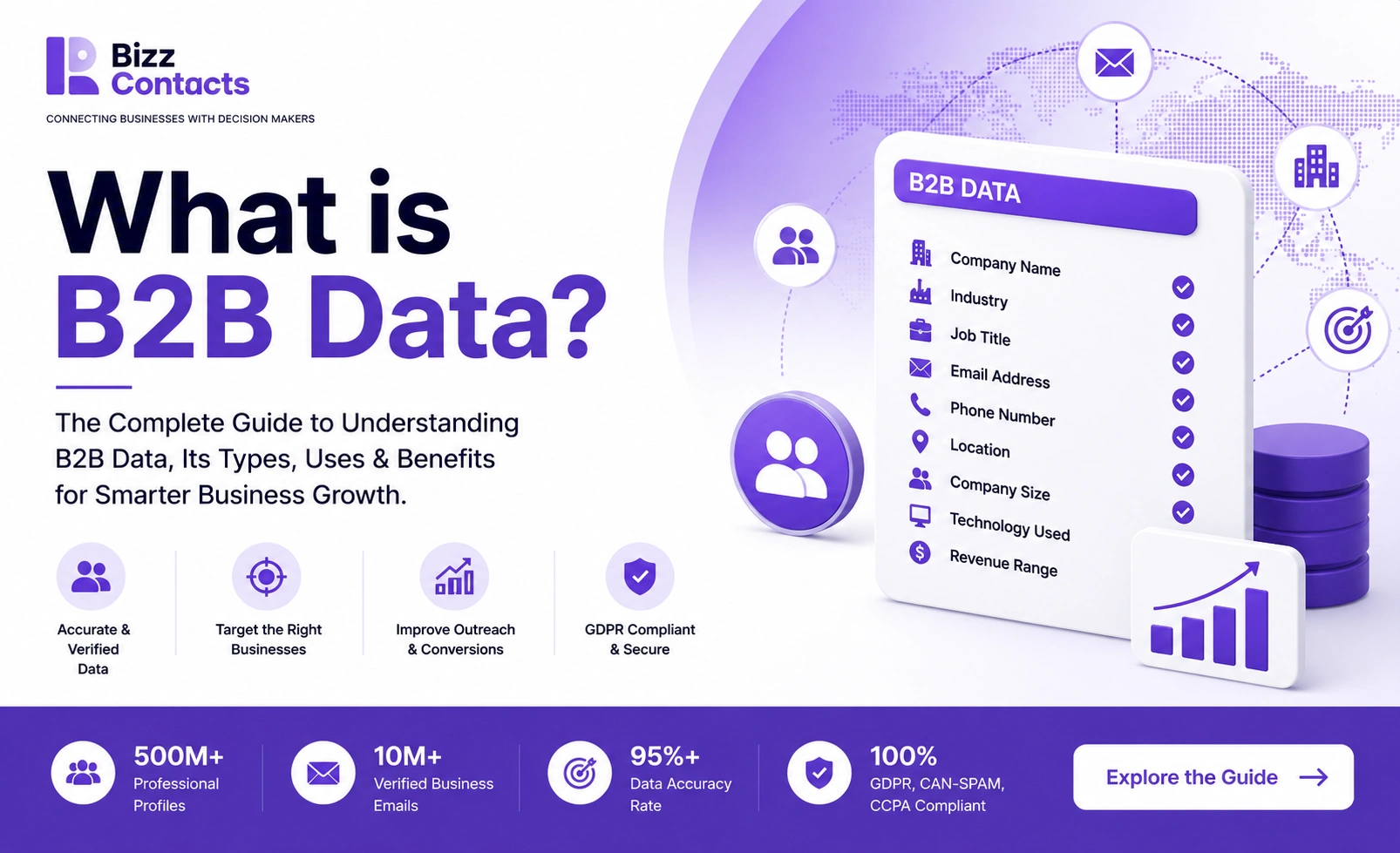
B2B data usually includes personal contact information of the key decision-makers, like job titles, business email addresses, and direct phone numbers, along with company insights such as industry, location, employee size, and annual revenue.
Businesses collect massive amounts of data in order to connect with their target audience and grow their business. But most of it is not ready to be used right away. Most of it starts off as raw data, consisting of unprocessed information collected from websites, directories, or public records. It has to undergo thorough verification and enrichment processes to turn into actionable data that can be used by businesses for their GTM strategies by allowing targeted prospecting, personalized outreach, and more informed decision-making.
What is the difference between B2B vs B2C data?
Both B2B and B2C data allow businesses to identify and reach their target audience. However, the type of information collected differs significantly.
Since B2B businesses have longer sales cycles and multiple decision-makers, they focus on professional attributes of the stakeholders involved and organizational details. On the other hand, B2C businesses usually collect personal demographics and consumer behavioral data.
To give you more clarity, here is a side-by-side comparison:
Target audience
- B2B: businesses, companies, and decision-making professionals.
- B2C: individual consumers.
Purchasing process
- B2B: long sales cycles with numerous stages.
- B2C: shorter and faster.
Stakeholders
- B2B: usually a buying committee is involved.
- B2C: usually a single buyer.
Key data points
- B2B: company name, job title, industry, company size, revenue, work email.
- B2C: name, age, gender, location, interests, purchase history.
Primary uses
- B2B: prospecting, ABM, networking.
- B2C: personalized marketing, retail targeting, behavioral analysis.
Part 2: What are the different types of B2B data?
There are quite a few different types of B2B data, each with its own functionality. Let us talk about the most popular types.
Firmographic data
Firmographic data refers to the attributes used by businesses to define their ICP, helping them spot, segment, and target companies in B2B. It comprises components such as:
- Industry: the market sector in which a company operates (e.g., software, healthcare, manufacturing).
- Company size: measured by the number of employees or the revenue generated.
- Location: country, state, city, etc., of a company's headquarters or branches.
- Ownership: whether the business is public, private, a subsidiary, or a startup.
Firmographic data allows businesses to segment companies, identify high-value prospects, and create marketing strategies to boost ROI. It allows B2B businesses to address the needs of the companies better, resulting in better engagement and more conversions. In fact, 73% of marketers have reported that they have witnessed an increase in the average deal size after using firmographic data for targeting.
Professional data
While ICPs can help companies find the companies they need to target for growth, the decision is ultimately made by human decision-makers, also known in B2B as buyer personas. Professional data helps B2B businesses target those decision-making professionals.
It basically comprises contact information such as name, job title, department, seniority, email, direct dial, and more. It allows B2B teams to run personalized campaigns targeted to the key decision-makers, address their pain points, and nudge them towards the bottom of the funnel.
Technographic data
Technographic data refers to the tech stack used by companies. It lists tools such as CRM platforms, marketing automation tools, ERP systems, and cloud infrastructure.
This data is especially useful for businesses that are looking for companies that benefit the most from their solutions. It enables teams to target prospects using compatible tools or spot opportunities to replace competing platforms. See how this works in practice on our technology installed base intelligence hub, where each software vendor (Salesforce, SAP, Workday, HubSpot, and 100+ more) has its own dedicated buyer list.
Intent data
In B2B, intent data refers to the online research behavior of companies, such as keyword searches, website visits, and content downloads. It allows B2B businesses to know what stage in the buyer journey a specific company is at and provide content that aligns with it. It allows B2B teams to focus more on high-intent leads while also running lead nurturing sequences to engage and, if possible, convert others.
Location and geographic data
Location or geographic data refers to the physical or administrative location of a company. This data helps businesses to segment markets, target prospects in specific regions with highly relevant campaigns, and make logistical decisions based on demand and revenue generation.
Part 3: What does a B2B record look like?
A B2B contact record is a collection of information about a decision-making professional and the organization they work for. It goes much beyond names and emails to contain multiple data fields, allowing B2B sales and marketing teams to identify leads, qualify them, and engage with the right decision-makers.
Each record contains professional information of a decision-maker, company attributes of their workplace, and contact details. It enables B2B teams to accurately segment their audiences and launch personalized outreach campaigns for higher relevance.
In most top-quality B2B databases, every record comprises four categories of details.
1. Professional details
Professional details give insights into the professional's role within an organization. It helps businesses answer the following questions:
- Who is the contact?
- What do they do?
- How much influence do they have in a purchasing decision?
Common fields include:
- Full name
- Job title
- Job function or department
- Seniority level
- Professional specialization
- Years of experience
- LinkedIn profile URL
- Social media handles
For example, knowing whether a contact is a Chief Technology Officer or an IT Specialist helps B2B teams understand whether they are a decision-maker, influencer, or end user in the buying process, and curate their messaging accordingly.
2. Company details
Company insights connect the decision-maker to the organization they work for. This data helps answer these questions:
- What is the size of the company?
- What industry do they belong to?
- What do the financials of the company look like?
It comprises fields such as:
- Company name
- Company website
- NAICS / SIC codes
- Organization size
- Annual revenue
- Geographic location
- Business type
It helps businesses segment prospects by industry vertical, company size, or revenue range, making their targeting more precise.
For example, surgical robots cost around $1.5 to $2.5 million upfront and hundreds of thousands per year in maintenance. So, a medical equipment supplier selling surgical robots would want to know whether a hospital can afford it and whether it has the supporting infrastructure before contacting them.
3. Communication channels
Communication fields define how a business can reach the contact. Accurate and verified communication channels are essential for outreach campaigns, sales engagement, and relationship building.
Communication fields tell B2B businesses how a prospect prefers to be contacted. Accurate and verified contact details help businesses avoid wasted outreach and connect directly with prospects with promotional or networking campaigns.
Common contact fields include:
- Work email address
- Direct phone number
- Mobile phone number
- Office phone number
- Corporate mailing address
- LinkedIn profile
These identifiers allow organizations to connect with prospects across multiple channels. Today, when B2B teams need 7 to 13+ touchpoints to generate a qualified lead, these details help them connect with prospects through multiple channels, including email campaigns, cold outreach, and social media.
4. Specialized data fields
Certain industries, such as healthcare, finance, and legal services, have special identification numbers that are unique, helping differentiate them from others. These fields help improve data accuracy, identify the professionals correctly, and match records across databases.
Examples include:
- National Provider Identifier (NPI) for healthcare professionals
- Medical license numbers
- Professional certification IDs
- Internal database contact IDs
- CRM record IDs
For instance, the NPI assigned to every physician is unique, making each of them easily distinguishable. This helps B2B teams accurately target specific physicians, maintain clear records, and avoid confusion between healthcare providers with similar names and affiliations. The BizzContacts Physicians Email List is built around this exact principle, with every record cross-referenced against the public NPPES registry.
This is what a B2B contact record usually looks like:
- Full name: Dr. Emily Black
- Job title: Director of Cardiology
- Company: Mercy General Hospital
- Industry: Healthcare
- Employees: 200+
- Annual revenue: $350M
- Work email: eblack@mercygeneral.org
- Phone: +1 415 555 9211
- LinkedIn: linkedin.com/in/sample-contact-emily
- NPI number: 1234567890
Part 4: How is B2B data collected?
B2B data is usually pulled from sources such as public records, professional associations, opt-in lists, lead magnets, workplace websites, job boards, newspapers and journals, research papers, feedback and surveys, and social media profiles.
While the verification process differs from one organization to another, the reputable ones have multi-tiered data validation processes in place to ensure high data accuracy.
First-party data
This refers to the user data companies collect on their own via interactions such as website forms, product trials, lead magnets, and event registrations.
Second-party data
Second-party data is another organization's first-party data that is shared or sold through a direct relationship, such as partnerships or data alliances.
Third-party data
Third-party data refers to data purchased from data vendors that collect data from multiple sources, clean them up, and sell them to B2B marketing and sales teams for outreach.
Most companies use some combination of these three sources to collect data for lead prospecting.
Part 5: How is data quality maintained in B2B?
In B2B, collecting data is only half of the job done. The other part is ensuring that they are accurate, active, and engaged. The problem is, with the high rates of B2B data decay, this job is much harder than it comes across.
Why does B2B data decay so quickly?
B2B data degrades at lightning speed. Professionals switch jobs, change roles, or move to new email addresses. Additionally, companies merge or get acquired by other companies all the time. These factors end up turning even the most perfect contact into an irrelevant one in no time. That is why it is critical to keep updating and validating B2B contacts to ensure relevant outreach.
Data verification in B2B
There is a range of methods B2B teams use to verify their data. Here is a list:
- Email verification, done using methods such as SMTP and domain validation.
- Phone validation, performed through direct calls or checking against telecom databases.
- AI enrichment, carried out using machine learning models that analyze existing records and infer or append missing information.
- Human verification, done through manual research and cross-checking by data specialists.
- Real-time updates, achieved through automated systems that continuously refresh data records.
High-quality B2B data usually goes through several of these processes before being used in campaigns.
Data enrichment
Data enrichment is the process of adding additional information to existing contact records. This helps B2B companies better understand their prospects and create more relevant outreach and marketing campaigns. Some teams handle enrichment internally, while others prefer connecting with data vendors with highly accurate, comprehensive databases.
Part 6: How do businesses use B2B data?
By now, we have covered what B2B data is, what it entails, and how it is compiled and validated. All this information probably has you wondering: how do businesses actually use it? Well, here are a few use cases.
Lead generation
Finding new prospects that fit their ICP, so that they can be converted into paying customers. If you are starting from scratch, our deeper guide on how to build a B2B email list in 2026 walks through the eight channels that consistently deliver.
Account-based marketing (ABM)
Targeting high-value accounts and reaching key decision-makers within them with personalized campaigns that address their individual pain points for better conversion rates.
Sales prospecting
Researching and qualifying prospects to engage with and advance them through the sales process. Reps who live inside LinkedIn often pair this with the BizzContacts Chrome extension, which reveals verified work emails directly on the profile they are viewing.
Market expansion
Growing into new markets by connecting with decision-makers who might need the solution. Pharma, medical-device, and healthcare-IT teams entering the US clinical market usually start with our healthcare email lists hub, which segments 1.1M+ prescribers by specialty, geography, and practice setting.
Maximizing visibility
Familiarizing your brand with your target audience, boosting brand awareness and recognition.
Event marketing
Inviting only a highly relevant audience to your events to increase engagement and get better results.
Recruitment drives
Reaching verified professionals and hiring from a pool of top talent.
Part 7: What is B2B data compliance?
Collecting B2B data is one thing; ensuring that it yields the results you want is a whole different ball game. One factor that plays a critical role in determining your KPIs is data compliance.
Basically, B2B communication is governed by a few data laws. Companies need to ensure that their campaigns are in line with these laws to protect sender reputation and avoid spam reports. Adhering to these laws is also important to avoid financial penalties and legal hassles.
Here is a list of the most popular B2B data frameworks:
- GDPR: General Data Protection Regulation (European Union)
- CCPA: California Consumer Privacy Act (United States, California)
- CAN-SPAM: Controlling the Assault of Non-Solicited Pornography and Marketing Act (United States)
- PECR: Privacy and Electronic Communications Regulations (United Kingdom)
- PDPA: Personal Data Protection Act (Singapore, Thailand, Malaysia)
- CASL: Canada's Anti-Spam Legislation (Canada)
Most of these laws have their own guidelines, but essentially, most of it boils down to making sure that any contact information you use is collected, stored, and shared responsibly, and the data is used for the purpose the owners consented to.
Part 8: What are the pros and cons of B2B data?
Like everything else on the planet, B2B data also comes with its own pros and cons. Let us walk you through some of them.
The pros of B2B data
Precise audience targeting
Accurate and segmented B2B data allows businesses to spot the companies that match their ICP and connect only with them. This allows B2B teams to focus their outreach on businesses that have the highest chances of converting.
Faster lead generation
Access to verified contacts of decision-making professionals allows B2B marketing and sales teams to quickly build prospect lists and launch campaigns without spending time collecting and qualifying leads.
Increased sales rates
Accurate contact data allows B2B sales teams to know who the key stakeholders are. This enables them to connect directly with these decision-making professionals and try to make a sale instead of traveling through the corporate hierarchy. That way, it can help shorten sales cycles and increase sales rates.
Supports account-based marketing (ABM)
B2B data allows organizations to target high-value accounts and engage multiple decision-makers within those companies through personalized campaigns, ensuring all the key stakeholders are reached. This helps businesses address issues faster, build consensus internally, and significantly increase the chances of closing the deal.
Data-driven decision making
B2B data provides insights into company growth, market trends, tech stack, and regional opportunities. This allows B2B teams to make strategic decisions that are backed by data.
Personalization at scale
Using attributes like job role, industry, and company size, businesses can personalize the messages to address the issues of the recipient. This ensures that the recipient feels heard, resulting in better engagement and conversion rates.
Disadvantages of B2B data
Rapid data decay
B2B data decays quite fast as professionals switch jobs or companies merge or go out of business. As a result, a substantial amount of B2B data becomes outdated each year.
Data accuracy issues
Many B2B teams fail to maintain the optimum data accuracy levels. Even when teams opt for data providers, businesses might end up opting for providers who offer subpar data. Inaccurate or incomplete records can result in B2B teams reaching an irrelevant audience, hampering KPIs.
Data compliance and privacy concerns
As professionals become increasingly cautious about data privacy, B2B teams need to ensure that they adhere to the applicable data privacy laws. Many a time, they end up using data providers offering non-compliant data, resulting in ruined sender reputation and legal issues.
High cost of reliable data
For teams that collect data in-house, a substantial amount of resources is necessary for collection, verification, and continuous updates. All these add up to make reliable data very expensive.
Integration problems
Many data providers offer data in formats that do not integrate easily with internal tools such as CRM and marketing automation platforms. This creates difficulties in starting the outreach immediately despite having accurate data. BizzContacts solves this with native one-click CRM push (HubSpot, Salesforce, Pipedrive, Zoho) via the Chrome extension and a REST API for everything else.
Reliance on data quality
The effectiveness of the outreach completely depends on the data that is used. Inaccurate and incomplete data thwarts campaign performance significantly.
Part 9: How to choose the right data provider?
If you are planning to purchase data from a B2B data provider, you need to get it right on the very first try. Given the number of options, making the right choice can be hard. To make things easy for you, here is a list of questions you need to ask the data vendor.
Question 1: How accurate and deliverable is your data?
Top providers usually offer data with an accuracy rate of more than 85 to 95% and a deliverability of 90 to 95%. Anything less than that and you might be looking at high bounce rates, spiked spam reports, and even legal hassles.
Question 2: Do you offer comprehensive coverage?
Look for vendors that offer a comprehensive coverage of your target region. That way, you get maximum visibility, and your campaigns have a better chance of producing desired results.
Question 3: Do you offer segmentation options?
Decision-makers receive hundreds of emails every day. The only way to stand out is to ensure the highest relevance. Segmentation helps in that regard. Ensure that the vendor you choose offers segmentation based on industry, job role, location, and other filters to help you narrow down your target audience and reach only those that match your goals.
Question 4: How frequently do you update your database?
We have repeatedly covered how rapidly B2B data decays. Therefore, look for a data provider that has a regular data update cycle. That way, you know that you are working with accurate data.
Question 5: Do you have a refund or replacement policy in place?
Check whether the data provider has a replacement policy in place and understand the threshold beyond which they will offer it. Avoid opting for vendors without clear replacement policies, as this may indicate that their data is inaccurate and could result in losses for you.
Question 6: Do you offer a free sample?
Look for data providers that offer a free sample. That way, you can ascertain the quality of data before you make a purchase. (Yes, BizzContacts ships 50 free verified records before you commit to a paid plan; no credit card required.)
Question 7: Is your data compliant?
Data policies are getting more stringent than ever. Therefore, opt for a data provider that offers data that is compliant with laws such as GDPR, CCPA, CAN-SPAM, and other applicable industry or region-specific laws.
Question 8: Do you offer post-purchase support?
The best data providers support their customers even after a purchase has gone through. Look for vendors offering prompt customer service and post-purchase support so that any difficulty you encounter while using the data can be addressed as soon as it arises.
Question 9: Can I customize the database?
Your product is not useful for every professional. To ensure that your outreach only reaches your ICP, opt for a data vendor offering customization options. This will enable you to limit your outreach only to those who can benefit from your product, making it more effective.
Question 10: How was your data sourced and compiled?
Ask the vendor where the data was sourced from, how it was compiled, and the verification process. Reliable vendors will be able to give you clear answers that address your query.
Part 10: Winding up
Many a time, B2B teams struggle to reach the desired level of success, not because their product is bad or their campaigns are not creative, but because they are targeting the wrong professionals. Accurate B2B data helps solve this issue once and for all. It connects B2B teams with the precise audience that needs their solution, creating engagement and driving up sales.
However, there is a catch: in order to make the most out of B2B data, you have to ensure that it is of high quality. Data that is inaccurate and outdated misleads you, making you reach the wrong professionals while the right ones settle for other options.
Fortunately, finding high-quality data is not all that difficult. You need to do your research and find a vendor offering accurate, compliant, and relevant data. And, if you want to skip the guesswork, BizzContacts is always a great option. Start with a free 50-record sample, or see transparent pricing before you talk to anyone on our team.
Frequently asked questions
Calvin Christopher is the Marketing & Sales Manager at BizzContacts, specializing in B2B marketing, lead generation, sales intelligence, and verified business contact data.