How To Build A B2B Email List In 2026?
Eight ways to build a high-performing B2B email list in 2026, from defining your ICP and using lead magnets to leveraging LinkedIn, webinars, ABM, referrals, and verified B2B data vendors. Includes lead nurturing, performance tracking, and a compliance primer.

Every year, since the 1990s, some marketing pundit has inadvertently turned up to declare email marketing dead. The cause of death? The “next big thing” in the market that would end up replacing it. And every year, email marketing has proven them wrong by refusing to die. Slack couldn’t kill it, social media couldn’t kill it, and mobile push notifications couldn’t kill it. In fact, it has done more than just survive. It has continued to be the highest revenue-generating marketing method, creating an ROI of 261% from 2018 to 2023.
These numbers make one thing pretty clear: B2B email marketing has continued being incredibly relevant since 1978, when it all began. What isn’t relevant is the old list-building methods. In this blog, we will walk you through the email list-building methods that get the results you want. Let’s get started.
What is a B2B email list?
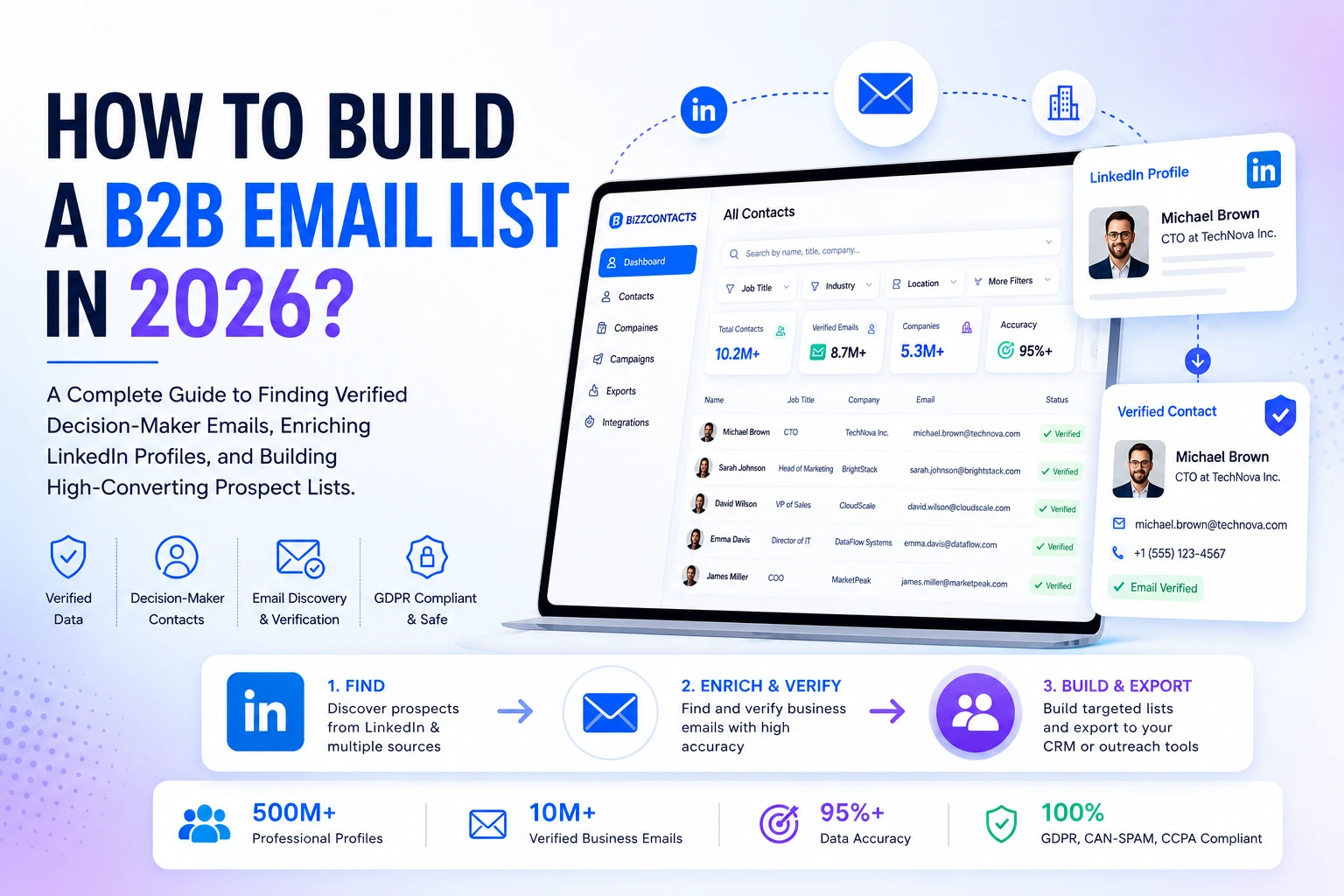
A B2B email list is a curated collection of verified professional information, such as names, business email addresses, direct dials, and job titles, of the top decision-makers of various companies. It allows B2B businesses to find the precise audience for their product and market exclusively to them, making the outreach more effective and affordable.
What makes a B2B list valuable?
Gone are the days when collecting exhaustive amounts of contacts and blasting the same message to all used to work. Now, buyers want relevance, and inbox rules are stricter, which means you have to accurately target your audience and offer value through your content. Irrelevant outreach will not just burn your marketing budget but harm your sender reputation irreparably.
Quality vs. Quantity
Many B2B teams prioritize hunting for more data without ensuring that they are collecting the right data. A valuable B2B email list is one where every single contact aligns with your ICP. A smaller but well-targeted email list is much better for outreach than a massive database with a high number of irrelevant contacts.
Right Data Points
Collecting contacts is of no use to you if they don’t offer you actionable insights you can use to generate leads. Therefore, to make your B2B list valuable, you need to ensure that it contains details such as job role, company, and industry, so that you can determine if the contact has decision-making authority and if you should reach out to them with your campaigns.
Accuracy And Freshness
B2B data decays really fast, which means that your email list might become stale before you realize. In order for a B2B list to be actually valuable to you, it has to be accurate and fresh. This means it is regularly updated, verified, and enriched, ensuring you reach real professionals who want to hear about your product.
A valuable list is less about its size and more about the opportunities it creates for you.
8 Ways To Build A High-Performing B2B Email List That Performs
Like we previously discussed, inbox rules have changed, which means in order to build a high-performing B2B email list, you have to be mindful of how you create your email list. Here are a few ways you could go about it -
Start Off With A Clearly Defined ICP
Before you start building an email list, you need to have a clear idea of who makes it to your email list. Otherwise, you might end up collecting contacts that seem even mildly relevant, making your outreach less targeted. You can start by asking the following questions -
- Which industries and company sizes should I target?
- Who are the decision-makers or key roles?
- What pain points does my solution solve?
Answering these questions will give you the clarity necessary to make your email list more targeted.
Now, let’s get to the list of methods.
Use Gated Content As Lead Magnets
Did you know that businesses using strategic lead magnets grow their email lists nearly 50% faster than those depending on organic signups? That’s right! Offering useful content for free incentivizes prospects to put down their contact details. Here’s a list of ways you can do it -
- Ebooks & Guides: Give them thorough knowledge about a topic they care about or an issue they are looking for ways to combat.
- Whitepapers & Reports: Share research, trends, or insights that are hard to come by and help them make better decisions.
- Templates & Checklists: Offer ready-to-use tools to make their day-to-day lives easier.
- Webinars & Workshops: Teach something valuable live. That way, you get high-intent connections while also coming across as an expert in the field.
- Free Trials or Demos: Before you push for a sale, ask them to try your product. This helps you come across as reliable instead of yet another company looking to make a sale.
- Case Studies: Show real stories of how you’ve helped others succeed. This helps your target audience see that your products work in real-life situations.
- Quizzes & Assessments: Interactive tools that keep your audience on your page, generating engagement and collecting contact info while giving personalized insights
- Discounts & Special Offers: Offer discounts and other exclusive perks on signing up. Since everyone loves a good deal, they will feel more inclined to share their contact information to enjoy it.
Such valuable content makes your target audience readily give up their contact details, allowing you to collect high-intent contacts while also building trust.
Utilize LinkedIn For List Building
Almost all decision-makers have a LinkedIn account these days, so if you aren’t leveraging the platform, you might be trailing behind. Go beyond searching for “contacts by job title” and utilize LinkedIn’s advanced search features to help you find your target audience. Here’s how you can go about it.
Use Boolean Operators
Combine keywords with AND, OR, NOT to precisely land on the profiles you need.
For example, “Marketing AND Manager NOT Assistant” filters out irrelevant results.
Filter by Industry and Company Size
Filter prospects by their sector and organization size to ensure that they match your targeting needs.
Leverage Location Filters
Set up your filters to target specific countries, states, cities, or regions, and find the right professionals there.
Save Searches and Set Alerts
LinkedIn lets you save searches and get notified when new profiles matching your targeting needs emerge, helping you keep your list fresh.
Check Out Mutual Connections
Find mutual connections and request them for warm introductions.
Analyze Profiles for Insights
Look at the activity, posts, and shared content of your target audience to understand pain points and personalize your messaging.
Given the fact that LinkedIn is 277% more effective than Facebook and X for lead generation, you will definitely miss out if you skip this platform while building email lists.
Organize Webinars and Virtual Summits
When it comes to establishing yourself as an expert in a field, webinars and virtual summits can generate unbelievable results. Here’s how you can use them to create credibility and become a go-to solution for your target audience.
Establish Your Brand’s Expertise
Host sessions that highlight your team’s knowledge and insights about the field. You can also consider discussing case studies to show how your solution works in real life to earn trust with your target decision-makers.
Engage Directly with Attendees
Use Q&A sessions, polls, and live chat to start conversations, address doubts, and offer solutions. This will help you build strong connections that might convert into leads later.
Build Strategic Partnerships
Collaborate with the standout brands or thought leaders within your industry. This boosts your credibility while also helping you expand your visibility to their audience.
Share Real Success Stories
Discuss customer success stories or demos to offer tangible proof of the effectiveness of your solution and create genuine interest around it.
Utilize Event Analytics
Track the engagement metrics of the event to find the most active and relevant prospects and connect with them via personalized outreach.
Repurpose The Content
Record your webinars and repurpose them as blogs, short videos for social media such as YouTube, Instagram, and TikTok, and on-demand resources to increase your chances of getting new sign-ups.
In B2B marketing, webinars have long stopped being a one-off event and have become a go-to method to build thought leadership and exhibit reliability. Using the methods we discussed allows you to do just that, building trust that organically brings in high-quality prospects with time.
Purchase Verified B2B Lists
A much easier, faster, and cost-effective route that numerous B2B businesses take is purchasing B2B email lists from reliable vendors. These vendors offer fully verified and highly relevant data, enabling marketers and SDRs to connect directly with real decision-makers who benefit from their offerings.
But choosing the right vendor takes a little more homework than just googling “B2B data vendors near me” or “the best B2B data vendors in the U.S,” as there are quite a few vendors selling poor quality data.
Here are a few things you need to keep in mind -
Accuracy
Opt for vendors that regularly refresh their email lists to reduce bounce rates and ensure that the contacts are active and up-to-date.
Compliance
Ensure that the data adheres to GDPR, CAN-SPAM, CCPA, and other relevant privacy regulations to avoid legal hassles.
Advanced Filters
Choose vendors with advanced segmentation options, so you can target prospects by industry, role, or company size and connect only with those who match your ICP.
CRM Integration
Select vendors offering CRM-ready email lists, allowing you to easily import the data into your existing workflows.
These pointers will help you find a data vendor offering just the high-quality data you need to run successful outreaches.
Use ABM To Target The Right Accounts
Another great method of building a high-performance B2B email list is going the ABM route. This means instead of targeting individual decision-makers’ contact details, you need to find high-value accounts and collect the contact details of all the relevant stakeholders.
Here’s how you can do it -
Identify High-Value Accounts
Start by filtering companies using firmographic data like industry, company size, revenue, and location. Use tools like LinkedIn, company databases, or reliable data vendors to find and shortlist accounts that match your ICP.
Find Decision-Makers
For each account, find relevant roles such as decision-makers and influencers using LinkedIn or company websites. Look for titles like Head, Director, or Manager in roles that directly use your product or solution.
Source Verified Contact Details
Use trusted data providers, lead generation tools, or form fills to collect accurate and permission-based email addresses.
Prioritize High-Value Contacts
Score accounts and accounts based on how aligned they are with your ICP and their role in the decision-making process.
Collect Opt-In Contact Information
Create personalized landing pages, gated content, or event invites customized for each account to nudge contacts to share their details willingly.
Segment by Role and Account and Add to Your Email List
Segment the contacts based on their role (such as decision-maker, influencer, and end-user) and company. Once that’s done, you can add them to your email list and run personalized campaigns later.
Collecting contact details via an ABM approach allows you to collect high-quality contacts that result in sales instead of building a gigantic collection of contacts that sits in your CRM and tanks your KPIs.
Use Website Content and Landing Pages To Gather Emails
Most B2B buyers start their buying journey by Googling their issues, and if your content shows up, your website becomes their first impression of your brand.
Therefore, your website content needs to do more than just display information and cash in on that high intent.
Here are a few ways you can do about it -
Create Targeted Landing Pages
Build focused landing pages that talk in detail about a single offering, explaining its traits and perks. Follow it up with a clear call-to-action that encourages the visitors to share their contact details.
Publish Content For Every Stage Of the Buyer Journey
Create informative content like blogs and articles for awareness, more insightful resources like case studies and product comparisons for consideration, and high-intent pages like product demos and free trials for decision stages.
Use relevant CTAs at each stage to collect email addresses for lead nurturing or sales outreach.
Optimize Website Forms for Conversions
Keep the website forms short and relevant. Ask only for essential details to improve sign-up rates.
Add CTAs Strategically Across Your Website
Place CTAs within blogs, product pages, and other spots within your website so that users can subscribe when their interest is at its highest.
Keep Testing Your Content
Regularly test the headlines, form placements, and CTAs to find the combinations that generate the most responses.
When you create a website and landing page content that answers the questions the users are asking, it gives them a reason to engage and trust you enough to give you their contact details.
Collaborate on Co-Marketing Campaigns
Creating enough credibility in your industry so that decision-makers willingly hand their contact details out can be tough, especially if you are a startup, an SMB, or just expanding into a new market. In such cases, running co-marketing campaigns can be quite beneficial.
Co-marketing campaigns are basically partnerships where two or more complementary and non-competitive companies team up to reach the same audience.
Here’s how you can launch your own campaigns -
Find the Right Partners
Find companies targeting the same audience but offering complementary solutions. That way, both of you benefit from the leads without competing among yourselves.
Create Valuable Content
Work together to come up with webinars, reports, or events that address a common issue for your audience. This gives your prospects the right reasons to connect with you.
Promote To Both Audiences
Maximize your reach by running campaigns across emails, social media, and website channels from both sides and bring in more qualified leads.
Co-marketing campaigns allow you to increase your visibility among an audience who already trusts your partner and operates in your industry, ensuring that you are not starting from zero when it comes to building credibility or starting conversations.
Create A Referral Programme
Did you know that referred customers have a 4X higher chance of making a purchase? Given its effectiveness, you need to ensure that you have a referral programme in place.
Here’s how you can create it -
Offer Great Incentives
Reward your customers when they refer you to others, whether it’s discounts, credits, or exclusive access.
Make It Easy to Refer
No one would want to work hard to give a referral for your brand. So, make the referral process simple by offering shareable links, referral codes, or email invites.
Promote the Programme
Highlight your referral programme on platforms such as emails, website pages, and product touchpoints to ensure your audience knows about its existence.
Monitor Performance
Keep a constant eye on the program to understand what’s working and adjust the rewards or messaging if needed.
Nurture The Contacts In Your Email List
While building an email list is critical in B2B, it won’t give you the success you desire if you don’t have lead nurturing cadences in place.
Different contacts in your CRM might be at different stages in their buyer journey. While some might be just discovering that they have a problem and your product can help solve it, others might already be comparing your solution to those of your competitors. Therefore, you need to keep sending emails that nurture them and convince them to purchase from you.
Here’s how you can do it -
Segment Your Audience
Put your audience into groups based on their stage, role, or behavior so that you can send them relevant content.
Offer Content That Matches Their Buyer Stage
Every buyer stage has its unique requirements, so ensure that you create content that solves those requirements.
For instance, in the awareness stage, your target audience is trying to understand their problem and seek viable solutions. Therefore, you should publish informational content such as blogs, articles, and guides for that stage.
Set Up Automated Drip Sequences
Create email cadences that trigger based on actions like sign-ups or downloads. This ensures that your leads are getting nurtured automatically and consistently without manual effort.
Personalize Wherever Possible
Use relevant professional details like name, company, or recent buying behavior to create relevant emails that address their pain points.
Nurturing your emails is beneficial in two ways. One, it warms up cold leads and increases the chances of conversion. Two, it helps your audience remember your brand, ensuring they don’t end up forgetting you and choosing a competitor. And three, it helps build trust and push the prospect into making a purchase.
Track Email List Performance
Done building your email list? Think you can relax now? Think again! B2B data degrades at an alarming rate, which means you can’t really trust your email list to be accurate for a very long time.
A great way to know whether your email list needs to be refreshed is by monitoring how it performs. Track KPIs such as deliverability, unsubscribe rates, and bounce rates. A decrease in deliverability and a spike in the other two indicate that your email list needs refreshing.
Data accuracy is one-half of it. Tracking campaign KPIs such as open rates, click to open rates, and click through rates tells you whether your copy is getting the right kind of response or needs work.
Data Compliance In Email List Building
Imagine running a campaign, hoping it will help you generate leads and drive conversions, only for it to land you in a legal hassle. Your campaign might end up meeting this fate if your email list isn’t in line with the data compliance laws of your target region.
Therefore, research the applicable data protection laws thoroughly.
For instance, GDPR requires every contact to be opt-in, while CAN-SPAM doesn’t require explicit opt-in but needs honesty and transparency in how and why you are collecting the emails.
Wrapping Things up,
B2B email list building in 2026 is about collecting fewer but high-quality contacts. It is about precisely defining your ICP and ensuring only highly relevant contacts make it to your CRM. There are quite a few ways you can go about it. You can leverage LinkedIn, run co-marketing campaigns, or even launch a rewarding referral program. Have a lead magnet in place, create engaging landing pages, and you can easily build an opt-in email list full of high-intent contacts. Just don’t forget to verify the raw data and ensure that it is compliant before running a campaign.
Alternatively, you can research and find a reliable data vendor to supply you with a premium email list. Or, you can skip all this hassle by connecting to xxx for custom-built email lists that are guaranteed to perform. Consider all the options and choose the methods that serve you the best! Good luck!
Frequently Asked Questions
Calvin Christopher is the Marketing & Sales Manager at BizzContacts, specializing in B2B marketing, lead generation, sales intelligence, and verified business contact data.