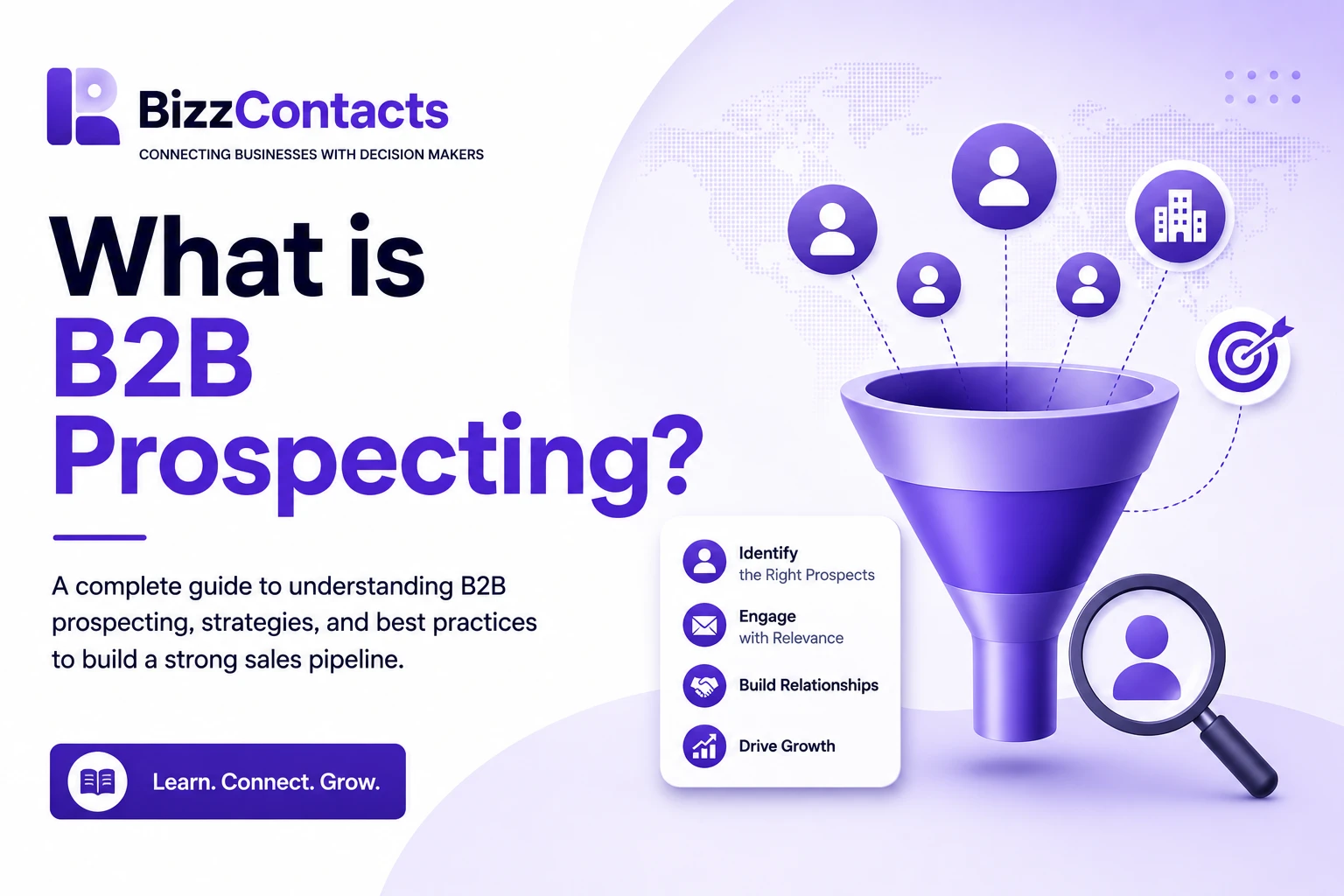
What is B2B Prospecting? A Complete Guide in 2026
A complete guide to B2B prospecting in 2026: definition, prospecting vs lead generation, the modern five-step process, top channels, high-conversion techniques, common mistakes to avoid, essential tools, and the metrics that actually predict pipeline.

Every closed-won deal starts with a decision to reach out. B2B prospecting is the discipline of picking the right accounts, the right decision makers, and the right moment for that reach-out, then running the outreach in a way that earns a first conversation. It is the earliest and most decisive part of the sales cycle, and it is the reason two teams selling the same product post very different pipeline numbers.
This guide covers what B2B prospecting is, how it differs from lead generation, the modern process in 2026, the channels and techniques that still convert, the common mistakes that quietly kill pipeline, and the metrics that predict which prospecting motions will actually book meetings. Everything is written for operators, not gurus.
What is B2B Prospecting?
B2B prospecting is the sales activity of identifying potential buyers at target companies and starting a personalized conversation designed to move them toward a first meeting. It sits in the first phase of the sales cycle, before qualification and before demo. The output of good prospecting is not a signed contract. It is a booked discovery call with a real decision-maker at a real target account.
A prospect is not a customer, not a lead, and not a random contact. A prospect is a named person at a company that fits your ideal customer profile who has not yet raised their hand. Turning that person into a first conversation is the prospector's job. Everything downstream, closing rate, ACV, retention, is shaped by whether that first conversation happened with the right person for the right reason.
Modern prospecting blends four ingredients: a precise account list, verified contact data, a relevant reason to reach out, and a multi-channel cadence that respects the buyer's time. Miss any one and results fall off a cliff. Combine all four and even a small team punches well above its weight.
- It is proactive, not passive. Prospectors initiate the conversation.
- It is targeted, not blast. Every touch is aimed at a named account and named person.
- It is multi-channel. Email, phone, LinkedIn, video, and referrals are all in scope.
- It is measurable. Reply rate, meeting-set rate, and pipeline generated are hard numbers.
- It is a role and a system. Great teams treat prospecting like a repeatable operation.
B2B Prospecting vs B2B Lead Generation
The two terms get used interchangeably, but they are not the same thing. Lead generation is the broader marketing motion that captures interest at scale and produces MQLs. Prospecting is the narrower sales motion that starts named-account outreach even when the prospect has not raised a hand. One creates inbound flow; the other creates outbound flow.
| Dimension | B2B Lead Generation | B2B Prospecting |
|---|---|---|
| Ownership | Marketing (with SDR overlap) | Sales development or AE |
| Trigger | Buyer raises hand (form fill, download, signup) | Seller identifies fit and initiates outreach |
| Volume | Higher, less targeted | Lower, more targeted |
| Channels | SEO, content, ads, events, webinars | Cold email, phone, LinkedIn, referrals, ABM |
| Data need | Traffic + form fills | Verified contact database, direct dials, LinkedIn URLs |
| Success metric | MQLs, MQL-to-SQL conversion | Meetings set, pipeline generated, reply rate |
| Speed to pipeline | Slower (weeks to months) | Faster (days to weeks) |
| Best fit for | Large TAM, self-serve motion | Named-account plays, enterprise deals |
If you are curious about the lead-generation side of this comparison, we have a dedicated guide covering the funnel and top strategies at B2B lead generation.
Why B2B Prospecting Matters in 2026
The 2026 buying environment has three characteristics that make prospecting more important, not less. Inbound volume is flat or declining across most B2B categories as content saturation caps organic reach. Buyer committees have grown to five to seven people, which means the same deal now requires more contacts, not fewer. And AI-generated outbound has raised the noise floor, which means only relevance and precision win replies.
The teams winning in this environment share a pattern: they invest in verified data, they run tighter target lists, they use trigger events instead of generic pitches, and they treat prospecting as a repeatable operation with clear metrics. The result is a smaller, cleaner motion that produces a larger, faster pipeline.
The Modern B2B Prospecting Process
Prospecting is a system, not a talent. The five steps below map to how the highest-performing teams run it in 2026. Every step has a measurable output, so any breakdown in results traces back to the step that owns it.
Step 1: Define your ICP and target account list
Everything starts with a precise ideal customer profile. Industry, sub-industry, revenue band, employee size, geography, and installed technology are the six primary axes. Add one or two secondary axes only if they materially predict fit, such as funding stage for series-A tools or accreditation for healthcare products. A team that skips this step ends up prospecting into accounts nobody would call a good fit, and reply rates collapse.
Once the ICP is written, build the target account list. Two hundred named accounts is a common starting point for a single SDR; enterprise motions may run tighter at 40 to 80. The list is not sacred. Refresh it every 60 to 90 days and drop accounts that failed to engage after two full cycles.
Step 2: Build verified contact data for the buyer committee
The average B2B deal in 2026 has 5.4 buying-committee members. Prospecting to only one contact per account is why so many outbound programs stall. For each target account, identify the economic buyer, the technical evaluator, the end user, and the internal champion, and enrich each with verified email, direct dial, and LinkedIn URL. A verified B2B contact database with regular re-verification is the fastest way to do this at scale.
If the sale depends on installed technology, pair the contact list with installed-base intelligence so outreach names the specific platform in use. Naming SAP, Salesforce, or Workday in the first line lifts reply rates two to three times over a generic pitch.
Step 3: Research the trigger and personalize the reason
Personalization is not the first name in the salutation. It is the reason the prospect should care right now. Trigger events supply that reason: new hire in the buyer's role, funding round, product launch, org restructure, executive turnover, expansion into a new market, a public earnings-call mention of a pain point, or a technology change flagged by intent data. The trigger is the fifteen seconds of context that turns a cold reach-out into a warm conversation.
Step 4: Multi-channel outreach with a deliberate cadence
Single-channel outbound is dead. A high-performing prospecting cadence pairs cold email with LinkedIn touches, direct dials, and video, spread over 10 to 14 business days. Six to nine touches across three channels is the current benchmark for named-account plays. The cadence is deliberate: each touch adds information rather than repeating the pitch, and each channel plays a specific role. Email carries the pitch, LinkedIn earns familiarity, phone drives urgency, and video adds warmth.
Step 5: Qualify the meeting and hand off cleanly
A booked meeting is only the beginning. Before the call the prospector needs to confirm four things: the prospect is a real decision-maker or influencer, the pain named in the outreach is real and current, there is an evaluation window in the next 90 days, and any prep material (agenda, one-pager, security PDF) has been sent. Meetings that skip this qualification produce demos that produce nothing. The hand-off to the AE should include the trigger, the pain named, the buyer center, and any objections voiced during scheduling.
The Best B2B Prospecting Channels
No single channel produces the whole outcome. The current stack is:
Cold email
The workhorse channel. Verified email data, warmed sending domains, and a personalized first line still produce the strongest volume-to-meeting ratio in most B2B categories. Modern deliverability best practice includes SPF, DKIM, DMARC, dedicated sending domains, and disciplined list hygiene. Reply rates in the 4-8% range are achievable when the list is verified and the pitch names a real trigger.
Phone and direct dials
Direct dial connect rates rebounded in 2026 after years of decline, driven by younger buyers picking up mobile calls when the caller ID is familiar. Phone works especially well for named-account plays into operations, procurement, and mid-market SMB where inbox saturation is highest.
The relationship channel. Comments on the prospect's content, personalized connection requests, and Sales Navigator inMail are all fair game when used sparingly. The best LinkedIn prospecting starts warm: engage with the prospect's posts three to five times before ever pitching, so the connection request lands with recognition attached.
Video and voice notes
Loom, Vidyard, Sendspark, and native LinkedIn voice notes have moved from novelty to routine. A 30 to 60 second personalized video referencing the prospect's website, product, or recent news outperforms plain text on reply rate, especially for enterprise plays where the buyer is drowning in AI-generated cold email.
Referrals and warm introductions
The highest-converting channel is also the smallest by volume. Referrals from customers, mutual investors, board members, or personal networks convert at three to five times the rate of any cold channel. Every prospecting program should include a systematic referral ask baked into onboarding and post-close.
Events, communities, and podcasts
Trade shows, industry Slack groups, community events, and podcast guest appearances create warm surface area that other channels can convert. A prospector who attends the same three events their ICP attends has a permanent context advantage over a competitor cold-emailing from outside the community.
B2B Prospecting Techniques That Work in 2026
ICP-first list building
Filter the target list on hard fit criteria before touching any messaging. If the account cannot buy, the message cannot save it. Verified data lets a prospector filter by NAICS, revenue, employee band, technology in use, and geography before the first email is drafted.
Trigger-event prospecting
Reach out inside a 30-day window of a real change at the account: new executive, new funding, new product launch, new office, new partnership, or new regulation. Trigger-event outreach outperforms generic outreach 3-4x on reply rate because the timing is intrinsically relevant.
Multi-thread the buyer committee
Prospect to three to five contacts per target account, not one. Enterprise deals rarely close with a single champion because a single champion can leave, get overruled, or lose interest. Multi-threading distributes risk and speeds evaluation. Coordinate the touches so contacts see a consistent narrative, not conflicting pitches.
Intent-based prioritization
Overlay third-party intent (Bombora, 6sense, G2 Buyer Intent) or first-party signals (website visits, community activity, LinkedIn engagement) on the target list, then reprioritize the queue every week. Prospecting into an in-market account lifts meeting-set rate by 40-70%.
Point-of-view prospecting
Publish a strong point of view on the prospect's problem before the first touch. A LinkedIn post, a short teardown, or a two-minute video that names the pattern the prospect is already thinking about creates familiarity and permission. The reach-out then references the point of view instead of pitching cold.
Executive-to-executive outreach
For deals over $100K ACV, having the seller's CEO or VP send a one-line email to the buyer's counterpart still converts at rates most SDRs cannot touch. A dedicated executive-to-executive prospecting cadence targeting the top 20-30 accounts a quarter is worth building.
Common B2B Prospecting Mistakes to Avoid
- Prospecting to a bad list. If the account cannot buy, no message will save the touch. Filter for fit before drafting messaging.
- Personalizing only the first line. If the pitch is generic beneath the first sentence, replies still fall off.
- Single-channel outreach. Email alone works only for a fraction of the buyer base. Add phone and LinkedIn.
- Cadence fatigue. Eight touches over three days feels like harassment. Space touches over 10 to 14 business days.
- Ignoring compliance. GDPR, CAN-SPAM, CCPA, and CASL rules still bind outbound. Unsubscribes must be honored inside ten business days.
- No trigger. Reaching out with no fresh reason gets ignored. Every campaign should name a change at the account.
- Prospecting only the champion. The champion can leave. Multi-thread the buyer committee from day one.
- Skipping meeting qualification. A booked demo with the wrong person is worse than no demo. Qualify before the call.
- Confusing volume with pipeline. 800 sends a week is not a strategy. Reply rate and meeting-set rate are the real numbers.
- Never refreshing the target account list. Accounts change. Cycle 15-20% of the list every quarter.
Essential B2B Prospecting Tools
The 2026 prospecting stack has five layers. Contact data supplies the verified emails, direct dials, and LinkedIn URLs. Sales engagement platforms run the cadences. Intent data prioritizes the queue. Video and Loom-style tools add warmth. And a CRM stores the state of every conversation.
| Layer | Purpose | Examples |
|---|---|---|
| Verified contact data | Names, emails, direct dials, LinkedIn URLs, firmographics, technographics | BizzContacts, Apollo, ZoomInfo, Cognism |
| Sales engagement | Multi-touch cadences across email, phone, LinkedIn, and tasks | Outreach, Salesloft, HubSpot Sales Hub |
| Intent and signal data | Buyer surge detection to prioritize the queue | Bombora, 6sense, G2 Buyer Intent, ZoomInfo Intent |
| Video and voice | Personalized asynchronous touches that earn attention | Loom, Vidyard, Sendspark |
| CRM and pipeline | Central record of accounts, contacts, opportunities, and forecast | Salesforce, HubSpot, Microsoft Dynamics 365, Pipedrive |
| LinkedIn intelligence | Reveal verified emails and direct dials on any LinkedIn profile | BizzContacts Chrome Extension |
The B2B Prospecting Metrics That Actually Matter
Volume is a vanity metric. The following six numbers are what predict whether a prospecting motion is producing pipeline or noise.
- Reply rate. Total replies divided by total sends. 4% is a healthy benchmark for cold email; 6-8% is excellent.
- Positive reply rate. Only replies that show real interest, filtered from unsubscribes and hard nos. 1.5-3% is good.
- Meetings set. The count that matters. Track by day, week, quarter, and per SDR.
- Meeting show rate. Booked meetings that actually happen. Below 60% means qualification is broken.
- Meeting-to-opportunity rate. Meetings that convert to opportunities in the CRM. A trailing signal for lead quality.
- Pipeline generated. Dollar amount of opportunities created from prospecting-sourced meetings, tracked per SDR and per campaign.
Two secondary metrics warrant attention: cost per meeting (fully loaded, not just tool cost) and touches per meeting (channel mix efficiency). A rising cost per meeting with steady volume usually signals list decay; a rising touches-per-meeting number signals cadence fatigue.
Prospecting Playbooks By Industry
The universal principles hold across industries, but the specific tactics that convert vary by sector. Below is a fast survey.
Healthcare
Prospecting into healthcare requires NPI-based targeting, HIPAA-aware messaging, and long-cycle patience. The buyer committee is wider than most sectors because clinical, financial, and IT all weigh in. See our healthcare email list pattern for how the buyer center is structured across specialties and hospital systems.
Manufacturing
Manufacturing prospecting benefits enormously from NAICS filtering and installed-technology signals. Plant managers and VPs of operations respond to specific production pain named in the outreach. Our manufacturing industry email list page maps the six-role buyer center and the eight most common go-to-market plays.
SaaS and Technology
Tech buyers respond to platform-specific outreach. Installed-base data (SAP, Oracle, Salesforce, Workday, NetSuite, HubSpot, Microsoft Dynamics 365) is the strongest single input. Prospecting cadences tend to be shorter (8-10 business days) because the buyer moves faster.
C-Suite outreach
Prospecting into C-suite buyers requires brevity, sharp point of view, and executive-to-executive sender authority. See the CEO email list and CFO email list guides for how the pitch structure shifts at the top of the org.
The Future of B2B Prospecting
Three shifts are actively reshaping prospecting in 2026, and every one of them favors prospectors who prioritize quality over volume.
AI raises the noise floor and the relevance bar
AI-generated cold email has flooded inboxes. That flood raises the noise floor, which means average-quality outbound now performs worse than it did two years ago. It also raises the relevance bar: outreach that references a real trigger, a real point of view, and a real named person outperforms because it is instantly distinguishable from bot-generated pitches.
Intent data becomes table stakes
First-party website signal, third-party intent, and technographic change are moving from bonus features to baseline inputs. In 2026, running prospecting without any signal overlay is like driving with the map off.
Consolidation of the outbound tool stack
Verified data, engagement, intent, and CRM are collapsing into unified platforms. Prospecting teams no longer stitch six tools together to run a single cadence. That consolidation lowers cost per meeting and shifts investment from tools to people and to data quality.
B2B Prospecting FAQs
Where to Start
B2B prospecting rewards teams that treat it as a system rather than an activity. The four levers that matter most are the account list, the contact data, the trigger, and the cadence. Get any two right and results improve materially; get all four right and results compound.
If you are rebuilding your prospecting motion from scratch, start with the account list and the contact data because they gate everything else. A verified target list of two hundred named accounts with three to five decision-makers each, filtered by NAICS, revenue, and technology, is a stronger starting point than any messaging framework. Everything else is downstream of that foundation.
When you are ready to start, request a free 50-record sample tailored to your ICP. It ships inside one business day and carries the same fields the full BizzContacts prospecting database ships with.
Calvin Christopher is the Marketing & Sales Manager at BizzContacts, specializing in B2B marketing, lead generation, sales intelligence, and verified business contact data.