What is B2B Marketing? A Complete Guide in 2026
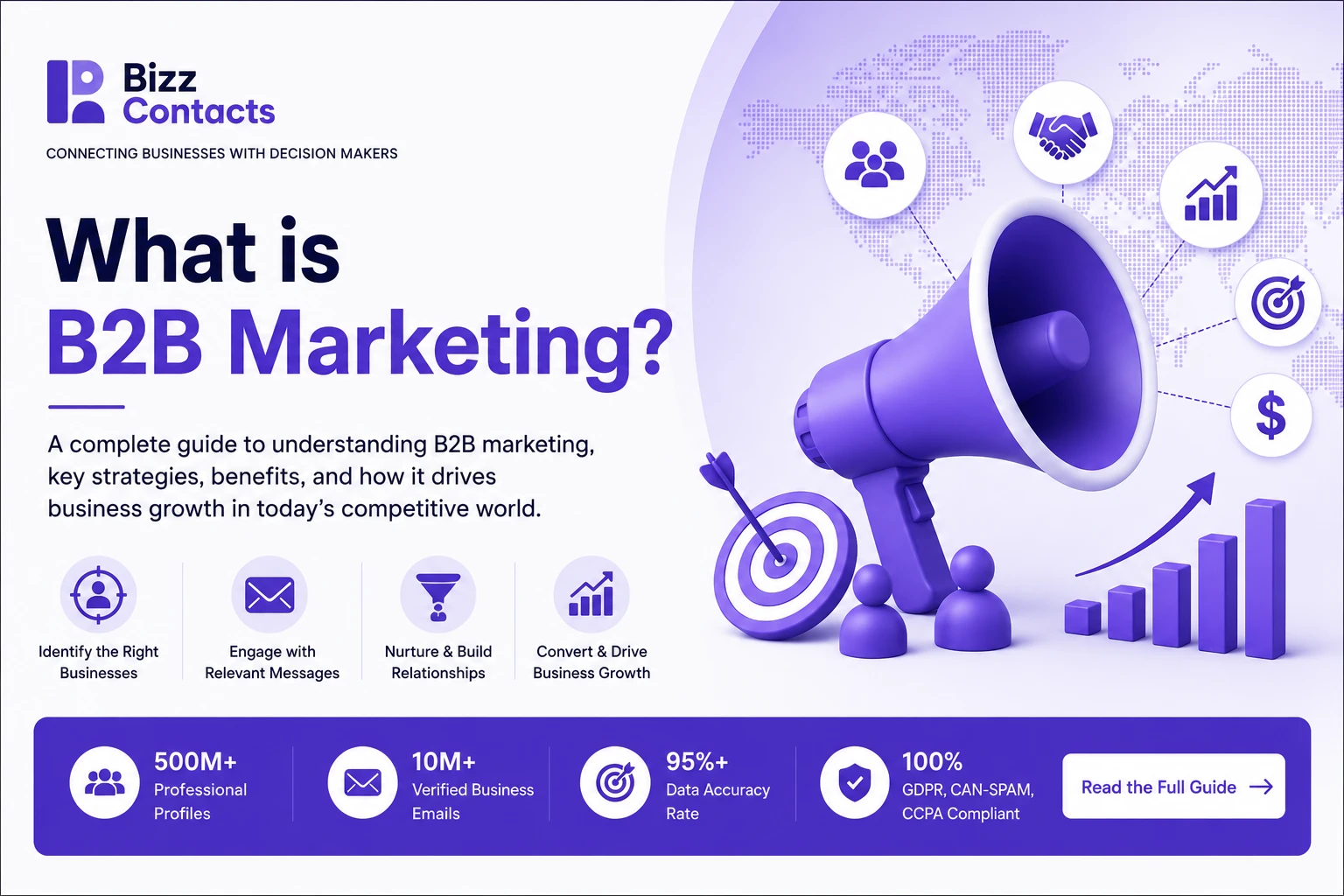
A complete guide to B2B marketing in 2026: the definition, how it differs from B2C, the four core marketing types, the channels and strategies that convert, common challenges, and where the discipline is headed next.

"B2B" stands for business-to-business, and if you have ever built a product your team believed in, launched it, and then watched months pass with no leads and no conversions, the problem was probably never the product. It was a gap in understanding what B2B marketing actually is and how it works.
Business buying is slow, complex, and built on trust, not impulse. B2B marketing is the discipline of selling products and services from one business to another rather than to individual consumers, and in 2026 it matters more than ever. It is no longer just about moving product. It is about selling solutions, experiences, and a long-term value system that a business can point to when it justifies the purchase internally.
Traditional marketing leaned on local presence and broadcast channels: print ads, billboards, face-to-face sales calls. Modern B2B marketing is different. It is built on relationships, trust, and measurable value, and it shapes revenue and brand positioning whether you are a startup, a SaaS company, or an established enterprise.
This guide covers everything from the fundamentals to the strategies and channels working right now, plus where B2B marketing is headed next.
What is B2B Marketing?
B2B marketing means promoting products and services from one business to another rather than to individual consumers. It is about solving business problems where multiple stakeholders are involved, not fulfilling a single person's want. The audience is decision-makers, managers, executives, and procurement teams, not casual shoppers.
A few characteristics separate it from consumer marketing:
- Data-driven decision-making
- Higher transaction values
- Multiple stakeholders in every deal
- A structured, step-by-step purchasing process
- Long-term relationship building over one-time sales
In practice, B2B marketing helps a business grow, operate more efficiently, and solve real problems, alongside selling the product itself.
Types of B2B Marketing
Businesses lean on several types of B2B marketing depending on their goals and industry. Four do most of the work.
1. Content Marketing
Content marketing is the backbone of most B2B marketing strategies. In a digital-first market, it builds authority, transparency, and trust before a prospect ever talks to sales. That means long-form, educational content, blogs, whitepapers, case studies, and guides that teach rather than pitch, plus customer success stories that give a buyer a reason to trust you before they buy.
A working content calendar maps to the funnel: top-of-funnel blog posts for awareness, mid-funnel case studies and guides for consideration, and bottom-of-funnel comparisons and ROI calculators for the decision stage. Refreshing older content regularly and linking it internally keeps it compounding instead of decaying, which is exactly why this guide links back to our B2B lead generation guide.
2. Email Marketing
Done well, email is one of the highest-performing B2B marketing channels there is. It is direct, personal, and measurable. Email nurtures leads, builds relationships, and drives sales with a list of people who actually opted in, and it can run on autopilot once workflows are segmented by behavior and demographics.
The channel only works if you are talking to the right decision makers. Open rates, click-through rates, and conversion tracking show exactly which emails move a deal forward, but none of that matters if the list itself is stale. A verified B2B contact database keeps bounce rates low and protects the sender reputation the whole program depends on.
3. Social Media Marketing
Social media marketing (SMM) uses platforms like LinkedIn, Instagram, and Facebook to build brand awareness, engage buyers, and drive conversions with content tailored to a specific audience. It spans strategy, content creation, community building, paid advertising, and analytics.
The power of SMM comes from connection and data, not reach alone. It is brand building, advertising, and data-driven marketing running at the same time, which is why it rewards teams that treat it as a system rather than a series of one-off posts.
4. Search Engine Optimization (SEO)
SEO drives organic traffic through targeted keywords, and serious B2B buyers usually start their research with a search. Tools like Ahrefs, Semrush, Ubersuggest, and Google Keyword Planner surface the keyword opportunities that put your site in front of buyers while they are actively looking.
SEO in B2B takes longer to pay off than paid channels, but it compounds. Getting the most out of it means optimizing site structure, title tags, meta descriptions, and content itself, and earning backlinks that signal authority to search engines.
Each of these four types plays a different role in reaching the target audience and turning visitors into customers. Most B2B teams run all four at once, not one at a time.
How B2B Marketing Works
B2B marketing builds campaigns on logic, ROI, and trust. It starts by identifying what a target business needs and guides that business through a structured decision-making process, understanding its growth stage, its challenges, and its goals along the way. The content exists to educate and inform first, and to promote second.
Awareness
The buyer identifies a need or a problem and starts researching, almost always online.
Consideration
The buyer compares solutions against the market and talks to peers, all before a salesperson enters the conversation.
Decision
The purchase decision comes down to value, credibility, and price, with data and analytics increasingly shaping which option wins.
Retention
The relationship continues after the sale through the same channels that won the deal, because a renewed or expanded account is cheaper to keep than a new one is to win.
The journey rarely moves in a straight line, because multiple stakeholders are involved at once. One person downloads an e-book while another follows the brand on LinkedIn and a third attends a webinar. Consistent communication across all of it, over time, is what builds the relationship. B2B marketing nurtures leads toward a well-informed purchase decision through patience, consistency, and strategy, not pressure.
B2B Marketing vs B2C Marketing
B2B and B2C marketing both aim to sell, but the approach is nothing alike. B2B marketing runs on logic, involves multiple stakeholders, and plays a long-term relationship game rather than chasing an individual consumer's impulse. B2C marketing targets one person directly with emotionally driven messages built for a fast, often impulsive, purchase. B2B optimizes for ROI over a long cycle; B2C optimizes for brand awareness and quick conversion.
| Aspect | B2B Marketing | B2C Marketing |
|---|---|---|
| Target audience | Businesses | Individual consumers |
| Decision driver | Logic and ROI | Emotion, desire, and impulse |
| Sales cycle | Long-term, often months | Short-term, often same-day |
| Content style | Technical, informative, detailed | Engaging and entertaining |
| Relationship | Long-term and consultative | Short and transactional |
An effective strategy starts with knowing which of these two worlds you are actually operating in. Understanding the split helps a marketer tailor messaging, channel mix, and pacing to the audience that is actually buying.
Key B2B Marketing Channels
The right channel mix matters because B2B buyers are not impulsive. Email, LinkedIn, webinars, and content marketing all work the same way: they educate and inform over time until trust is built, rather than pushing for an immediate sale.
LinkedIn remains the strongest platform for professional networking, and 85% of B2B marketers use it as a strategic tool for brand authority and lead generation. Reps who prospect heavily on the platform lean on tools like the BizzContacts Chrome extension to reveal verified emails and direct dials on any profile without leaving the page.
Email is one of the highest-ROI channels in B2B marketing precisely because it is built for relationships, not instant sales. It nurtures leads and delivers education over a series of touches instead of asking for a decision on the first message.
SEO
SEO is a high-value channel because it beats paid ads on organic traffic once the content is in place. High-quality, well-optimized content leads directly to sales opportunities by building authority that compounds over time, unlike ad spend that stops the moment the budget does.
Webinars
Webinars and virtual events are built for engagement and education. They produce high-quality leads by establishing authority and solving a real industry pain point live, rather than pitching a room that showed up expecting a sales call.
Every channel plays a specific role across awareness, nurturing, and decision support. The goal of a channel strategy is simple to state and hard to execute: get the message to the right person at the right time, consistently, until a potential buyer becomes a long-term customer.
B2B Marketing Strategies in 2026
Standing out in a saturated market takes more than a bigger budget. B2B marketing strategy in 2026 is personalized, value-oriented, and data-driven, and companies are moving past generic messaging toward AI-assisted targeting that responds to actual buyer behavior rather than a demographic guess.
1. Content-First Strategy
Instead of leading with a pitch, content-first marketing educates the business on its own pain points through blogs, case studies, and whitepapers, which makes the eventual buying decision easier and more confident. High-quality, insightful content is the foundation every other tactic on this list depends on.
2. Account-Based Marketing (ABM)
ABM is a highly targeted approach that goes after specific high-value accounts instead of a broad audience, building a personalized strategy, including custom email, content, and social outreach, around each account's specific needs and goals. It is the natural fit for selling into named enterprise accounts or a defined list of decision-makers, and it overlaps heavily with B2B prospecting. Done well, it consistently lifts conversion rates and ROI over broad-based campaigns.
3. Data-Driven Marketing
Analytics and insight refine every campaign that follows. Tracking buying patterns and behavior lets marketers reallocate resources in real time with AI and automation, predict what a buyer does next, and cut the guesswork out of the plan. Building this muscle usually starts with understanding what B2B data actually is and how it gets verified, and if you are evaluating vendors, the guide to the top B2B data providers in the USA is a useful starting point.
4. Personalization
Personalization tailors messaging to a specific industry, company, and set of challenges instead of sending the same message to everyone on the list. Personalized emails and ads only work, though, if the underlying contact and firmographic data is accurate, which is why more teams are sourcing from a verified B2B contact database instead of building lists by hand.
5. Sales and Marketing Alignment
Marketing generates the leads; sales closes them, and the split only works when both teams are chasing the same number. Close alignment cuts down on handoff friction and misunderstanding, and it is one of the most reliable ways to convert a full pipeline into closed revenue instead of a stalled one.
The strategies that win in 2026 combine technology with empathy. AI paired with a human touch solves real business problems and creates meaningful interactions at every stage of the buyer's journey. Voice-first optimization, video-first content, interactive tools, sustainability, data privacy, and ethical branding are all shaping what "meaningful" and "authentic" mean in B2B marketing going forward.
Challenges in B2B Marketing
B2B marketing comes with real friction, and understanding it up front makes for better decisions later.
- High competition in a crowded market
- Complex decision-making across stakeholders with different priorities
- Long sales cycles that take real time to close
- Reaching the actual right audience instead of a lookalike
- Measuring ROI accurately across a long, multi-touch cycle
None of this resolves overnight. B2B marketing rewards patience, attention, and consistency, which means strategic planning and continuous optimization matter more than any single campaign. The best practice across all of it: focus on value over volume, invest in content, use data properly, build real relationships, and optimize for search so the content keeps working after it is published.
Role of Technology in B2B Marketing
Technology has changed what is possible in B2B marketing by making it faster, smarter, and more targeted, largely by making it easier to collect and act on data. A few categories of tooling do most of the heavy lifting:
- CRM systems such as Salesforce and HubSpot for tracking every account and interaction
- Automation tools for running email and outreach campaigns at scale
- Data analytics software for personalizing communication based on real behavior
- Customer data platforms for tracking performance in real time
AI and machine learning now help B2B marketers predict trends, optimize strategy, and make faster decisions, while digital channels expand how far a team can reach without expanding headcount. Technology is what makes scaling a relationship-driven motion actually possible.
The Future of B2B Marketing
B2B marketing is only getting more personalized and more relationship-driven, powered by AI and data analytics that read buyer behavior and needs more precisely than any manual process could. Expect hyper-personalized experiences, content that stays central but becomes more interactive, and account-based marketing and automation that solve specific business problems instead of broadcasting to everyone.
Trust, authenticity, and transparency sit at the center of that shift, not aggressive selling. The winning approach blends human-centered strategy with advancing technology, continuously analyzing and optimizing content across every channel a buyer actually uses.
Conclusion
B2B marketing in 2026 is equal parts strategy, psychology, and necessity. Businesses that adapt to a fast-changing landscape and lead with effective B2B marketing strategies win the deals that go to companies focused on helping, not just selling. The companies that turn silence into conversation, personalize consistently, and build for the long term will keep winning.
Content marketing, account-based marketing, and data-driven strategy will keep doing most of the work as technology and competition both keep moving. The shift that actually matters is simple to state: stop selling and start helping. Businesses that educate their audience naturally become the reliable partner instead of just another vendor, and in a digital landscape, closing one deal matters far less than opening a lasting relationship.
Ready to put verified data behind your next campaign? Get a free sample from the BizzContacts B2B email list, or go straight to the executive email list to reach CEOs, CFOs, CMOs, and every other C-suite title your ABM program is targeting.
Frequently Asked Questions
Calvin Christopher is the Marketing & Sales Manager at BizzContacts, specializing in B2B marketing, lead generation, sales intelligence, and verified business contact data.