
Our Clients















What Actually Makes an ENT Contact Valuable?
Every data vendor shows you a list of fields. Almost none of them explain why any given field changes what happens when you hit send. So here is the reasoning behind the ones that matter, and what each one lets you do that you could not do without it.
Not a personal address, and not a generic info@ inbox that a receptionist triages. A working professional address is the difference between landing in front of the physician and landing in a queue nobody reads. It is also what protects your sender reputation, and that reputation carries across every campaign you run afterwards, not just this one.
This tells you who else is in the room. An ENT at a 600-bed academic centre cannot buy your equipment alone, and knowing that up front means you can build the account plan rather than discovering the committee three calls in. It also lets you run proper account-based campaigns, reaching every relevant specialist inside a target health system instead of the one name you happened to have.
Otolaryngology splits into rhinology, otology and neurotology, laryngology, head and neck oncology, facial plastics, paediatric ENT, and sleep surgery. A rhinologist and a neurotologist share a board certification and almost nothing else in their working day. Writing to both with the same message guarantees at least half your audience files it as irrelevant within two seconds.
Territory routing is the obvious use, but location does more than that. ENT density is uneven, and your rep in Montana faces a completely different market from your rep in Los Angeles. City and ZIP-level accuracy also lets you build conference-adjacent campaigns, targeting the specialists within driving distance of an event you are sponsoring.
Department chairs, practice owners, and service line leads sign things. Associates recommend them. Both are worth reaching, but not with identical copy. A message about clinical outcomes lands with the physician who will use the product; a message about throughput and cost lands with the person who has to justify it.
Experience changes buying behaviour in a way that surprises buyers. Physicians in their first few years of independent practice are still assembling their toolkit and are markedly more open to switching. Established specialists have settled workflows and need a stronger reason to change. Same product, two different arguments, and tenure is what tells you which one to lead with.
Hospital-employed, private practice, academic, or part of a multi-site group. This single field probably changes more about how you sell than any other. The private practice owner can trial your product next month. The hospital employee is looking at a capital cycle two or three quarters out. Sending both the same call to action wastes one of them.
None of this is exotic. It is simply the information you would gather yourself if you had a researcher and a few months. The point of buying an ENT specialists email database is that somebody already did, and keeps doing it every week.
The Data Fields on Every ENT Record
Twenty-three fields ship as standard. You do not have to take all of them, and most people do not. Tell us which ones your CRM actually uses and we build the ENT specialists mailing database around that shortlist, so you are not paying for columns nobody opens.
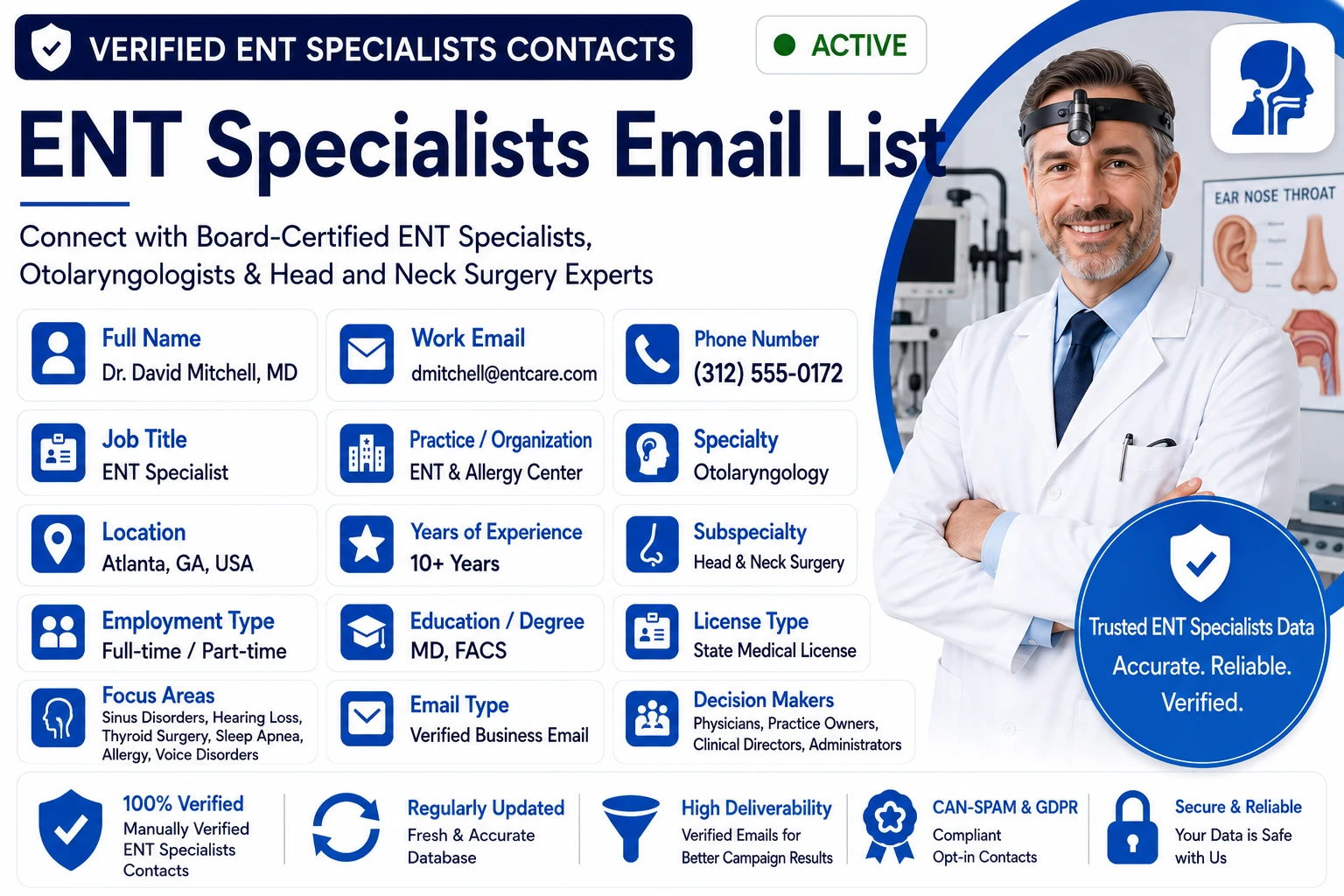
Field availability varies a little by record and by country. International records carry the local registration identifier in place of NPI, and a handful of fields are populated on most rather than all of the file. Rather than describe that in the abstract, your free sample shows exactly which columns are filled in for the segment you asked for, before you commit to anything.
See these fields filled in for your own segment
Fifty real ENT records from the sub-specialty and geography you actually care about, with every column above populated. One business day, no card, nothing to sign. Judge the data rather than the pitch.
Imagine Your Next Campaign Reaching the Right ENT Specialists
Picture a marketing manager at a mid-sized device company. She has a balloon sinuplasty product, a quarterly target, and a list of 40,000 “ENT and related” contacts that somebody bought two years ago. She schedules the send on a Tuesday morning.
By Wednesday she has a 19% bounce rate, three abuse complaints, and a note from her email platform about sender reputation. Of the messages that did land, most went to audiologists and hearing aid dispensers who cannot buy a surgical device and never could. Six people opened it. One replied, to ask how they got on the list.
Now run it again with different data. Same product, same copy skill, same budget. This time the list is 900 rhinologists and general otolaryngologists with documented sinus caseloads, filtered to the eleven states her reps actually cover, split between hospital-employed and physician-owned practices.
The private practice group gets a message about chair time and procedure economics, because they own the business and those numbers are their numbers. The hospital group gets a message about clinical outcomes and a case study from a comparable institution, because that is what survives a value analysis committee. Two versions. Twenty minutes of extra work.
Bounces come in under 2%. Opens land where a well-targeted specialty send usually lands, which is considerably north of a generic blast. More importantly, the replies are from decision makers who could actually buy, and her reps stop burning mornings on conversations that were never going anywhere.
Nothing in that second scenario required a better writer or a bigger budget. It required knowing which 900 people to talk to, and one fact about each of them that shaped what to say. That is the entire argument for verified contact data, and it is why the smaller list outperforms the larger one almost every time.
Who Really Uses an ENT Specialists Database?
These are the eight groups who come to us most often for otolaryngologist contact data, and what each of them is genuinely trying to solve. If you recognise your own situation in one of them, the filters that matter to you are probably the ones described alongside it.
Sinus dilation systems, surgical navigation, cochlear implants, powered instrumentation, and office-based procedure kits all get evaluated by the same small population of surgeons. A device rep with a defined territory needs every relevant ENT inside it, not a national file they will work through 3% of. Sub-specialty and practice type are what turn a territory list into a call plan.
EHR modules, surgical scheduling, patient intake, and audiology practice management sell into practices, not hospitals, which makes physician-owned ENT groups the sweet spot. These are small businesses where the surgeon is also the buyer, so the decision can be quick if you reach the right person and glacial if you reach an office manager who has no mandate to change anything.
Chronic rhinosinusitis biologics, allergy therapies, and post-operative pain protocols depend on ENT prescribing and referral behaviour. Medical affairs teams also use the file for advisory board recruitment and speaker programmes, where they need specific sub-specialties in specific regions rather than broad prescriber coverage.
Otolaryngology is a persistent shortage specialty, and the fellowship-trained segments are tiny. There may be only a few hundred neurotologists in the country who fit a given role. When the candidate pool is that small, a hospital switchboard number is useless and a verified mobile is the whole job.
Filling a symposium or a hands-on cadaver course means reaching a precise sub-specialty within travelling distance of the venue. A ZIP radius around the conference city, filtered to the right fellowship, fills sessions in a way a national blast never does, and it costs a fraction as much to run.
Journal subscriptions, board review materials, and surgical atlases sell to different career stages in different ways. Residents and early-career surgeons buy exam preparation. Established specialists buy reference and technique material. Years in practice is what separates those two pitches, and getting it backwards reads as careless.
Head and neck oncology, chronic rhinosinusitis, and hearing restoration trials need investigators with the right patient population and the right institutional setup. Academic affiliation plus sub-specialty narrows a national list to a workable site shortlist in an afternoon rather than over a quarter.
ENTs carry CME requirements tied to licence renewal, so there is reliable annual demand. The trick is relevance: a course on paediatric airway management should not be promoted to a facial plastics surgeon. Sub-specialty targeting is the difference between a course that fills and one that gets cancelled.
Behind Every Verified ENT Specialist Email Address
A record starts life in a public source. State medical boards for licence status, the federal NPI registry for taxonomy and practice address, board certification records, hospital and group practice staff directories, conference faculty listings, published journal authorship, and opt-in professional channels where a physician has agreed to be contacted. Every one of those carries a documented consent or public-record basis, and we log which sources a record came from on the record itself.
Then software goes to work. Automated checks reconcile each record against its own sources: licence state against practice address, NPI taxonomy against claimed sub-specialty, credential formatting, email syntax and domain validity, phone line type. Anything that contradicts itself, or scores low on confidence, gets flagged rather than published with an assumption attached to it.
Then a person picks up the phone. This is the slow part and the part that actually matters. Our researchers call practices to confirm a surgeon still works there, check board certification directly, clarify sub-specialty where the licence record is silent, and correct affiliations after a move or a group merger. Automation is very good at spotting that something looks wrong. It is poor at finding out what is right.
In the days before your file ships, every address is re-tested at the mail server: MX lookup, SMTP handshake, catch-all and role-account detection, screening against known spam traps and disposable domains. Anything that fails is removed from your delivery. Not flagged, not discounted, removed. The temptation to leave a questionable record in to keep the count high is exactly how files rot.
After that it never really stops. The whole database runs a weekly cycle on email, phone, and practice affiliation, with licence and certification checked on a rolling schedule, and opt-outs applied everywhere within 72 hours.
The obvious cost of a bad record is a bounce. The real cost is what bounces do to your domain reputation, because mailbox providers read a high bounce rate as a signal that you are sending to a list you did not earn. Once that reputation dips, your carefully built messages to good contacts start landing in spam too. One bad campaign quietly taxes every campaign that follows it, which is why a smaller verified file is not just more efficient. It is protective.
Why Marketers Choose a Verified ENT Specialists Email List Over Generic Data
Generic lists are cheap, and that is a real advantage worth acknowledging. The question is what you give up for it. Ten places where the difference shows up in your results rather than on the invoice.
| What matters | A generic list | BizzContactsRecommended |
|---|---|---|
| What you are actually buying | A row count, often padded with adjacent job titles | 12,400 verified US otolaryngologists, counted honestly |
| Sub-specialty detail | “ENT” and nothing more | Rhinology, otology, laryngology, head and neck, paediatric, facial plastics, sleep |
| Practice type | Not captured | Hospital, private practice, academic, and multi-site group tagged separately |
| Email verification | Checked when compiled, whenever that was | Re-tested at the mail server in the days before your file ships |
| Direct phone numbers | Main switchboard, if anything | Direct dial and mobile where verified |
| How current it is | Refreshed quarterly at best, often never | Weekly cycle on email, phone, and affiliation |
| Duplicate records | Common, especially across state sources | De-duplicated nationally before delivery |
| What happens when it bounces | Your problem | Verified and replaced free within 30 days |
| Seeing it before you buy | A demo file of cherry-picked rows | 50 real records from your actual target segment |
| Compliance position | Vague assurances, no documented basis | Documented lawful basis, suppression screened, no PHI, no invented certifications |
How to Narrow an ENT Specialists Mailing List Down to Your Buyers
Buyers usually ask what filters are available. A more useful question is what you are trying to do, so here are the requests we get most often, phrased the way customers phrase them, with what each one actually means for the file you end up with.
Then you want roughly 1,050 verified ENT specialists, not 12,400. Texas is the second largest ENT market in the country after California, which holds about 1,450, ahead of New York at 980 and Florida at 920. Those four states together are about a third of the entire US ENT population, which is why a four-state campaign can feel almost national in reach while costing a quarter as much to run.
Filter to hospital-employed and academic ENTs and you have removed everyone who could never fund your purchase. You can layer facility size on top, because a 600-bed teaching hospital and a 90-bed community hospital run completely different approval processes. Expect a longer cycle here, and plan the sequence around a committee rather than an individual.
That is private practice. Physician-owned ENT groups are small businesses where the surgeon is the clinical user, the economic buyer, and the person who signs, all at once. Decisions land in weeks rather than quarters. The message has to change too: practice owners think about chair time, staffing, and reimbursement, not just clinical outcomes.
Academic affiliation is the filter. University-affiliated ENTs run the research programmes, sit on the guideline committees, and carry the fellows who become next decade's buyers. It is a smaller segment with a longer horizon, and it is the right one for clinical research, advisory boards, and any product whose adoption depends on published evidence.
Draw a radius. A 50 or 100-mile ZIP radius around the venue reaches the specialists who can attend without booking a flight, which is the difference between a session that fills and one that does not. City-level and metro-level targeting works the same way for territory launches and roadshows.
Then rhinology is your segment, plus the general otolaryngologists with documented sinus caseloads. Sub-specialty filtering is the highest-leverage cut available in ENT because the sub-specialties genuinely do different work. Cochlear implants, voice, sinus, paediatric airway, and head and neck oncology are five separate markets that happen to share a board certification.
Organisation size and employee count are tagged, so you can set a floor and stop paying to reach solo practitioners who will never qualify. This matters most for enterprise software and service contracts, where a two-physician practice is not a small deal so much as a deal that cannot happen at all.
Outside the United States the same logic applies to different registries. Canada, the United Kingdom, Australia, and the larger European markets are all covered, with local registration identifiers in place of NPI. Tell us the market and we will tell you honestly how deep our coverage runs there before you commit to anything.
Worked out your segment? Send it over and we will count it
Tell us the sub-specialties, states, and practice types you have in mind, even loosely. We come back with how many ENT specialists match and what that segment costs, before you commit to anything.
Questions Buyers Ask Before Buying an Otolaryngologist Email List
These are the real ones, in roughly the order they come up on a first call. Answered the way we would answer them on the phone.
More Than Just an ENT Specialists Email Database
Most people arrive looking for addresses to email. A good share end up using the data for things that have nothing to do with sending email at all, because accurate information about a market is useful well beyond the inbox.
Reach every relevant ENT inside a target health system at once, coordinated with your outreach to procurement and the service line lead, instead of hoping one contact carries the whole account.
Test a state or a country with a small verified segment before you commit headcount to it. A scoped pilot tells you whether the demand is there for a fraction of what a field hire costs.
Reach passive candidates directly. In fellowship-trained ENT segments the qualified population may be a few hundred people nationally, and a verified mobile number is worth more than any job board.
Identify ENT practices worth approaching for referral relationships, co-marketing, or acquisition, filtered by ownership type, size, and geography.
Give each rep the complete, current picture of their patch. Territory design built on accurate counts stops the argument about whose territory is unfairly small.
Fill accredited CME, fellowship programmes, and technique courses with the sub-specialty the curriculum was built for, rather than whoever happened to be on the list.
Sequence a launch properly: early adopters and academic opinion leaders first, then the wider practising population once you have references worth quoting.
Build an invite list scoped by sub-specialty and travel distance, then follow up afterwards with the decision makers who attended and the ones who could not.
Understand how a specialty is actually distributed before you plan against it. Counts by state, setting, and sub-specialty are useful strategic input even before anybody sends an email.
Ready to build your ENT specialists email list?
Per-record pricing with volume tiers, no subscription, delivery in 24 to 48 business hours, and free replacement of any hard bounces within 30 days.
Why Healthcare Companies Keep Working With BizzContacts
No awards, no superlatives. Just the things customers tell us made the difference when they were deciding, and the things that made them come back for a second list.
If our coverage in a market is thin, or a filter you want is only populated on part of the file, you hear it at the counts stage. It costs us the occasional order. It costs a lot less than a customer discovering it after delivery.
Not a showcase file. Fifty records pulled from the exact criteria you gave us, so what you evaluate is what you would receive. Verify it independently. We would rather you did that than take the accuracy figure on trust.
One named data specialist scopes the counts, builds the segment, and stays reachable after delivery. You are not filing tickets into a queue and hoping.
Filters combine however you need them to. If you want a cut we do not hold as standard, we will tell you honestly whether the underlying data supports it rather than quietly approximating.
Not one vertical among fifty. That focus is the reason ENT is segmented by sub-specialty and practice type here, when most general B2B providers stop at the word otolaryngology.
Documented verification steps, stated accuracy at point of delivery, and free replacement of hard bounces within 30 days. Written down, so it is a commitment rather than a claim.
Custom segments in 24 to 48 business hours after sign-off, pre-built segments usually same day. If something will take longer, you are told before you order, not after.
“We had been treating ENT as one audience and wondering why the numbers were mediocre. Splitting rhinology from otology and writing to each properly roughly doubled our reply rate on the same send volume. The data made that possible. Nothing else changed.”
Demand Generation Lead, Surgical navigation vendor
“The practice type field is what sold us. Our product only makes sense for physician-owned practices, and every list we had bought before mixed them in with hospital employees. We stopped wasting reps on conversations that could never close.”
VP Sales, Practice management software
“I asked for the sample expecting the usual cherry-picked rows. They pulled it from our actual target segment, which was paediatric ENT in four states, and it held up when we verified it independently. That was the whole decision.”
Marketing Director, Paediatric device manufacturer
On compliance, briefly: the file holds professional business contact information only, with no patient data. It is GDPR ready with documented lawful basis, CCPA compliant, CAN-SPAM compliant, and CASL aligned. We do not claim HIPAA certification, because no such certification exists for a marketing list. You remain responsible for meeting the email marketing rules in each market you send to, and it is worth running your approach past your own counsel before launch.
Bad ENT Data Is the Expensive Option
It rarely looks that way on the invoice. A cheap list is a few hundred dollars and a verified one is more, so the cheap one wins the procurement conversation and everybody moves on.
The costs show up later and land somewhere else. A rep spends a morning chasing a physician who retired in 2019. A campaign burns its send allowance on audiologists who were never going to buy a surgical device. Your domain reputation takes a hit that quietly suppresses the next six months of email, including the messages to contacts who were perfectly good. Meanwhile the competitor who bought properly is already in conversation with the surgeons you meant to reach.
In a specialty of 12,400 people, those misses are not statistical noise. Each wasted contact is a measurable share of your entire addressable market, and you do not get a second first impression with any of them.
So start with the sample. Fifty real records from the exact segment you care about, in your hands inside a business day, at no cost and with nothing to sign. Check them yourself. Run them through your own verification tool. Send a small test and watch what happens.
If the data holds up, you will know quickly and we can talk about counts and pricing. If it does not, you have lost a day and learned something useful about how we work. That is a fair trade in either direction, and it is the only way we know to earn the larger conversation.
Working a wider healthcare programme? The healthcare email list covers the full catalogue, and ENT campaigns often run alongside physicians, surgeons, audiologists, hospitals, and hospital executives.
Explore the full BizzContacts healthcare catalog
Every healthcare specialty page on the site, in one scrolling cloud. Hover any row to pause and click through.