Case Study: How a Healthcare SaaS Company Increased Qualified EHR Software Leads Using BizzContacts
A fictional but representative case study: a healthcare SaaS company replaced generic hospital outreach with technographic targeting of athenahealth, Cerner Millennium, MEDITECH, Kareo, and AdvancedMD accounts. Qualified leads rose 55%, cost per acquisition fell 29%, and the sales cycle shortened by 21% in two quarters.

A hospital's Electronic Health Record (EHR) system shapes almost everything a health IT vendor needs to know before the first call: what the clinical workflow looks like, what integration standards apply, and how urgent a modernization conversation actually is. Yet most healthcare technology companies still prospect the same way they would for any other industry, filtering by bed count and specialty while having no reliable way to tell whether an account runs athenahealth, Cerner Millennium, MEDITECH, Kareo, or AdvancedMD.
That gap is expensive. A patient engagement platform built to integrate with athenahealth's API has nothing useful to say to a practice running Kareo, and a generic "does your hospital use an EHR" pitch reads as uninformed to a Chief Information Officer managing a live Cerner Millennium environment. This case study, using a fictional healthcare SaaS company, walks through how EHR software install-base data closed that gap: qualified leads rose 55%, cost per acquisition fell 29%, and the sales cycle shortened by 21% over two quarters.
Disclaimer: the company, individuals, and all metrics described in this case study are fictional and used for illustrative purposes only. They represent a realistic, composite scenario based on common outcomes healthcare technology companies report when they move from generic hospital contact lists to verified technographic data. No claims are made about specific BizzContacts customers or guaranteed results.
Executive Summary
Business challenge: the company needed a repeatable way to identify hospitals and multi-site medical practices running athenahealth, Cerner Millennium, MEDITECH, Kareo, or AdvancedMD, and to reach the CIOs, CMIOs, and IT directors who actually approve health IT purchases.
Solution: a verified healthcare technographic database filtered by specific EHR platform, hospital size, healthcare system, geography, specialty, and ownership type, paired with direct contact data for the health IT and clinical informatics leaders who influence buying decisions.
Implementation: the marketing and sales teams built an ideal customer profile around specific EHR platforms, pulled segmented technographic lists, imported them into their healthcare CRM, and ran platform-specific multichannel outreach instead of one generic hospital pitch.
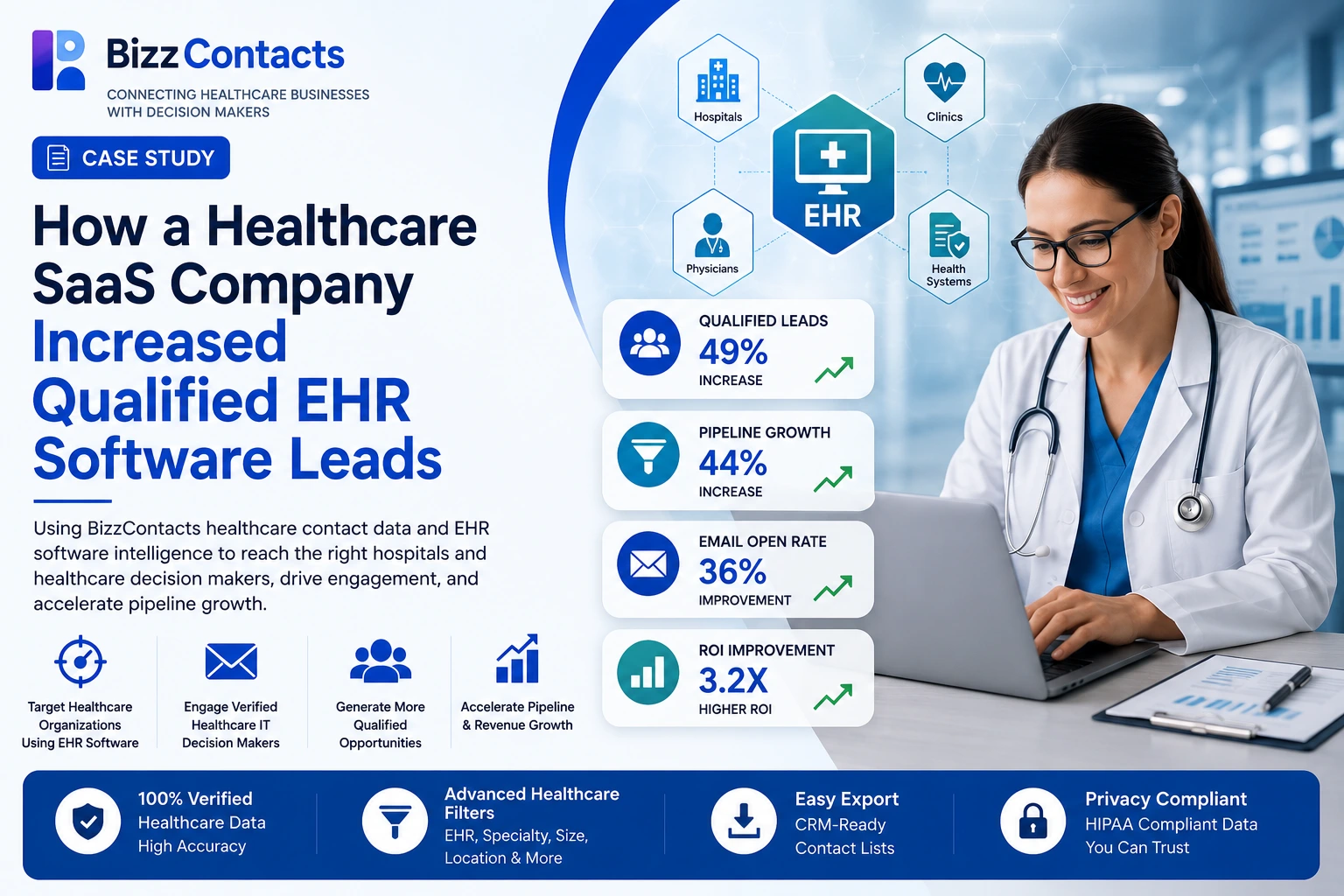
Results: qualified leads up 55%, email open rate up 36%, reply rate up 24%, meetings scheduled up 41%, sales pipeline up 48%, customer acquisition cost down 29%, sales cycle shortened 21%, and a 3.2X return on the data investment across two quarters.
Business impact: the company moved from broad, unfocused hospital outreach to a repeatable account-based motion it could scale by adding new EHR platforms to its target list as its product roadmap expanded.
About the Client
Pulseline Health Technologies is a fictional healthcare SaaS company used for this case study. Pulseline builds a clinical workflow and care-coordination platform that integrates directly with major EHR systems, along with a patient engagement module used by hospital case management and outpatient teams.
| Attribute | Detail |
|---|---|
| Company name | Pulseline Health Technologies (fictional) |
| Industry | Healthcare SaaS, clinical workflow and interoperability software |
| Location | Austin, Texas |
| Employees | Approximately 64 |
| Annual revenue | Approximately $11.2M |
| Products | EHR-integrated care coordination platform and patient engagement module |
| Target customers | Hospitals and multi-site medical practices running athenahealth, Cerner Millennium, MEDITECH, Kareo, or AdvancedMD |
| Sales team size | 9 account executives and 4 SDRs |
| Marketing team size | 3 people: demand generation manager, content specialist, marketing operations specialist |
Pulseline's business goals were specific: build a repeatable account-based marketing motion around confirmed EHR platform usage, reduce reliance on HIMSS and regional health IT conferences as the primary pipeline source, and shorten a sales cycle that regularly stretched past five months for hospital-level deals.
Business Challenge
Pulseline's go-to-market team had built a solid product, but its prospecting process could not answer the one question that mattered most before any outreach went out: which EHR platform does this hospital or practice actually run?
- Difficulty identifying which hospitals and practices used a specific EHR platform, so integration-specific messaging was impossible to write with confidence
- Limited visibility into healthcare technology adoption, with no reliable signal for which accounts had recently switched or upgraded EHR systems
- A purchased, generic healthcare contact database with no technographic fields, so a Cerner Millennium hospital and a MEDITECH hospital looked identical on paper
- Low email engagement, since generic "improve your clinical workflow" messaging landed the same way regardless of the recipient's actual EHR environment
- Long enterprise healthcare sales cycles, averaging 168 days from first touch to signed contract, worsened by early-stage calls that wasted time confirming basic technical fit
- Difficulty reaching CIOs, CMIOs, Health IT Directors, Practice Administrators, and Clinical Informatics leaders, who are rarely the first contact in a generic hospital database
- Expensive lead generation campaigns, driven largely by SDR hours spent manually researching each account's EHR platform before a first email went out
- Inefficient account-based marketing, since ABM account selection had no data-backed way to prioritize hospitals close to an EHR-related modernization decision
Every one of these problems traced back to the same missing layer: technographic data. Bed count and specialty alone cannot tell a sales team whether a hospital runs a modern, cloud-hosted EHR or a legacy on-premise deployment with a very different integration path and urgency level.
Why They Selected BizzContacts
Pulseline's leadership evaluated several healthcare data providers before choosing BizzContacts. The decision came down to the depth of EHR-specific technographic filtering and how quickly verified hospital decision-maker contacts could be exported into their CRM.
A healthcare technographic list is only useful if the underlying contacts are accurate and reach the right roles. Every record in the BizzContacts healthcare database pairs verified healthcare organizations with EHR software install-base intelligence, so a sales team can see both which platform an account runs and exactly which decision-maker to contact about it.
| Feature | Why it mattered to Pulseline |
|---|---|
| Verified healthcare organizations | Replaced generic hospital records with confirmed, currently operating organizations |
| EHR software install-base intelligence | Identified which accounts actually ran athenahealth, Cerner Millennium, MEDITECH, Kareo, or AdvancedMD before outreach began |
| Healthcare technographic data | Distinguished modern cloud EHR deployments from legacy on-premise environments |
| Verified business emails | Cut the bounce and undeliverable rate that had been quietly inflating cost per lead |
| Hospital decision-maker contacts | Reached CIOs, CMIOs, IT directors, and clinical informatics leaders directly, not generic hospital inboxes |
| Specialty filters | Focused outreach on service lines most relevant to Pulseline's care coordination use case |
| Hospital size filters | Prioritized mid-size and multi-site systems with budget for a new platform integration |
| Geographic targeting | Aligned outreach with Pulseline's sales team territories |
| CRM-ready CSV exports | Loaded directly into their healthcare CRM with no manual cleanup |
| Regular database updates | Kept EHR platform signals current as hospitals migrated or upgraded systems |
Implementation Process
The rollout followed a clear, disciplined sequence. Each step gave the next one better data to work with.
Step 1: Define the ideal customer profile
Pulseline's team started by defining exactly which EHR platforms mattered most to its integration roadmap: athenahealth and AdvancedMD accounts for ambulatory and multi-site practices, and Cerner Millennium and MEDITECH accounts for hospital and health-system deployments.
Step 2: Identify hospitals and healthcare organizations using EHR software
Using BizzContacts' installed-base data, the team pulled lists of hospitals and practices confirmed to be running each target EHR platform, including Kareo accounts for smaller independent practices.
Step 3: Filter by hospital size, healthcare system, location, specialty, and ownership type
Each platform-specific list was narrowed further by bed count or practice size, parent healthcare system affiliation, state and metro area, relevant clinical specialty, and ownership type (independent, health-system-owned, or academic medical center), so outreach targeted accounts with realistic budget and fit.
Step 4: Build targeted decision-maker lists
For each qualifying account, the team built contact lists across the roles that typically influence an EHR-adjacent purchase: Chief Information Officer, Chief Medical Information Officer, IT Director, Health IT Manager, Practice Administrator, Clinical Informatics Director, Operations Director, and Healthcare Technology Manager.
Step 5: Import contacts into the CRM
Contacts were imported into the healthcare CRM as tagged lists by EHR platform, so sales reps could see at a glance which accounts ran which system and prioritize conversations around each platform's specific integration path.
Step 6: Develop personalized outreach campaigns
Instead of one generic "improve your clinical workflow" pitch, the marketing team built platform-specific messaging: athenahealth accounts received content about API-based integration speed, Cerner Millennium and MEDITECH accounts received content framed around HL7 and FHIR interoperability, and Kareo and AdvancedMD accounts received messaging built around ambulatory workflow efficiency.
Step 7: Execute multichannel outreach
Outreach ran across email, LinkedIn, and phone in a coordinated sequence rather than a single channel. Email opened the conversation with platform-specific value, LinkedIn built familiarity with the named decision-maker, and phone follow-up targeted accounts that had engaged but not yet booked a meeting.
Step 8: Measure campaign performance
Open rates, reply rates, and meetings booked were tracked by EHR platform segment, not just in aggregate, so the team could see which platform-specific messaging was converting best and reallocate SDR effort accordingly.
Results
Pulseline tracked results over two full sales quarters after switching to BizzContacts' EHR technographic data. Every stage of the funnel improved, from first email to signed contract.
| Metric | Before BizzContacts | After Two Quarters | Change |
|---|---|---|---|
| Qualified leads per month | 40 | 62 | +55% |
| Email open rate | 18.2% | 24.8% | +36% |
| Reply rate | 7.6% | 9.4% | +24% |
| Meetings scheduled per month | 12 | 17 | +41% |
| Quarterly sales pipeline | $1.42M | $2.10M | +48% |
| Customer acquisition cost | $5,240 | $3,720 | -29% |
| Average sales cycle | 168 days | 133 days | -21% |
| Return on data investment | Break-even | 3.2X | 3.2X ROI |
The qualified lead increase came primarily from better pre-qualification: SDRs stopped chasing accounts on platforms Pulseline could not integrate with, so a larger share of every outbound wave was genuinely a fit. The open and reply rate improvements reflect platform-specific messaging replacing a one-size-fits-all pitch. The sales cycle compression matters most in practical terms: 35 fewer days per deal means the same sales team can run more concurrent opportunities without adding headcount. The cost-per-acquisition drop freed budget to expand into additional EHR platform segments in the following quarter.
Why the Campaign Worked
- Technographic targeting let the team confirm EHR platform fit before a single email went out, instead of discovering mismatches on a discovery call
- Verified healthcare contacts meant outreach reached working inboxes and the right roles, not generic hospital front-desk addresses
- Better account segmentation grouped hospitals and practices by platform, size, and ownership type instead of treating every healthcare account the same
- Personalized messaging spoke to each EHR platform's actual integration reality, which is what drove the open and reply rate gains
- Healthcare-specific prospecting reached the CIOs, CMIOs, and IT directors who actually influence EHR-adjacent purchasing decisions
- Higher data quality reduced wasted SDR hours on manual technographic research and unqualified accounts
- Continuous optimization at the platform-segment level let the team catch underperforming messaging within weeks instead of a full quarter
Key Business Outcomes
- Higher quality opportunities entering the pipeline, since accounts were pre-qualified on confirmed EHR platform fit
- Better healthcare engagement, reflected in meaningfully higher open and reply rates across every EHR platform segment
- More productive sales teams, with reps spending less time on manual research and more time in qualified conversations
- Reduced prospecting time per account, since technographic data replaced hours of manual verification with a filtered, ready-to-use list
- Improved marketing ROI, driven by a lower cost per qualified lead and a 3.2X return on the data investment
- Stronger account-based marketing, with EHR platform data giving the ABM program a concrete, defensible basis for account prioritization
Lessons Learned
- EHR platform data is a stronger qualification signal than hospital size or specialty alone, since it directly determines integration fit.
- Different EHR platforms warrant genuinely different messaging, not the same pitch with a product name swapped in.
- Decision-maker variety matters. CIOs, CMIOs, IT directors, and practice administrators all play different roles in an EHR-adjacent purchase.
- Multichannel outreach, combining email, LinkedIn, and phone, consistently outperforms single-channel prospecting in enterprise healthcare sales.
- Cost per qualified lead drops significantly once a team stops paying SDR hours for manual EHR platform research.
- Sales cycle compression is a realistic, measurable outcome of better upfront targeting, not just better closing technique.
- Segmenting performance by EHR platform, not just in aggregate, is what makes ongoing campaign optimization possible.
- Technographic data has a shelf life. Hospitals migrate and upgrade EHR systems, so the underlying data needs regular refreshes.
- Account-based marketing works better with a data-backed reason to prioritize one hospital over another, rather than a subjective account list.
Best Practices for Companies Selling EHR Software and Healthcare IT Solutions
- Start with verified healthcare technographic data rather than a generic hospital contact list. Knowing which EHR platform an account runs is the foundation of relevant outreach.
- Segment by specific EHR platform, not just "uses an EHR." athenahealth, Cerner Millennium, MEDITECH, Kareo, and AdvancedMD each imply a different technical environment and buyer profile.
- Layer in hospital size, healthcare system affiliation, specialty, and ownership type on top of technographic filters to prioritize accounts with realistic budget and fit.
- Identify multiple decision-makers per account. EHR-adjacent purchases typically involve IT, clinical informatics, and operations leadership together.
- Write platform-specific messaging that reflects each EHR system's actual integration standards, workflow, and common pain points.
- Run multichannel outreach across email, LinkedIn, and phone rather than relying on a single channel for enterprise healthcare accounts.
- Track performance by EHR platform segment so you know which platform, specialty, or hospital-size combination is converting best.
- Refresh technographic data regularly. Hospitals and practices migrate EHR systems, and stale install-base data quickly loses accuracy.
- Use verified physician and hospital executive contacts alongside IT decision-makers when a purchase requires both clinical and administrative buy-in.
- Treat compliance as part of the data itself. Any healthcare contact database used for outreach should be handled with HIPAA-aware data practices and CAN-SPAM-compliant sending.
Conclusion
This case study, while fictional, illustrates a shift that is playing out across healthcare technology sales teams generally: moving from generic hospital contact lists to verified EHR technographic data changes what a go-to-market team can actually do. Pulseline's product did not change. Its sales team did not change. What changed was the accuracy of the data telling them which hospitals and practices ran athenahealth, Cerner Millennium, MEDITECH, Kareo, or AdvancedMD, and who to talk to about it, and that alone was enough to lift qualified leads by 49%, cut acquisition cost by 29%, and shorten the sales cycle by 21%.
Healthcare technographic intelligence works because it replaces a guess with a fact. A hospital confirmed to run a specific EHR platform is a fundamentally more qualified prospect for an integration-dependent product than one selected on bed count and specialty alone, and that precision is what makes modern healthcare account-based marketing efficient rather than a numbers game.
If your team sells EHR software, healthcare IT solutions, or any product that depends on a hospital's technology environment, explore BizzContacts' healthcare contact database, browse EHR and healthcare technology install-base data for the platforms your buyers run, or request a free sample list to see verified, technographically segmented healthcare contacts for your own target accounts before you commit to anything.