Case Study: How an IT Consulting Firm Increased Qualified Leads Using BizzContacts' ERP Software Users List
A fictional but representative case study: an ERP modernization consultancy replaced generic prospecting with technographic targeting of companies running SAP, Oracle, and Microsoft Dynamics. Qualified leads rose 52%, cost per acquisition fell 31%, and the sales cycle shortened by 23% in two quarters.

Finding a company that needs your product is only half the job in B2B technology sales. The harder half is finding companies that are already running a specific piece of software, because that single fact tells you more about buying intent than almost anything else in a prospect record. A business running SAP ECC on-premise is a fundamentally different prospect than one already live on SAP S/4HANA Cloud, and a generic contact list has no way to tell the two apart.
This case study walks through how a fictional IT consulting firm solved that exact problem using technographic data on companies running major ERP platforms: SAP, Oracle, and Microsoft Dynamics. Before the change, the firm's outbound motion could not reliably tell a legacy ERP account from a modern one, so every campaign treated a 15-year-old on-premise deployment the same as a cloud-native rollout finished six months ago. After switching to a verified ERP software users list, qualified leads rose 52% and the sales cycle shortened by 23% within two quarters.
Disclaimer: the company, individuals, and all metrics described in this case study are fictional and used for illustrative purposes only. They represent a realistic, composite scenario based on common outcomes B2B technology and IT consulting firms report when they move from generic contact lists to verified technographic and install-base data. No claims are made about specific BizzContacts customers or guaranteed results.
Executive Summary
Business challenge: the firm needed a repeatable way to find mid-market and enterprise companies running SAP, Oracle, or Microsoft Dynamics ERP systems, and to tell legacy deployments apart from modern ones, without relying on conference badge scans and referrals for every new opportunity.
Solution: a verified technology users database filtered by specific ERP platform and version, company size, revenue, industry, and country, paired with direct contact data for the finance, IT, and operations decision-makers who actually approve ERP modernization budgets.
Implementation: the marketing and sales teams built an ideal customer profile around specific ERP platforms and deployment types, pulled segmented technographic lists, imported them into their CRM, and ran platform-specific outreach sequences instead of one generic pitch.
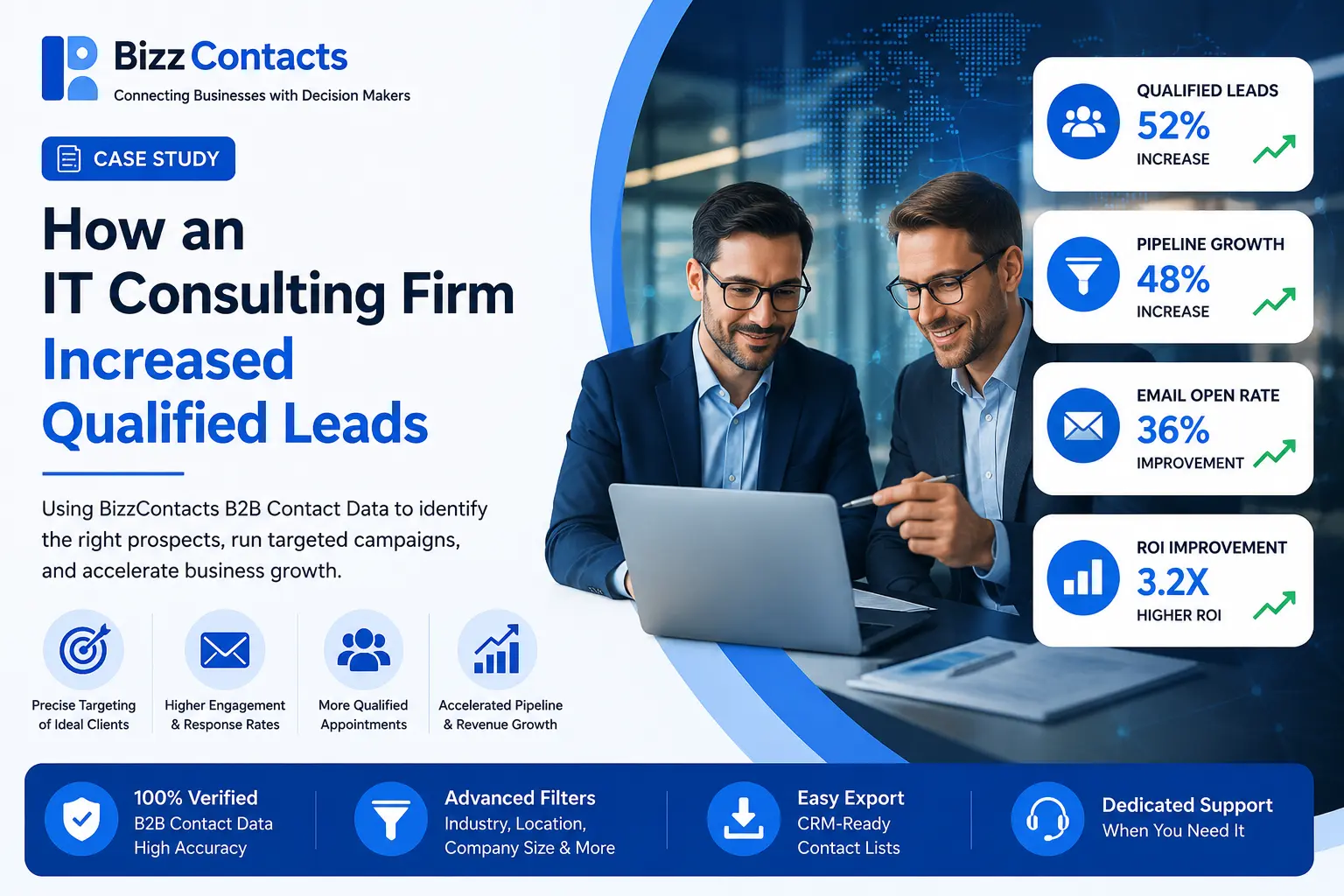
Results: qualified leads up 52%, email open rate up 36%, reply rate up 28%, meetings booked up 41%, pipeline growth of 48%, customer acquisition cost down 31%, sales cycle shortened 23%, and a 3.2X return on the data investment across two quarters.
Business impact: the firm moved from an unpredictable, referral-dependent pipeline to a repeatable outbound motion it could scale by simply adding new ERP platforms and versions to its target list.
About the Client
Meridian Process Solutions is a fictional mid-sized IT consulting firm used for this case study. Meridian specializes in ERP modernization, data migration, and post-go-live managed support for finance, manufacturing, and distribution companies running major enterprise resource planning (ERP) systems.
| Attribute | Detail |
|---|---|
| Company name | Meridian Process Solutions (fictional) |
| Industry | IT consulting, ERP modernization and systems integration |
| Headquarters | Chicago, Illinois |
| Employees | Approximately 85 |
| Annual revenue | Approximately $18.4M |
| Target customers | Mid-market and enterprise finance, manufacturing, and distribution companies running SAP, Oracle, or Microsoft Dynamics |
| Internal technology stack | Salesforce (CRM), HubSpot (marketing automation), Outreach (sales engagement) |
| Products | ERP modernization and migration services, data integration and middleware development, post-go-live managed support |
| Sales team | 11 account executives and 3 SDRs |
| Marketing team | 4 people: demand generation manager, content specialist, marketing operations specialist, growth marketer |
Meridian's business goals were direct: build a repeatable outbound motion that could identify companies running an ERP platform ready for modernization, reduce dependence on conferences and referrals for new pipeline, and shorten the unusually long sales cycle typical of enterprise IT consulting deals.
The Challenge
Meridian's outbound program had a structural problem that no amount of better copywriting could fix: the team could not reliably tell which companies on their prospect list were actually running SAP, Oracle, or Microsoft Dynamics, let alone which version or deployment type. Everything downstream of that gap suffered.
- No reliable way to identify which companies in their target market were running SAP, Oracle, or Microsoft Dynamics before a first call
- A purchased, generic B2B contact database with no technographic fields, so every prospect looked identical on paper
- High acquisition costs, since SDRs spent significant time on manual research just to confirm an ERP platform before an email went out
- A long sales cycle, averaging 142 days from first touch to signed contract, driven partly by outreach that missed the mark on relevance
- Outdated contact information, with job titles and email addresses that had not been refreshed in over a year
- Low email engagement, with generic ERP messaging landing the same way for a company running a 12-year-old on-premise deployment as for one already migrated to the cloud
- Limited technographic insight in the CRM, so account prioritization was based on company size alone rather than platform, version, or modernization readiness
- Poor CRM segmentation, with no consistent way to group accounts by ERP platform for reporting or campaign targeting
- Difficulty reaching the actual decision-makers, since ERP modernization budgets are typically approved by a mix of finance, IT, and operations leadership rather than one obvious buyer
Every one of these problems traced back to the same root cause: the underlying data had no technographic signal. Company size and industry alone cannot tell a sales team whether an account is running a legacy on-premise ERP deployment approaching end of support, or a modern cloud instance with no near-term reason to talk to a systems integrator.
Why They Selected BizzContacts
Meridian's leadership evaluated several data providers before choosing BizzContacts. The decision came down to the depth of technographic filtering available on major ERP platforms and how quickly verified contact data could be exported into their existing CRM.
A technology install base list is only useful if the underlying business contacts are accurate. Every record in the BizzContacts ERP software users list pairs verified business contacts with technographic install-base intelligence, so a sales team can see both what platform an account runs and exactly who to talk to about it.
| Feature | Why it mattered to Meridian |
|---|---|
| Verified business contacts | Replaced a stale, unverified list with current, working email addresses and phone numbers |
| Technology install-base intelligence | Identified which companies actually run SAP, Oracle, or Microsoft Dynamics before the first outreach touch |
| Technographic filters | Segmented accounts by specific ERP platform and deployment type, not just "uses an ERP" |
| Decision-maker contacts | Reached finance, IT, and operations leaders who influence ERP modernization budget, not generic company inboxes |
| Industry filters | Focused outreach on manufacturing and distribution, Meridian's strongest-fit verticals |
| Revenue filters | Prioritized mid-market and enterprise accounts with budget for a modernization engagement |
| Company size filters | Excluded accounts too small to need Meridian's services |
| Country and state targeting | Kept outreach inside Meridian's serviceable US regions |
| CSV export and CRM-ready format | Loaded directly into Salesforce with no manual cleanup |
| Regular data updates | Kept technographic signals current as accounts migrated or upgraded platforms |
| Affordable, transparent pricing | Fit a mid-sized consultancy's data budget without a long procurement process |
| Responsive customer support | Helped Meridian's marketing ops team scope and refine segments quickly |
Implementation Process
The rollout was a straightforward, disciplined sequence rather than anything exotic. Each step fed directly into the next.
1. Defined the ideal customer profile
Meridian's team started by defining exactly which ERP platforms, versions, and deployment types mattered most: SAP ECC and SAP Business One accounts likely due for SAP S/4HANA migration, Oracle E-Business Suite accounts evaluating Oracle Cloud, and Microsoft Dynamics AX or GP accounts approaching end of mainstream support.
2. Selected companies running the target ERP platforms
Using BizzContacts' installed-base data, the team pulled lists of companies confirmed to be running SAP, Oracle, or Microsoft Dynamics, tagged by specific product and, where available, deployment type.
3. Filtered by industry
Lists were narrowed to manufacturing and distribution first, Meridian's two strongest-performing verticals historically, before expanding into finance-heavy sectors in the second quarter.
4. Filtered by employee size and revenue
The team excluded companies below 150 employees and $25M in revenue, since smaller accounts historically had neither the budget nor the complexity to justify a modernization engagement.
5. Downloaded verified contacts
Each segment was exported as a clean CSV of decision-maker contacts, including finance leadership, IT directors, and operations executives at the qualifying accounts.
6. Imported into the CRM
Contacts were imported into Salesforce as tagged lists by ERP platform and version, so sales reps could see at a glance which accounts ran which system and prioritize the ones closest to a support end-of-life deadline.
7. Created personalized campaigns
Instead of one generic "we do ERP consulting" pitch, the marketing team built platform-specific messaging: SAP ECC accounts received content about S/4HANA migration planning, Oracle E-Business Suite accounts received content about cloud migration paths, and Dynamics AX and GP accounts received content specifically about end-of-support timelines.
8. Executed outreach
Campaigns launched in platform-specific waves rather than all at once, letting the team validate messaging on a smaller SAP segment before rolling the same structure out to the Oracle and Dynamics segments.
9. Measured results
Open rates, reply rates, and meetings booked were tracked by ERP platform, not just in aggregate, so the team could see which technographic segment was converting best and reallocate SDR time accordingly.
10. Optimized messaging
Every two weeks, underperforming subject lines and opening messages were revised based on segment-level data, rather than waiting until the end of the quarter to make changes.
Campaign Metrics
Meridian tracked results over two full sales quarters after switching to BizzContacts' technographic data. The lift was consistent across every stage of the funnel, from first email to signed contract.
| Metric | Before BizzContacts | After Two Quarters | Change |
|---|---|---|---|
| Qualified leads per month | 58 | 88 | +52% |
| Email open rate | 19.6% | 26.7% | +36% |
| Reply rate | 8.9% | 11.4% | +28% |
| Meetings booked per month | 17 | 24 | +41% |
| Quarterly pipeline generated | $1.85M | $2.74M | +48% |
| Customer acquisition cost | $4,850 | $3,347 | -31% |
| Average sales cycle | 142 days | 109 days | -23% |
| Return on data investment | Break-even | 3.2X | 3.2X ROI |
Why the Campaign Worked
None of these results came from a single change. They came from removing the technographic blind spot so that targeting, messaging, and sales follow-up all had accurate data to work from.
- Verified contacts meant SDRs stopped burning time confirming basic facts, like whether an account actually ran the ERP platform in question, before a call
- Technographic targeting let the team focus outreach on accounts running SAP, Oracle, or Microsoft Dynamics specifically, instead of guessing from firmographic data alone
- Industry segmentation concentrated effort on manufacturing and distribution, where Meridian's win rate was already strongest
- Personalized messaging matched each platform's specific modernization path, so a SAP ECC account and an Oracle E-Business Suite account received genuinely different, relevant content
- Sales automation kept a consistent, multi-touch follow-up cadence running without adding headcount
- Continuous optimization at the segment level let the team catch and fix underperforming messaging within two weeks instead of a full quarter
Key Takeaways
- Technographic data turns a generic contact list into a prioritized target list by revealing what technology a company actually runs, not just its size or industry.
- Platform and version matter more than the vendor name alone. A SAP ECC account and a SAP S/4HANA Cloud account are different prospects with different needs.
- Segmenting by ERP platform allows genuinely different messaging, which is what actually drives open and reply rate improvements, not subject-line tricks.
- Decision-maker identification matters as much as company identification. ERP modernization budgets usually involve finance, IT, and operations leadership together.
- Cost per qualified lead drops significantly once a team stops paying SDR hours for manual technographic research.
- Sales cycle compression is a realistic outcome of better targeting, since more relevant first contact means fewer wasted early-stage calls.
- A phased rollout, testing messaging on one platform segment before expanding, catches problems early and cheaply.
- Tracking performance by technographic segment, not just in aggregate, is what makes ongoing optimization possible.
- Technology install-base data has a shelf life. Companies migrate and upgrade, so the underlying data needs regular refreshes to stay accurate.
Best Practices for Targeting ERP Software Users
- Start with verified technographic data rather than a generic business contact list. Knowing what a company runs is the foundation everything else is built on.
- Segment by specific platform and version, not just the vendor name. SAP, Oracle, and Microsoft Dynamics each include multiple product lines with very different buyer needs.
- Layer in industry, revenue, and company size filters on top of technographic data to avoid wasting outreach on accounts too small or off-vertical to convert.
- Identify multiple decision-makers per account. ERP modernization decisions typically involve finance, IT, and operations stakeholders, not one buyer.
- Write platform-specific messaging. A SAP-focused message and an Oracle-focused message should reference genuinely different technical realities, not just swap a product name.
- Roll out campaigns in phased waves by segment so messaging problems surface on a small group before scaling to the full list.
- Track performance by technographic segment so you know which platform, industry, or company-size combination is converting best.
- Refresh technographic data regularly. Companies migrate, upgrade, and switch ERP vendors, and a stale install-base list loses accuracy quickly.
- Pair technographic targeting with a structured, multi-touch follow-up sequence rather than a single cold email.
- Export data directly into your CRM in a clean, tagged format so sales and marketing work from the same segmented view of the account base.
Common Mistakes When Prospecting ERP Software Users
- Targeting by vendor name only. Treating every SAP account the same ignores the difference between legacy on-premise ECC and modern S/4HANA Cloud. Avoid it by filtering on specific product and version.
- Relying on firmographic data alone. Company size and industry cannot tell you what software a business actually runs. Avoid it by adding verified technographic filters to your ICP.
- Using stale install-base data. Companies migrate platforms constantly, and outdated technographic data leads to irrelevant outreach. Avoid it by choosing a provider with regularly refreshed data.
- Sending one generic message to every ERP platform segment. A single pitch cannot speak to SAP, Oracle, and Dynamics buyers equally well. Avoid it by writing platform-specific messaging.
- Ignoring deployment type. On-premise and cloud deployments of the same ERP platform have very different modernization timelines. Avoid it by filtering for deployment type where the data supports it.
- Contacting only one stakeholder per account. ERP budget decisions are rarely made by a single person. Avoid it by identifying finance, IT, and operations contacts at each target account.
- Skipping industry and revenue filters. Not every company running a given ERP platform is a viable customer. Avoid it by layering industry and revenue thresholds onto technographic filters.
- Launching to the full list at once. A messaging problem discovered after a full-list send is expensive to fix. Avoid it by testing on a smaller segment first.
- Measuring results only in aggregate. Aggregate metrics hide which technographic segment is actually working. Avoid it by tracking performance broken out by platform and industry.
- Treating technographic data as a one-time purchase. Install-base accuracy decays as companies change systems. Avoid it by budgeting for ongoing data refreshes, not a single static file.
Expert Insights: Why Technographic Intelligence Is Becoming Essential
Technographic data is no longer a niche prospecting tactic. As enterprise software stacks grow more complex, knowing what a company runs, not just what industry it operates in, has become a core input for modern B2B sales and marketing operations.
Account-based marketing
Account-based marketing (ABM) depends on precise account selection. Technographic data gives ABM teams a concrete, verifiable reason to prioritize one account over another: a company running a specific ERP, CRM, or cloud platform is a fundamentally better-qualified target than one selected on firmographics alone.
Intent data
Intent data shows what a company is actively researching. Combined with technographic data, it becomes far more actionable: a company researching ERP migration content that is also confirmed to be running a legacy platform is a substantially stronger signal than either data point alone.
Buying signals
A confirmed, aging ERP deployment is itself a buying signal. Vendor end-of-support timelines, platform version, and deployment type all indicate how close an account is to a modernization decision, well before that account shows any public research activity.
Sales intelligence
Sales intelligence platforms increasingly blend firmographic, technographic, and contact-level data into a single account view. Reps who can see what technology an account runs, alongside who the decision-makers are, prioritize their time far more effectively than reps working from a flat contact list.
Predictive prospecting
Predictive prospecting uses signals like technology install base, company growth, and hiring patterns to forecast which accounts are most likely to convert. Technographic data is one of the strongest available inputs, since it reflects a company's actual infrastructure rather than an inferred characteristic.
Revenue operations
Revenue operations (RevOps) teams use technographic segmentation to align marketing, sales, and customer success around the same account view. When every team can see which ERP, CRM, or cloud platform an account runs, campaign targeting, sales prioritization, and customer success planning all pull from the same source of truth.
Conclusion
This case study, while fictional, illustrates a real and common shift in B2B technology sales: moving from generic contact lists to verified technographic data changes what a sales team can actually do. Meridian's product did not change. Its sales team did not change. What changed was the accuracy of the data telling them which companies were running SAP, Oracle, or Microsoft Dynamics, and who to talk to about it, and that alone was enough to lift qualified leads by 52%, cut acquisition cost by 31%, and shorten the sales cycle by 23%.
Technology-specific prospecting works because it replaces a guess with a fact. A company confirmed to run a specific ERP platform, at a specific version, is a fundamentally more qualified prospect than one selected on industry and size alone. That is the core value technographic data brings to modern B2B sales.
If your team sells into companies running specific enterprise software, whether ERP, CRM, cloud infrastructure, or any other technology category, explore BizzContacts' technology install-base data, browse the full technology users catalog for the platforms your buyers run, or request a free sample list to see verified, technographically segmented contacts for your own target accounts before you commit to anything.