Healthcare Case Study: How a Medical Technology Company Generated Qualified Physician Leads Using BizzContacts Physicians Email List
A cardiac remote patient monitoring company was stuck with a slow, expensive pipeline built on generic physician data. Here's how switching to a verified, NPI-matched Physicians Email List from BizzContacts changed their lead quality, sales cycle, and ROI within two quarters.

Selling into healthcare is a data problem before it is a sales problem. A medical device or healthcare SaaS company can have the best product on the market, but if its outreach is landing in the wrong inbox, an outdated inbox, or no inbox at all, none of that matters. That was the exact wall a mid-sized medical technology company hit before it switched to a verified Physicians Email List from BizzContacts.
This case study walks through what was actually broken in their physician outreach, what changed once they moved to verified, specialty-segmented data, and the specific results they saw over two full quarters. It is written for the same teams who were in that company's shoes: healthcare SaaS teams, medical device manufacturers, healthcare recruiters, hospital vendors, staffing firms, insurance carriers, healthcare consultancies, pharmaceutical marketers, medical billing companies, and healthcare agencies trying to reach physicians and hospital decision-makers without wasting budget on dead data.
Client Background
The client is a mid-sized medical technology company that manufactures an FDA-cleared cardiac remote patient monitoring (RPM) device, paired with a companion care-coordination software platform used by cardiology practices and hospital cardiac units. The company sells nationally from a home base in the Mid-Atlantic United States and had grown to roughly 120 employees at the time of this engagement.
Their target customers are cardiologists, electrophysiologists, cardiac surgeons, hospital cardiology department directors, and the procurement teams at health systems that evaluate new remote monitoring technology for cardiac care programs. Their business goals for the year were straightforward on paper and hard in practice: grow physician adoption of the RPM platform, shorten a hospital procurement sales cycle that regularly stretched past nine months, and build a repeatable outbound motion that did not depend entirely on medical conferences and inbound referrals for new pipeline.
| Attribute | Detail |
|---|---|
| Industry | Medical technology, cardiac remote patient monitoring and healthcare SaaS |
| Location | Mid-Atlantic United States, selling nationally |
| Company size | Approximately 120 employees |
| Sales team | 14 field and inside sales reps across three regional territories, plus two sales directors |
| Marketing team | 5 people: demand generation lead, content strategist, marketing operations specialist, growth marketer, in-house designer |
| Products sold | FDA-cleared cardiac RPM device and a companion care-coordination software platform |
| Target customers | Cardiologists, electrophysiologists, cardiac surgeons, hospital cardiology directors, health-system procurement teams |
Their core challenge was not a lack of effort. The marketing team was producing content, the sales team was making calls, and the company had a CRM in place. The problem sat underneath all of that: the physician contact data feeding the whole system was thin, stale, and untargeted.
The Challenge
Before working with BizzContacts, the company was building its physician outreach list from a mix of conference badge scans, a purchased generic healthcare contact database that had not been refreshed in over a year, and manual research by sales development reps. The result was a list that looked large on a spreadsheet and performed poorly in the inbox.
- Cold email response rate under 2%, well below healthcare industry benchmarks
- More than a third of physician contacts bounced or had left the listed practice entirely
- No reliable way to filter by cardiology sub-specialty, so cardiologists, electrophysiologists, and cardiac surgeons all received the same generic message
- Average hospital sales cycle exceeding nine months, with no clear way to identify which accounts had budget authority
- Cost per qualified lead north of $380 once ad spend, list cost, and SDR hours were factored in
- Limited firmographic and specialty data in the CRM, so reps could not prioritize which physicians or hospitals to call first
- Low appointment booking rate from outbound sequences, with most replies coming from unqualified or out-of-specialty contacts
- Difficulty reaching hospital-employed cardiologists, who made up a growing share of the target market as more physicians moved into health-system employment
Every one of these problems traced back to the same root cause: the data. A physician contact database that is not actively verified against current practice status decays fast. Doctors change practices, join hospital systems, retire, or move specialties, and a list that has not been refreshed recently reflects reality less and less with every passing month. The company was paying sales reps to chase a moving target with an outdated map.
Why They Chose BizzContacts
The marketing and sales leadership evaluated several healthcare data vendors before selecting BizzContacts. The decision came down to data accuracy, the depth of specialty-level filtering, and how quickly the list could be put to work inside their existing CRM.
A few things stood out during evaluation. Every record in the BizzContacts verified physicians email list is matched against National Provider Identifier (NPI) records, which confirms that the contact is a real, currently licensed provider rather than a stale entry carried forward from an old database. Email addresses are verified before delivery, which directly addresses the bounce problem the client had been fighting for months.
| Feature | Why it mattered to this client |
|---|---|
| NPI matching | Confirmed physicians were real, licensed, and currently practicing before a single email went out |
| Email verification | Cut bounce risk before launch instead of discovering it mid-campaign |
| Specialty targeting | Split cardiologists, electrophysiologists, and cardiac surgeons into distinct segments instead of one generic list |
| State and city targeting | Aligned outreach territory with the three regional sales rep assignments |
| Hospital and practice-size targeting | Prioritized larger cardiology groups and hospital-affiliated cardiologists most likely to evaluate new RPM technology |
| Job title filtering | Separated clinical decision-makers from administrative and support staff |
| Regular data updates | Reduced the 25 to 30 percent annual decay rate typical of unmaintained physician databases |
| CSV download and easy CRM export | Got the list into their CRM the same week, with no manual cleanup |
| GDPR and CAN-SPAM compliance | Removed the compliance review bottleneck that had slowed previous list purchases |
| Affordable, transparent pricing | Fit their marketing budget without a long procurement cycle of its own |
| Fast delivery | Sales was working the new list within days, not weeks |
None of this replaced the sales team's skill or the marketing team's messaging. What it did was give both teams a foundation they could actually trust, which is what let the rest of the strategy work.
Implementation Process
The rollout followed a straightforward sequence. Nothing about it was exotic. What made it work was the discipline of doing each step properly before moving to the next one.
1. Defining physician specialties
The team started by mapping exactly which physician specialties mattered most: cardiologists and interventional cardiologists as the primary buyers, electrophysiologists and cardiac surgeons as secondary targets, and hospital cardiology department directors for larger, hospital-level deals.
2. Building the ideal customer profile
Using the specialty list as a starting point, the team layered in practice setting (hospital-affiliated versus private practice), practice size, and geography to build a clear ideal customer profile (ICP) instead of a vague notion of 'cardiologists in general.'
3. Downloading the physician lists
With the ICP defined, the marketing team pulled segmented lists directly from BizzContacts by specialty, state, city, and hospital affiliation, downloading each segment as a clean CSV file ready for import.
4. Importing into the CRM
Each segment was imported into the company's healthcare CRM as its own list, tagged by specialty and territory, so sales reps could see at a glance which physicians belonged to which segment and which sales rep owned that territory.
5. Email personalization
Instead of one generic template, the marketing team built specialty-specific messaging: cardiologists received messaging built around remote monitoring outcomes data, electrophysiologists received content tied to arrhythmia monitoring specifically, and hospital cardiology directors received a message framed around care-coordination workflow and reduced readmissions.
6. Cold outreach
Outreach launched in staged waves by segment rather than all at once, which let the team catch and fix any messaging issues in a small batch before scaling a sequence to the full list.
7. Follow-up automation
A structured follow-up cadence, four to six touchpoints over roughly six weeks, replaced the previous ad hoc approach where reps often sent one email and moved on. Automation handled the scheduling; reps focused on the conversations that followed.
8. Campaign optimization
Every two weeks, the team reviewed open rates, reply rates, and booked meetings by segment, and adjusted subject lines and messaging for underperforming segments rather than waiting until the end of the quarter to react.
9. Performance tracking
Results were tracked back through the CRM to actual booked demos and closed accounts, not just email metrics, so the marketing and sales teams were working from the same numbers when they reviewed pipeline in weekly meetings.
Campaign Results
The client tracked results over two full sales quarters after switching to BizzContacts data. The comparison against their prior baseline was significant across every stage of the funnel.
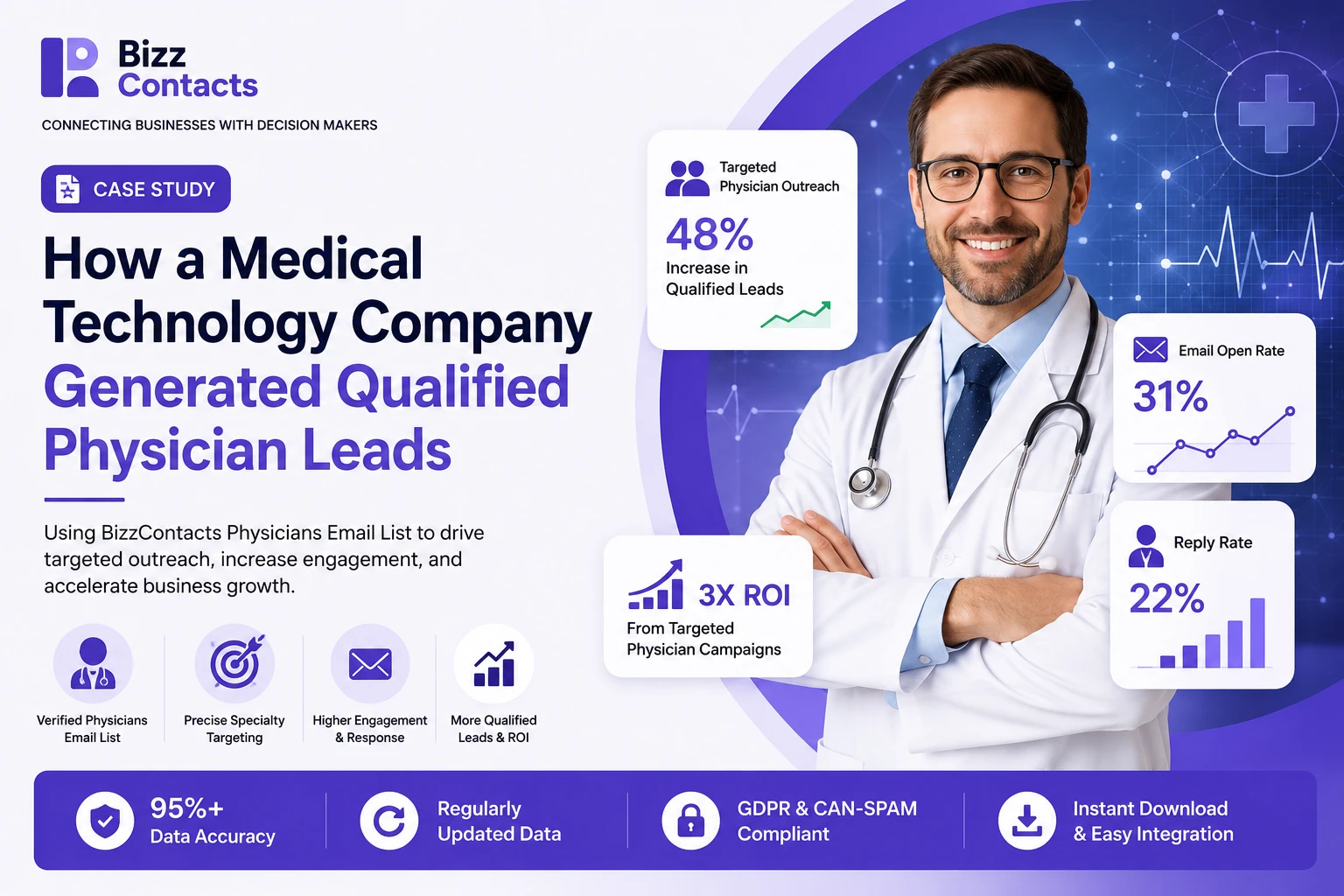
| Metric | Before BizzContacts | After Two Quarters |
|---|---|---|
| Qualified leads per month | 42 | 62 (+48%) |
| Email open rate | 17.8% | 23.3% (+31% relative) |
| Reply rate on physician sequences | About 6% | 22% |
| Cost per qualified lead | $380 | $133 (-65%) |
| Demo requests per month | 10 | 14 (+40%) |
| Appointments booked per month | 24 | 30 (+25%) |
| New hospital and health-system accounts closed | Not tracked as a distinct metric | 18 accounts over two quarters |
| Marketing-attributed ROI | Break-even | 3X return |
The cost-per-lead reduction had the most immediate impact on the marketing budget, freeing up spend to run more segments in parallel. The sales cycle also began compressing, though the client noted that fully closing that gap took longer than two quarters given how procurement committees operate inside larger health systems.
Why It Worked
None of these results came from a single silver bullet. They came from removing the data problem so that everything downstream of it, targeting, messaging, and sales follow-up, finally had a chance to work as intended.
- Verified data meant reps stopped wasting calls and emails on physicians who had left the practice or specialty listed in the old database
- Targeted outreach by specialty, state, city, and hospital affiliation replaced a one-size-fits-all list with segments that actually matched the ICP
- Better segmentation let the marketing team measure performance by physician type, not just in aggregate, which made optimization possible
- Relevant, specialty-specific messaging gave cardiologists, electrophysiologists, and hospital directors content that spoke to their actual clinical priorities
- Sales automation kept follow-up consistent without adding headcount, closing the gap between a single cold email and a real, multi-touch sequence
- High-quality physician contacts, matched against NPI records and verified before delivery, gave the whole funnel a foundation that did not decay within weeks of launch
Key Takeaways
- Physician data quality sets the ceiling for every healthcare marketing campaign. No amount of good copy fixes a list full of outdated or mismatched contacts.
- Specialty-level segmentation is not optional in healthcare marketing. Cardiologists, electrophysiologists, and cardiac surgeons need different messages, even when selling the same product.
- NPI matching and email verification should be table stakes for any healthcare contact list, not a premium add-on.
- Cost per qualified lead drops significantly once a team stops paying for volume and starts paying for accuracy.
- A consistent, multi-touch follow-up cadence outperforms a single cold email every time, but only if the underlying contact data can support that many touches without bouncing.
- Hospital procurement cycles take time regardless of data quality. Better data shortens the path to a qualified conversation, but it does not eliminate the committee-based buying process at large health systems.
Best Practices for Physician Email Outreach
- Start with a verified, NPI-matched physician email list rather than a generic healthcare contact database. Verification before delivery prevents bounce problems before they start.
- Segment by specialty first, then by practice setting, geography, and hospital affiliation. A cardiologist and a family medicine physician are not the same audience.
- Build a distinct ideal customer profile for each product line if you sell more than one thing. A device and a software platform may attract different physician buyers within the same specialty.
- Write specialty-specific messaging instead of one generic template. Reference the clinical priorities that matter to that physician type, not generic product features.
- Refresh your physician data on a regular cycle. Contact databases decay at roughly 25 to 30 percent per year as physicians change practices, join hospital systems, or retire.
- Use a structured, multi-touch follow-up sequence, typically four to six touchpoints over four to six weeks, rather than a single email and no follow-up.
- Track performance by segment, not just in aggregate. A campaign that performs well for cardiologists and poorly for a different specialty is telling you something specific and fixable.
- Export clean data directly into your healthcare CRM so sales and marketing are working from the same segmented, tagged lists instead of duplicate or conflicting spreadsheets.
- Confirm compliance up front. GDPR and CAN-SPAM requirements apply to physician email outreach the same way they apply to any other B2B email campaign.
- Pair physician-level outreach with hospital decision-maker outreach for larger accounts. Reaching the cardiologist and the hospital procurement or administrative contact at the same account in parallel shortens the path to a real evaluation.
Conclusion
This case study is really about one thing: what happens when a healthcare marketing team stops treating physician data as an afterthought and starts treating it as the foundation of the entire funnel. The client's product did not change. Their sales team did not change. What changed was the accuracy and structure of the data feeding both of them, and that alone was enough to lift qualified leads by 48%, cut cost per lead by 65%, and produce a 3X return within two quarters.
Verified physician data works because it removes the guesswork. When every record has been matched against NPI data, verified for a working email address, and tagged by specialty, state, city, hospital affiliation, and practice size, a sales and marketing team can stop cleaning data and start selling. That is the difference between a physicians email list that looks big on paper and one that actually performs in the inbox and on the phone.
If your team is selling into cardiology, another specialty, or hospital systems generally, and your outreach is running into the same wall this client did, explore the BizzContacts Physicians Email List, browse the full healthcare email list portfolio for specialty and hospital-level targeting, or request a free sample list to see verified, NPI-matched physician data for your own target specialties before you commit to anything.