Top Healthcare Companies in the USA
A guide to the 15 largest and most influential healthcare companies in the United States, covering insurers, distributors, hospital networks, and pharma. Includes the segments that drive the market and what the shift to consumer-centric care means for B2B vendors selling into healthcare.

The U.S. healthcare market is one of the most influential and closely watched sectors in the global economy. For businesses operating in healthcare, pharmaceuticals, medical devices, health insurance, digital health, and healthcare data, the United States represents a highly valuable and competitive market. Its scale, technological advancement, research capabilities, and investment potential make it a major focus for companies, investors, service providers, and B2B marketers worldwide.
From hospital systems and health insurers to biotech innovators and healthcare IT providers, the U.S. healthcare ecosystem continues to create strong business opportunities across multiple segments. Its ability to adopt new technologies, improve care delivery models, and support innovation at scale makes it a key market for organizations looking to expand, partner, sell, or invest in healthcare.
The healthcare sector in the USA
The U.S. healthcare industry has undergone significant transformation in recent years, driven by technological innovation, changing patient expectations, regulatory pressure, rising costs, and the need for more efficient care delivery. For businesses serving this space, those changes are opening new opportunities in healthcare technology, data services, digital transformation, patient engagement, and operational support.
It is also one of the largest and most complex industries in the world. It includes a mix of public and private stakeholders, but private organizations continue to dominate a large share of healthcare delivery, administration, and innovation. Those private entities include hospital groups, health insurance providers, pharmaceutical companies, healthcare IT firms, medical device manufacturers, outpatient care providers, and specialty healthcare service organizations.
For B2B companies, this market matters because decision-making is distributed across many types of organizations. Healthcare businesses in the U.S. are constantly looking for ways to improve clinical outcomes, reduce operational costs, strengthen patient access, accelerate digital transformation, and improve revenue cycle performance. That creates demand for products and services such as healthcare contact data, analytics, software, staffing, logistics, compliance solutions, telehealth infrastructure, and marketing support.
Key segments in the U.S. healthcare market
The healthcare sector in the U.S. is made up of several major segments that drive both service delivery and business growth:
- Hospitals and healthcare services
- Healthcare IT and digital health
- Health insurance and managed care
- Pharmaceutical and biotechnology
- Medical devices and diagnostics
Each of these segments creates its own B2B opportunities for vendors, data providers, marketers, consultants, software companies, and service partners. They also buy very differently, which is why segment-level targeting usually beats treating healthcare as a single audience.
Top 15 healthcare companies in the USA
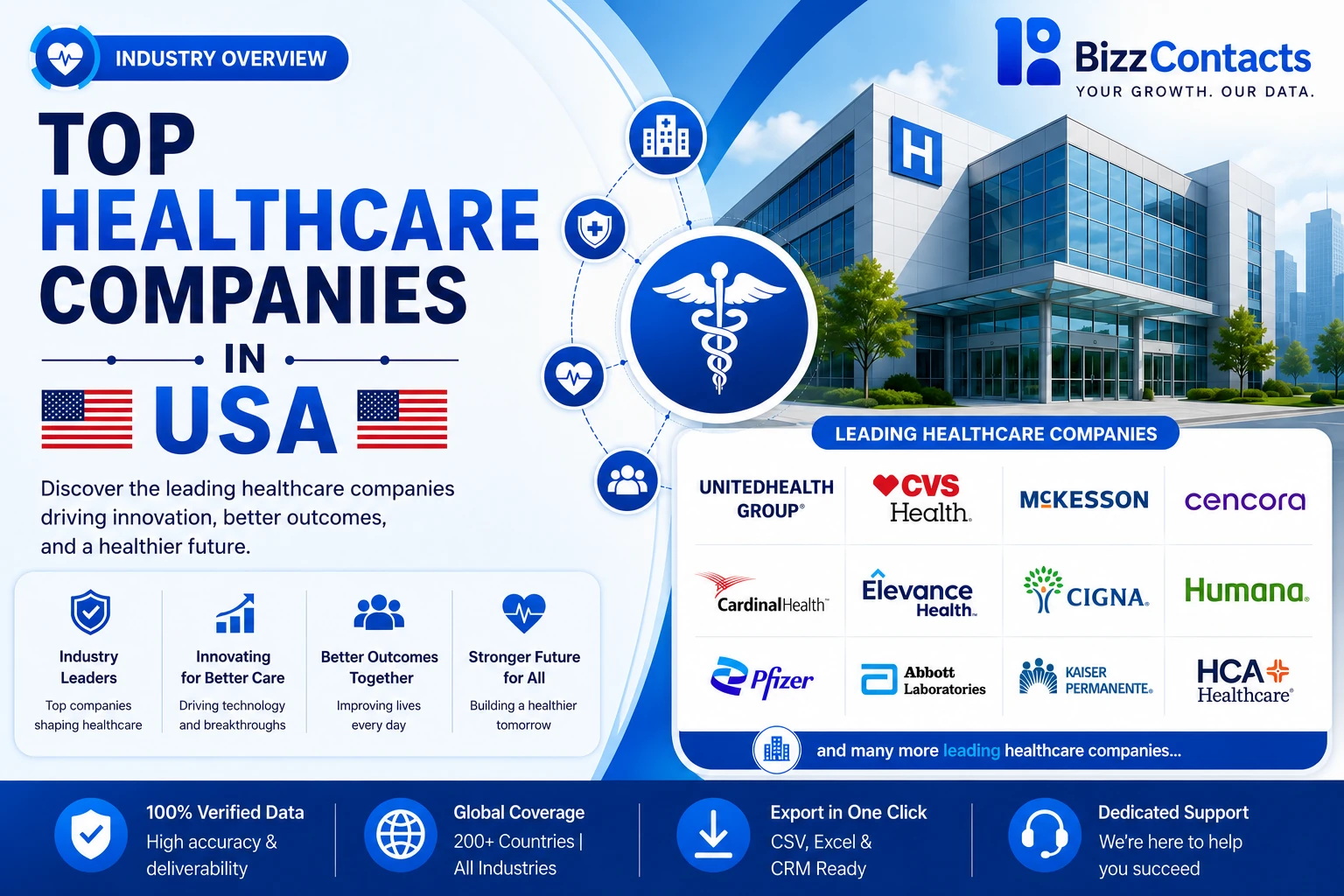
Healthcare companies in the USA are generally ranked on revenue, innovation and technological advancement, industry influence, and market capitalization. The 15 below span every major segment: managed care, pharmaceutical distribution, hospital operations, pharma, and medical devices. Revenue figures and rankings move year to year, so treat the scale descriptions as directional and confirm current numbers against each company's investor relations page or the Fortune 500 list.
| # | Company | Primary segment | Known for |
|---|---|---|---|
| 1 | UnitedHealth Group | Managed care and health services | Largest U.S. healthcare company by revenue |
| 2 | CVS Health | Retail pharmacy, insurance, clinics | Vertically integrated care and pharmacy |
| 3 | McKesson | Pharmaceutical distribution | One of the largest drug distribution networks |
| 4 | Cencora | Pharmaceutical distribution | Formerly AmerisourceBergen |
| 5 | Cardinal Health | Distribution and medical products | Supply chain and inventory management |
| 6 | The Cigna Group | Health services and insurance | Employer and international coverage |
| 7 | Elevance Health | Health insurance | Large Medicare and Medicaid footprint |
| 8 | Centene | Government-sponsored insurance | Medicaid and marketplace plans |
| 9 | Humana | Health insurance | Medicare Advantage and home care |
| 10 | HCA Healthcare | Hospital operations | One of the largest hospital networks |
| 11 | Kaiser Permanente | Integrated nonprofit care | Care delivery and coverage combined |
| 12 | Johnson & Johnson | Pharma and medical devices | Global R&D and device portfolio |
| 13 | Pfizer | Pharmaceutical and biotech | Vaccines and innovative therapeutics |
| 14 | Abbott | Devices, diagnostics, nutrition | Diagnostics and device innovation |
| 15 | Prime Healthcare | Hospital operations | Fast-growing multi-state hospital network |
1. UnitedHealth Group
 UnitedHealth GroupManaged care and health servicesVisit the official site ↗
- One of the largest healthcare companies in the United States, offering health insurance, data analytics, consulting, and pharmacy services.
- It delivers those services at enterprise scale, reporting revenue of roughly $448 billion in 2025.
- A key player in managed care, with operations that extend well beyond the U.S. through its Optum health services arm.
2. CVS Health
 CVS HealthRetail pharmacy, insurance, and clinicsVisit the official site ↗
- CVS Health works with insurers and employers to deliver more cost-effective healthcare to their members.
- It is a vertically integrated healthcare company that combines insurance, pharmacy services, and retail clinics under one roof.
- That combination gives it one of the strongest omnichannel footprints in U.S. healthcare, spanning retail, digital, and in-person care.
3. McKesson Corporation
 McKesson CorporationPharmaceutical distributionVisit the official site ↗
- McKesson operates one of the largest pharmaceutical distribution networks in the U.S. and is critical infrastructure for pharmacies, hospitals, and healthcare providers.
- It runs a worldwide healthcare logistics network supplying medical products and pharmaceuticals.
- Its scale makes it a significant partner for any manufacturer that needs national distribution reach.
4. Cencora
 CencoraPharmaceutical distribution and servicesVisit the official site ↗
- Cencora, formerly known as AmerisourceBergen, holds long-standing partnerships across the pharmaceutical industry.
- It offers advanced supply chain solutions with global reach, particularly in pharmaceutical services and drug distribution.
- It is a common route to market for pharmaceutical companies that need distribution scalability.
5. Cardinal Health
 Cardinal HealthDistribution and medical productsVisit the official site ↗
- Cardinal Health focuses on supply chain optimization and inventory management for healthcare providers.
- It supplies medical products and distribution services to hospitals and pharmacies.
- It pairs an efficient logistics network with a strong presence in medical devices.
6. The Cigna Group
 The Cigna GroupHealth services and insuranceVisit the official site ↗
- Cigna is a major U.S. health services organization that helps members make better healthcare and insurance decisions.
- It serves U.S. employers, government programs, and international healthcare organizations.
- Its digital health services support customized healthcare programs for corporations and large enterprises.
7. Elevance Health
 Elevance HealthHealth insuranceVisit the official site ↗
- Elevance Health is one of the largest health insurance companies in the U.S., focused on lowering medical costs, simplifying the member experience, and improving health outcomes.
- It regularly delivers scalable healthcare solutions for both government and private-sector clients.
- It maintains a substantial Medicare and Medicaid presence.
8. Centene Corporation
 Centene CorporationGovernment-sponsored insuranceVisit the official site ↗
- Centene is a leading healthcare enterprise and consistently one of the largest healthcare companies on the Fortune 500. Its stated purpose is high-quality, cost-effective care delivered locally.
- It primarily serves under-served populations through government-sponsored programs, acting as the managed care intermediary.
- It operates mainly across Medicaid, Medicare, and commercial marketplace lines of business.
9. Humana
 HumanaHealth insurance and home careVisit the official site ↗
- Humana is among the largest health insurers in the U.S. and operates as a for-profit managed care company.
- It concentrates on Medicare, Medicaid, and employer-sponsored plans, and also provides home care and pharmacy services.
- Its positioning emphasizes a human approach to care, community health, and personalization.
- Much of its growth comes through elderly care programs and value-based care models.
10. HCA Healthcare
 HCA HealthcareHospital operationsVisit the official site ↗
- HCA Healthcare is a for-profit hospital operator focused on community health and patient-centred care.
- It has been named one of the World's Most Ethical Companies by Ethisphere on multiple occasions.
- It runs one of the largest hospital networks in the U.S., with substantial care delivery infrastructure.
- Its advanced clinical service lines have supported consistent revenue growth.
11. Kaiser Permanente
 Kaiser PermanenteIntegrated nonprofit health systemVisit the official site ↗
- Kaiser Permanente is a nonprofit integrated health system built around high-quality, affordable care.
- It connects primary care, specialists, laboratories, and pharmacies within a single system.
- It offers same-day care alongside its own insurance plans, with a strong emphasis on preventive care.
12. Johnson & Johnson
 Johnson & JohnsonPharmaceuticals and medical devicesVisit the official site ↗
- Johnson & Johnson is a global leader in pharmaceuticals and medical devices.
- Its research and development organization underpins a substantial global presence.
- It maintains a diverse healthcare portfolio spanning multiple therapeutic areas and device categories.
- It is deeply integrated with distribution networks, hospitals, and research organizations.
13. Pfizer
 PfizerPharmaceutical and biotechnologyVisit the official site ↗
- Pfizer is a leading multinational biopharmaceutical company headquartered in the U.S.
- Its core focus areas include oncology, vaccines, immunology and inflammation, rare disease, and internal medicine.
- It maintains a deep pipeline of innovative drugs and remains a key player in vaccine development.
14. Abbott Laboratories
 Abbott LaboratoriesDevices, diagnostics, and nutritionVisit the official site ↗
- Abbott is a leading multinational healthcare company that supplies hospitals with advanced diagnostic solutions.
- It specializes in diagnostics, nutrition products, and medical devices across diabetes management, cardiovascular care, and neuromodulation, with a strong global footprint.
- It invests continuously in new technology to advance its product lines.
15. Prime Healthcare
 Prime HealthcareHospital operationsVisit the official site ↗
- Prime Healthcare is one of the largest for-profit health systems in the U.S. and among the fastest-growing hospital networks operating across multiple states.
- It focuses on delivering affordable, high-quality care through its hospitals.
- It continues to invest in quality improvement and value-based care.
- It operates more than 50 hospitals in the U.S. and continues to expand its infrastructure.
Revenue and headcount figures shown above are the most recent publicly reported numbers for each company, and several use a fiscal year that does not match the calendar year. Distributors in particular report enormous revenue relative to their headcount because drug sales pass through their books, so revenue is a poor proxy for organisation size when you are sizing an account. Always confirm current figures against the company's own investor relations page before using them in a pitch.
All company logos shown above are the property of their respective owners and are reproduced here for identification only. Each links to that company's official website, which is the primary source for its current figures, structure, and service lines. BizzContacts is not affiliated with, endorsed by, or sponsored by any of the organizations listed.
The shift toward consumer-centric healthcare and what it means for B2B companies
Although the companies listed above are known for their scale, innovation, and operational strength, the U.S. healthcare market is steadily moving toward a consumer-centric model. For B2B organizations, that shift matters because it changes how providers, insurers, and service networks invest in technology, communication, and care delivery.
Consumer-centric healthcare means patients are no longer passive recipients of care. They expect transparency, convenience, control, and digital access. That expectation is reshaping how healthcare organizations design services, select vendors, and modernize operations.
In this model, patients can:
- Choose their doctors and preferred hospitals
- Access their medical records more easily
- Participate in treatment decisions
- Understand their medical billing more clearly
- Use mobile health apps and teleconsultation platforms
- Book appointments online
- Communicate faster with healthcare providers
For B2B companies, that trend creates growing demand for:
- Telehealth solutions
- Patient engagement platforms
- Healthcare CRM systems
- Digital appointment and workflow tools
- Medical billing transparency solutions
- Healthcare data and analytics
- Omnichannel communication systems
Why consumer-centric healthcare matters in a B2B context
Consumer-centric healthcare matters not only to patients but to healthcare businesses trying to stay competitive. It helps organizations improve patient satisfaction, strengthen loyalty, reduce inefficiency, and deliver more accessible care.
For healthcare vendors and service providers, that translates into rising demand for solutions that support:
- Better patient experience
- Faster service delivery
- Lower operational friction
- Preventive care engagement
- Cost efficiency
- Digital transformation
In other words, as healthcare becomes more patient-focused, the business side of healthcare has to become more agile, integrated, and technology-driven.
How B2B teams actually reach these organizations
Knowing which companies lead the market is only the first step. Selling into them means reaching the right role inside the right segment, and those roles differ sharply. A pitch that lands with a hospital operations leader will not land with a payer's network strategy team.
- Provider organizations: reach hospital decision-makers, clinic and outpatient contacts, and hospital CEOs for care delivery, staffing, and infrastructure offers.
- Clinical audiences: target physicians and nurses by specialty when the product touches the point of care.
- Pharma and biotech: work the pharmaceutical contact list for distribution, trials, commercial, and medical affairs conversations.
- Health IT buyers: reach technology leadership through CIO and IT executive lists, or target by the systems already deployed using installed base data.
Installed base targeting is particularly effective in healthcare because the software estate predicts the buying need. Vendors that integrate with, migrate from, or extend a specific platform can go straight to the accounts running it, whether that is Epic, Oracle Cerner, athenahealth, or Veeva.
For a deeper walk-through of the channels, messaging, and compliance rules that apply when the audience is clinical, see our guide to marketing to physicians. If you are still evaluating where to source contact data, compare vendors first in the top B2B data providers in the USA.
Final thoughts
U.S. healthcare is a diverse, complex ecosystem that leads globally on technological advancement, innovation, and infrastructure. The top healthcare companies covered above are not simply large market participants. They set the direction the rest of the industry follows, and patient expectations of high-quality, accessible service keep pushing them toward a more consumer-centric model. A steady flow of new entrants and healthcare startups continues to reshape the market alongside them.
Understanding the strategies and service models of the leading U.S. healthcare companies helps you identify investment opportunities and growth paths in one of the most dynamic sectors in the world.
For B2B businesses, understanding the structure of the U.S. healthcare market and where its leading companies sit within it helps surface high-value opportunities in data services, healthcare marketing, digital transformation, enterprise sales, partnerships, and expansion. Whether you sell to hospitals, insurers, pharmaceutical firms, health tech brands, or provider networks, the U.S. market offers real growth potential for the right B2B solution. If you want a segmented view of a specific audience, talk to our data team and we will put a sample together.
Frequently asked questions
Calvin Christopher is the Marketing & Sales Manager at BizzContacts, specializing in B2B marketing, lead generation, sales intelligence, and verified business contact data.