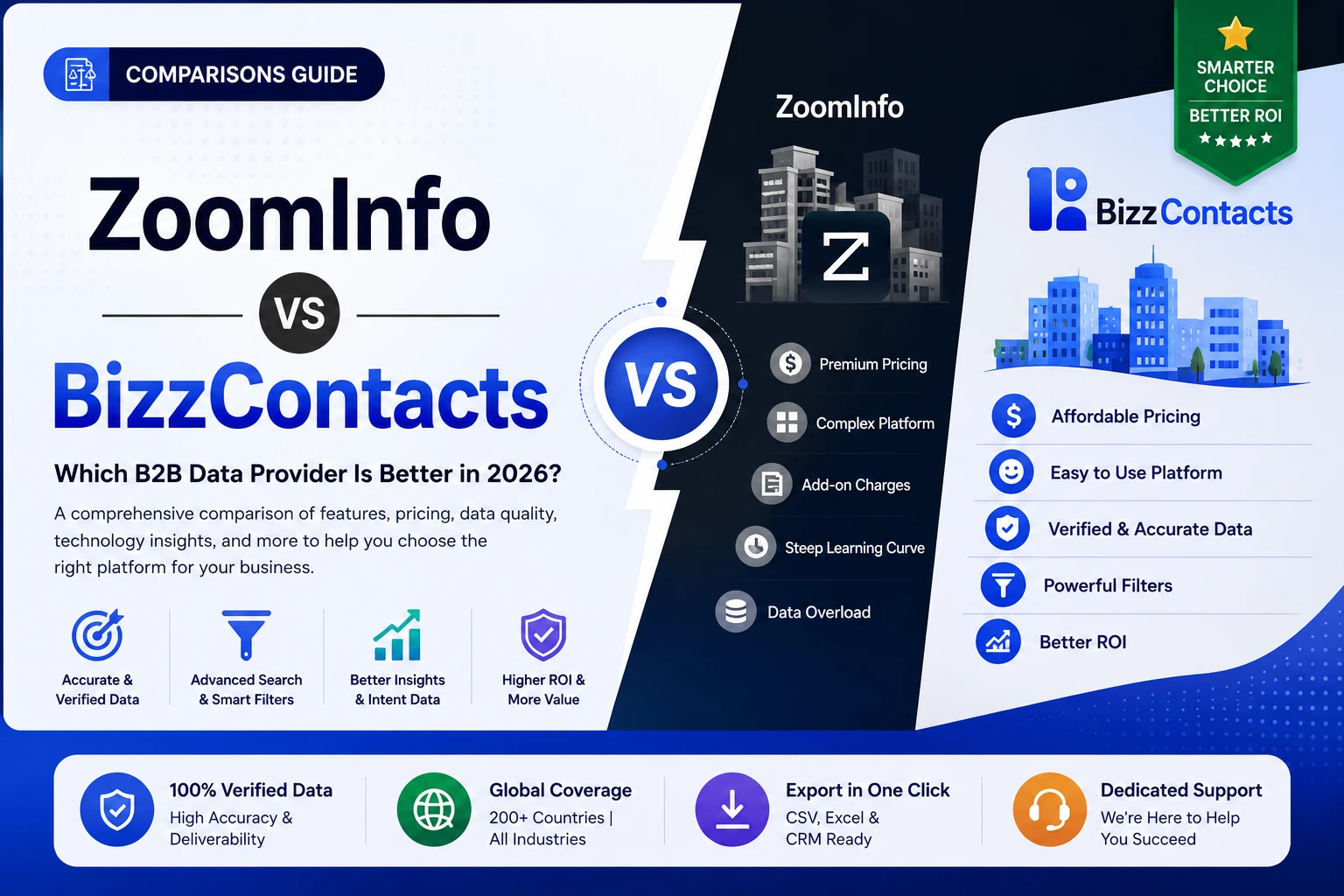
ZoomInfo vs BizzContacts: Which B2B Data Provider Is Better in 2026?
One is a full go-to-market suite with buyer intent data and deep CRM enrichment. The other is a 700M+ contact database with healthcare and installed-base depth, custom lists verified before delivery, and no subscription. Here's an honest, side-by-side comparison across data quality, coverage, integrations, and fit.

Quick answer: ZoomInfo is better if you need proprietary buyer intent data, a deep enterprise workflow suite, ongoing CRM enrichment, and dedicated account management, and you are comfortable with a quote-gated annual contract. BizzContacts is better if you need verified healthcare provider data, technology installed-base targeting (which companies actually run SAP, Salesforce, Oracle, athenahealth, Cerner Millennium, or MEDITECH), a custom database built to your specification and verified before it reaches you, or you simply want to pay once for credits that never expire instead of signing a subscription. They are not the same kind of product: one is a broad go-to-market platform, the other is a focused contact-data source with a custom-build service attached. Most teams should pick based on which of those two shapes matches how they actually prospect.
A note on sourcing before we start. ZoomInfo does not publish pricing anywhere on its site, so this article describes its contract structure (quote-only, annual, three-seat minimum) without attaching dollar figures to it. BizzContacts' data figures come from its own published product pages. Both companies' database counts are vendor claims rather than audited figures, on both sides, and vendors count records differently, so treat every number below as a starting point for your own testing rather than a settled fact. BizzContacts has no independent G2 or Capterra rating at the time of writing, so no rating is claimed for it anywhere. This article is published by BizzContacts, which is exactly why the sections where ZoomInfo wins are stated as plainly as the sections where it doesn't.
ZoomInfo vs BizzContacts at a Glance
Before the detail, here is the whole comparison in one table. Each row is expanded into its own section further down, with the reasoning behind it.
| Criterion | ZoomInfo | BizzContacts |
|---|---|---|
| Company profile | Publicly traded (NASDAQ: ZI), Vancouver, Washington | Bootstrapped and profitable since 2019, no venture funding |
| Positioning | Full go-to-market intelligence suite | Specialist B2B contact data provider |
| Contact database | 410M+ contacts, 203M+ companies (claimed) | 700M+ contacts across 250+ industry databases (claimed) |
| Pricing model | Annual subscription, quote only, 3-seat minimum | One-time credit packs, no seats, credits never expire |
| Free access | No self-serve free trial | Free credits at signup, no card required |
| Verification | AI-driven plus a 300+ person research team | 95%+ verified accuracy, 97% inbox deliverability, weekly re-verification |
| Custom database builds | No, you pull from the platform database as-is | Yes, built to your specification |
| Verified before delivery | No, records are served from the database on demand | Yes, every custom list is re-verified before it is handed over |
| Buyer intent data | Yes, proprietary, tier-dependent | Not a core feature at time of writing |
| Technographic / installed base | Yes, part of the broader platform | 116+ dedicated technology databases |
| Healthcare depth | Covered within the generalist database | NPI-validated providers across 290+ specialty datasets |
| API access | Yes | Yes, included on every paid plan |
| Chrome extension | Yes | Yes, free forever |
| Support model | Dedicated account management on enterprise tiers | Priority support from Business tier, dedicated AM on Enterprise |
| Independent rating | Established G2/Capterra presence | No independent rating yet at time of writing |
What Is ZoomInfo?
Listed on NASDAQ as ZI and run out of Vancouver, Washington, ZoomInfo is the company most buyers benchmark this category against. Upwards of 35,000 businesses use it, and the reason is scope: contact records, company records, buying signals, and the orchestration that pushes all of it into Salesforce or HubSpot sit inside a single subscription. The database underneath is claimed at 410 million contacts and 203 million companies, maintained by algorithmic verification working alongside a large internal research team.
Calling ZoomInfo a "contact database" undersells what it is. The database is the foundation, but the product sold to enterprise buyers is a workflow suite: intent signals that flag accounts researching your category, data operations tooling that deduplicates and enriches your CRM, conversation intelligence, and orchestration that routes all of it to reps. That breadth is the reason for the price, and it is also the reason a team that only needs contact records often ends up paying for a lot of surface area it never touches.
- A core database claimed at 410M+ contacts sitting across 203M+ company records
- Verification that pairs algorithmic checking with a research team of 300+ people
- Intent and buying-signal data, plus technographics covering the software an account runs
- A dedicated operations module for enrichment, deduplication, and keeping the CRM clean
- First-party connectors into Salesforce and HubSpot, with wider API access on top
- A browser extension for pulling contacts off LinkedIn and company sites
What Is BizzContacts?
BizzContacts has been self-funded and in profit since it launched in 2019, having never raised outside capital. The general database runs to 700M+ contacts, and two datasets sit on top of it at much greater depth: verified healthcare providers, and technology installed base, meaning a record of which software each account actually runs. How it is sold differs from every subscription vendor in the category — credits are bought once, there are no seats and no monthly fee, and nothing expires.
The platform surface is deliberately narrower than ZoomInfo's. There is no conversation intelligence, no orchestration layer, and no proprietary intent feed. What it does instead is go deeper on two datasets that generalist platforms treat as one segment among hundreds — healthcare provider data validated against NPI records, and technology installed-base data covering 116+ software products including healthcare-specific platforms like athenahealth, Cerner Millennium, MEDITECH, Kareo, and AdvancedMD — and add a service layer on top: a data team that builds a custom database to your specification and verifies it before it is delivered.
- A 700M+ contact database segmented into 250+ industry-specific datasets
- Published quality figures of 95%+ accuracy and 97% inbox deliverability, on weekly re-verification
- Healthcare data — physicians, nurses, dentists, and hospital executives checked against NPI records, split across 290+ specialty datasets
- Technology installed-base data — 116+ product-level datasets across ERP, CRM, cloud, security, and clinical systems
- Custom database builds — a data team assembles the exact records matching your ICP, verified before delivery
- A free browser extension that reveals contacts from LinkedIn in one click
- API and webhook access from the entry tier upward, rather than held back for enterprise buyers
- Push captured leads to Salesforce, HubSpot, or Outreach, or export a clean CSV
How These Two Platforms Were Compared
Headline record counts are the simplest thing to put on a homepage and close to worthless as a basis for choosing, since no two vendors count the same way and verification standards are nowhere near uniform. Seven hundred million contacts with a fifth of them in old jobs beats nothing; a smaller set re-checked every 30 days may well beat it. None of that is provable from a marketing page, this one included. The dimensions below are the ones that actually predict whether a platform earns its keep for a particular team.
- Commercial model and commitment, including how failed lookups and overages are billed
- Database scale and what a single record actually contains
- Verification methodology and refresh cadence, not just claimed accuracy
- Whether a list can be custom-built to your spec and verified before delivery
- Technology installed-base and technographic depth
- Healthcare and vertical-specific coverage
- Buyer intent and signal data
- CRM integration, API access, and Chrome extension quality
- Compliance posture, support model, and how quickly you can start testing
Commercial Model: Subscription vs One-Time Credits
This is the dimension where the two platforms differ most, and it is not a difference of degree. ZoomInfo sells annual subscriptions with a three-seat minimum, quoted after a sales call, with no pricing published anywhere on its site. BizzContacts sells one-time credit packs: no seats, no monthly fee, no auto-renewal, and credits that never expire.
The practical consequences matter more than the numbers. A subscription commits you for a year before you know whether the data fits your ICP, and a three-seat minimum means a two-person team pays for a seat it will not use. A credit pack commits you to nothing beyond the pack itself, but it is not built for a large team working the same dataset daily. Neither model is better in the abstract; they suit different team shapes.
Database Size and Record Depth Compared
On published totals, BizzContacts is the larger database: 700M+ contacts against ZoomInfo's claimed 410M+, alongside 203M+ companies on the ZoomInfo side. Both figures are vendor claims rather than audited counts, and this is the point in any comparison where the numbers deserve the least weight. Vendors count differently. Some count every record ever collected, some count only records passing a current verification check, some count a person at three employers as three contacts. A larger total does not automatically mean a higher match rate on your specific list.
Where raw scale stops being the deciding factor entirely is when your ICP is narrow. A team selling exclusively into hospital revenue-cycle departments, or exclusively into companies running a specific ERP, does not benefit from hundreds of millions of records that fall outside the target. What matters then is whether the records inside the target are complete, and completeness is a different property from count. This is why the sections below spend more space on verification, vertical depth, and delivery than on headline totals from either side.
| Dimension | ZoomInfo | BizzContacts |
|---|---|---|
| Contacts (claimed) | 410M+ | 700M+ |
| Companies (claimed) | 203M+ | Covered across 250+ industry databases |
| Geographic reach | Global, strongest in North America | Global, 200+ countries |
| Industry segmentation | Generalist across all industries | 250+ dedicated industry databases |
| Direct dials / mobile | Yes | Yes, 2 credits per reveal |
| Vertical specialization | Breadth over depth by design | Healthcare and technology installed base |
| List built for you | No, self-serve filtering only | Yes, custom build verified before delivery |
Data Accuracy and Verification Compared
Both platforms run a verification pipeline, and at a high level the shape is the same across the whole category. The differences are in depth, in refresh cadence, and in what happens to a record that fails a check.
| Dimension | ZoomInfo | BizzContacts |
|---|---|---|
| Primary method | AI-driven verification at scale | Multi-step validation with human review |
| Human research team | 300+ person in-house team | In-house verification team, size not published |
| Published accuracy figure | Not published as a single figure | 95%+ verified accuracy |
| Deliverability figure | Not published as a single figure | 97% inbox deliverability |
| Refresh cadence | Continuous, cadence not published per record | Weekly re-verification, 30-day validation |
| Failed lookups | Governed by contract credit terms | Never charged |
Read that table carefully, because it cuts both ways. BizzContacts publishes specific accuracy and deliverability numbers and ZoomInfo does not, but a self-published figure from any vendor, including this one, is a claim rather than an audit. ZoomInfo's 300-person research team is a genuinely large human verification investment that few competitors can match at that scale. The only accuracy number that should influence your decision is the bounce rate you measure yourself on a live send to records from each platform.
Custom Databases and Verification Before Delivery
This is the difference most buyers miss when they compare the two on features, because it is not a feature at all. It is a difference in how the data reaches you. ZoomInfo is a self-serve platform: you get access to a database, you apply filters, and you pull records out of it yourself. Whatever is in the database at the moment you run the query is what you get, and any verification happened before you arrived, on the vendor's schedule rather than yours. There is no step where a person builds your list and checks it before handing it over.
BizzContacts offers that step. Describe the target — industry and geography, the technology running in production, the decision-maker titles you need — and a data team assembles the matching records and re-verifies them before the file is delivered. Verification happens against your actual list, at the moment it is built, not against the whole database months earlier. For a campaign where a bounce rate above a few percent damages sending reputation, that ordering is the whole point.
| Step | ZoomInfo | BizzContacts |
|---|---|---|
| Who builds the list | You, via self-serve filters | Your spec, built by the data team (or self-serve if you prefer) |
| Custom database to your ICP | Not offered as a service | Yes, assembled to your specification |
| Verification timing | Before you query, on the vendor's refresh cycle | After the list is built, before it is delivered |
| Records outside the database | Not available | Can be researched and added to a custom build |
| What you receive | Whatever the filters return at query time | A checked file matching the brief |
| Typical turnaround | Immediate, self-serve | Around one business day for a scoped sample |
The honest counterweight: a self-serve platform gives you the list in seconds, and a custom build does not. If you need 30 contacts before a call this afternoon, self-serve wins outright. The custom-build model is designed for campaign-scale lists where accuracy compounds, not for ad-hoc lookups — which is why BizzContacts also ships the self-serve platform and the Chrome extension alongside it.
Technology Installed-Base Data Compared
Installed-base data, sometimes called technographics, answers a question firmographics cannot: what software is this company actually running in production? For a vendor selling an integration, a migration service, or a competitive replacement, it is often the single highest-signal filter available, because it identifies companies with a concrete, current reason to buy.
Both platforms offer it. The difference is architectural. ZoomInfo surfaces technographics as one attribute layer within a much larger generalist platform. BizzContacts builds dedicated installed-base databases per product, 116+ of them, each maintained as its own dataset with its own contact records rather than as a filter applied over a general list.
| Dimension | ZoomInfo | BizzContacts |
|---|---|---|
| Technographic data available | Yes, within the platform | Yes, as a core specialization |
| Dedicated technology datasets | Attribute layer over the main database | 116+ individual technology databases |
| Enterprise software coverage | Broad | SAP, Salesforce, Oracle, AWS, and more |
| Healthcare platform coverage | Part of general technographics | athenahealth, Cerner Millennium, MEDITECH, Kareo, AdvancedMD |
| Typical use case | Enriching accounts already in your CRM | Building a net-new list of accounts running a named product |
| Access model | Included in subscription tiers | Same credit cost as any other record |
Healthcare Data Compared
Healthcare is the second area where the two platforms differ by design rather than by degree. ZoomInfo covers healthcare companies the way it covers every other industry: thoroughly, as part of a generalist database. BizzContacts treats healthcare as a first-class vertical with its own taxonomy, its own validation step, and 290+ specialty-level datasets.
The practical difference is NPI validation. Provider records are checked against National Provider Identifier data, which is a healthcare-specific verification layer that generalist platforms do not typically apply. For a team selling into clinical audiences, a record that is confirmed to be a practising physician of a named specialty at a named facility is a materially different asset from a LinkedIn-derived title that says "Physician."
| Dimension | ZoomInfo | BizzContacts |
|---|---|---|
| Healthcare contacts | Included in the generalist database | Dedicated vertical with 290+ specialty datasets |
| NPI validation | Not a published feature | Yes, provider records validated against NPI data |
| Provider specialties | Available via title and industry filters | Physicians, dentists, nurses, and more by specialty |
| Institutional coverage | Hospitals and health systems as companies | Hospitals, IDNs, labs, clinics |
| Healthcare executives | Yes | Yes, including CMO, CNO, CFO roles |
| Healthcare technology overlay | General technographics | EHR installed-base data by platform |
Buyer Intent Data: A Clear Win for ZoomInfo
This section is short because the answer is unambiguous. ZoomInfo offers proprietary buyer intent data, included on a tier-dependent basis, that flags accounts showing research activity in your category. BizzContacts does not offer intent data as a core feature at the time of writing. If intent signals are a requirement, BizzContacts does not meet it, and no amount of strength elsewhere changes that.
| Dimension | ZoomInfo | BizzContacts |
|---|---|---|
| Buyer intent data | Yes, proprietary | Not a core feature at time of writing |
| Availability | Included, tier-dependent | N/A |
| Alternative signal | Website visitor and engagement signals | Installed-base data as a proxy for fit, not timing |
One nuance worth stating rather than glossing over: intent data and installed-base data answer different questions. Intent tells you an account may be in-market right now. Installed base tells you an account has a structural reason to care, whether or not they are shopping today. They are complements, not substitutes, and a team that treats technographics as a replacement for intent will be disappointed, just as a team that treats intent as a replacement for fit will burn credits on accounts that were never going to buy.
CRM Integrations and Workflow Compared
ZoomInfo's integration depth is a genuine competitive moat and the main thing enterprise buyers are paying for beyond the data itself. Native Salesforce and HubSpot integrations, plus ZoomInfo Operations for enrichment, deduplication, and ongoing CRM hygiene, mean the platform can run as continuous infrastructure inside a revenue stack rather than as a place reps go to look things up.
BizzContacts integrates at the point of delivery rather than as an always-on data layer: push captured leads to Salesforce, HubSpot, or Outreach, export CSV or Excel, or pull records programmatically through the REST API and webhooks, which are included on every paid plan rather than reserved for a top tier. That last detail matters more than it sounds, because API access gated behind an enterprise tier is one of the most common hidden costs in this category.
| Dimension | ZoomInfo | BizzContacts |
|---|---|---|
| CRM integration | Native Salesforce and HubSpot | Push to Salesforce, HubSpot, Outreach, or CSV |
| Ongoing CRM enrichment | Yes, via ZoomInfo Operations | Not a core feature |
| API access | Yes | Yes, all paid tiers, rate limits scale by plan |
| Webhooks | Yes | Yes, included on paid plans |
| Chrome extension | Yes | Yes, free forever |
| Export formats | CSV and direct sync | CSV, Excel, direct CRM push |
Compliance and Data Sourcing Compared
Both platforms position themselves as GDPR- and CCPA-compliant, and neither has the regulatory history that has affected some smaller players in this category. That said, compliance claims are not something to take from a comparison article, including this one. Ask both vendors the same four questions in writing before you sign anything.
- How is contact data sourced, and what is the lawful basis for processing EU personal data?
- What is the opt-out and suppression process, and how quickly does a removal request propagate?
- Where is data stored and processed, and is there a data processing agreement available?
- For healthcare buyers specifically: how is provider data handled, and what is the position on any protected health information adjacency?
Support, Onboarding, and Time to First List
ZoomInfo's enterprise motion includes implementation support and dedicated account management on higher tiers, which is genuinely valuable for a large team rolling the platform out across multiple functions. The cost is time: a mandatory sales call, a quote cycle, procurement, and an annual contract before anyone builds a list.
BizzContacts is self-serve by default. Sign up, get free credits without a card, and pull records the same day. Priority support arrives at the Business tier and a dedicated account manager at Enterprise, but there is no implementation programme because there is comparatively little to implement.
| Dimension | ZoomInfo | BizzContacts |
|---|---|---|
| Self-serve signup | No, sales call required | Yes |
| Free evaluation | No self-serve free trial | Free credits at signup, no card |
| Time to first list | Sales cycle plus onboarding | Same day |
| Standard support | Included, tier-dependent | Included on all paid plans |
| Priority support | Higher tiers | Business tier and above |
| Dedicated account manager | Enterprise tiers | Enterprise plan |
| Implementation programme | Yes, for enterprise rollouts | Not applicable |
Pros and Cons of Each Platform
ZoomInfo: Strengths
- Very large generalist database at 410M+ claimed contacts and 203M+ companies, with the deepest firmographic coverage in the category
- Proprietary buyer intent data that BizzContacts does not offer at all
- Deepest CRM and workflow integration ecosystem, including ongoing enrichment via ZoomInfo Operations
- 300+ person human research team supplementing AI verification
- Established track record, public company transparency, and a large independent review base
- Dedicated account management and implementation support for enterprise rollouts
ZoomInfo: Limitations
- No published pricing; every plan requires a sales call and a custom quote
- Annual contracts with a three-seat minimum rule out small teams before they get a quote
- No self-serve free trial, so evaluation depends on a vendor-run demo
- No custom database service and no verification step between your query and your file
- Breadth by design means less vertical depth than a specialist in healthcare or per-product installed base
- Credit and seat metering on enterprise contracts can produce overage surprises if the terms are not pinned down
BizzContacts: Strengths
- One-time credit packs with no subscription, no seat pricing, and credits that never expire
- 700M+ contacts across 250+ industry databases, larger than ZoomInfo's claimed total
- Custom databases built to your specification and verified before delivery, which ZoomInfo does not offer
- Free credits at signup with no card required, so you can test data quality before spending
- NPI-validated healthcare provider data across 290+ specialty datasets
- 116+ dedicated technology installed-base databases, including EHR platforms
- REST API, webhooks, and the Chrome extension included on every paid plan rather than gated to a top tier
- Unmatched lookups are never charged
BizzContacts: Limitations
- No buyer intent data, which is a hard blocker for intent-driven outbound programmes
- No ongoing CRM enrichment or data-operations layer
- Smaller, newer brand with no independent G2 or Capterra rating at the time of writing
- Shallower firmographic and company-level coverage than ZoomInfo's 203M+ company records
- A custom build takes about a business day, so it does not serve ad-hoc lookups the way self-serve does
- Not built for a large team that needs many seats working the same dataset daily
Which Should You Choose?
Map the decision to the need rather than to the brand. Six common requirements, and which platform tends to fit each:
| If you are… | Better fit | Why |
|---|---|---|
| An enterprise revenue team with 10+ reps | ZoomInfo | Seat depth, workflow suite, and account management justify the contract |
| Running intent-driven outbound | ZoomInfo | BizzContacts has no intent data at all |
| A healthcare marketing or medical device team | BizzContacts | NPI-validated providers across 290+ specialty datasets |
| Selling into a specific software installed base | BizzContacts | 116+ per-product databases to build lists from, not just enrich |
| A startup or small team without annual budget | BizzContacts | One-time credits, no seat minimum, no contract |
| Wanting a list built and checked for you | BizzContacts | Custom build verified before delivery; ZoomInfo is self-serve only |
| Needing deep company-level firmographics | ZoomInfo | 203M+ company records and the richest firmographic layer |
| Needing ongoing CRM hygiene and enrichment | ZoomInfo | ZoomInfo Operations has no equivalent on the other side |
| Running occasional, campaign-based list builds | BizzContacts | Pay once, use credits whenever, nothing expires |
Switching from ZoomInfo, or Running Both
If you are considering a move, treat it as a data-continuity exercise rather than a swap. The records you exported during your ZoomInfo contract are generally yours to keep under the terms of most agreements, but confirm that in your specific contract before it lapses, and export everything you need while access is live.
- Export your existing lists and CRM enrichment while the current contract is still active, and confirm the retention terms in writing.
- Note your renewal date and give notice ahead of any auto-renewal window, which is the single most common way teams end up paying for an unwanted extra year.
- Run a parallel test before switching: pull the same 100 target accounts from both platforms and compare match rate, completeness, and bounce rate on a live send.
- Identify what you will lose, not just what you will save. If intent data or ongoing CRM enrichment is load-bearing in your process, plan the replacement before you cancel.
- Start narrow on the new platform: one vertical campaign, measure the results, then widen.
Test the Data Before You Decide
No comparison article, including this one, can tell you which platform returns better records for your specific ICP. Only a test against your own target list can. BizzContacts gives you free credits at signup with no card required, and will build a scoped custom sample against a described ICP, verified before it reaches you, in about a business day.
Final Verdict
ZoomInfo is the better platform if you are buying a go-to-market system: proprietary intent data, ongoing CRM enrichment, the deepest company-level firmographics in the category, deep workflow integration, and account management, with an annual contract and a procurement cycle to match. Nothing in the specialist camp replaces that combination, and a team that needs it should budget for it rather than trying to assemble a cheaper substitute.
BizzContacts is the better fit if you are buying contact data rather than a platform, and particularly if that data is healthcare provider records, a technology installed base, or a list you want built to spec and verified before it reaches you. The database is larger on published totals at 700M+ contacts, credits are one-time and never expire, and free credits mean you can test the quality claim yourself rather than taking it from this page. The tradeoffs are equally real: no intent data, no enrichment layer, thinner company-level firmographics, and no independent rating yet.
For most teams the decision comes down to two questions. Do you need signals and workflow, or do you need records? And do you want to filter a database yourself, or receive a list someone built and checked for you? Signals and self-serve filtering favour ZoomInfo. Records, vertical depth, and verified-before-delivery favour BizzContacts. Features in this category change often, so treat everything here as a mid-2026 snapshot and confirm current terms with both vendors. For more on choosing and running a data source once you have picked one, see our lead generation resources.
Frequently Asked Questions
Calvin Christopher is the Marketing & Sales Manager at BizzContacts, specializing in B2B marketing, lead generation, sales intelligence, and verified business contact data.